
ROCK N ROLL OVER AND OVER
In 1976, when Kiss released Rock and Roll Over, I was nine years old. I’d love to say I saved up my pocket money for weeks until I had enough money to buy it because every Kiss fan wants to get as close to the golden-era as they can but that would be a lie. In 1976 I had never heard of Kiss and was floating upside down in a sea of Scandi-Pop (you know who I’m talking about). It’s not my fault they took their time taking over the world…
In 1976, when Kiss released Rock and Roll Over, I was nine years old. I’d love to say I saved up my pocket money for weeks until I had enough money to buy it because every Kiss fan wants to get as close to the golden-era as they can but that would be a lie. In 1976 I had never heard of Kiss and was floating upside down in a sea of Scandi-Pop (you know who I’m talking about). It’s not my fault they took their time taking over the world.
I didn’t come to the album until 1980, by which point Kiss had already found the big red emergency button and pressed it with both hands. Peter Criss was effectively out. Dynasty had sent “I Was Made for Lovin’ You” onto dancefloors and the cover of Unmasked had made the once ferocious gang of four look like the stars of a Saturday-morning cartoon, which was fitting because the album itself occasionally sounded as though it came with a free bowl of cereal and who knows, given the amount of merch that had been coming out, at some point maybe it did.
None of that mattered because things didn’t work in the same way back then. There wasn’t the division between “new” and “old” music that exists now, where every release arrives with a timestamp and the majority of the internet has finished discussing it by lunchtime. Records stayed alive because they stayed unavailable. Some albums you had. Some albums your friends had. Some existed only as pictures in magazines or titles printed on the inner sleeve of something else. You couldn’t press a button and hear the entire history of a band before breakfast. Hell, sometimes, you didn’t even know how many albums they had out or what they were called. In 1980, a record from four years earlier wasn’t old, it was simply one you hadn’t got yet.
But by 1980, I was more than au fait with the local record shop. I had Dynasty and a copy of Alive! Months had been wasted/spent scanning through the K rack to see what else there was and every cover looked like magic but it was Rock n Roll Over that I obsessed over for reasons we will come to…
I wanted it badly enough to make it everybody else’s problem. I hassled my parents. Then I hassled them again, presumably in case they had mistaken the first hundred requests for passing interest. Eventually, they surrendered and gave me the money to buy it for Christmas from them. Such is the embarrassment of an adult going into a public shop and buying a Kiss album I guess.
There was, naturally, a condition - why were there always conditions back then? I could go into town and buy the album myself, but when I got back home, I had to hand it over. No listening. No “just checking the record isn’t damaged.” No emergency preview of side one. It was a Christmas present and Christmas presents belonged to Christmas, even when you had personally travelled to the shop, handed over the money and carried the thing home like a hunter.
So there I was on the bus with the Holy Grail. I might not have been able to listen to it, but I could sure as hell commit every inch of its cover to memory: I read the label, the song titles and every piece of information I could find. I looked at it until the sleeve stopped being packaging and in my head became something else entirely.
Kiss had great album covers. Even a schmuck who hates the band would have to bow to that statement. The three albums that come between Alive! and Alive II are the very best of them. Destroyer placed the band leaving a flattened megalopolis and were feeling pretty good about their chances of conquering whatever city came next. Love Gun placed them inside a lurid fantasy kingdom - because this was still the age of Conan - that was populated by women who had apparently been waiting there all week just for them - again, maybe they were.
But, cool as that was, Rock and Roll Over did something else.
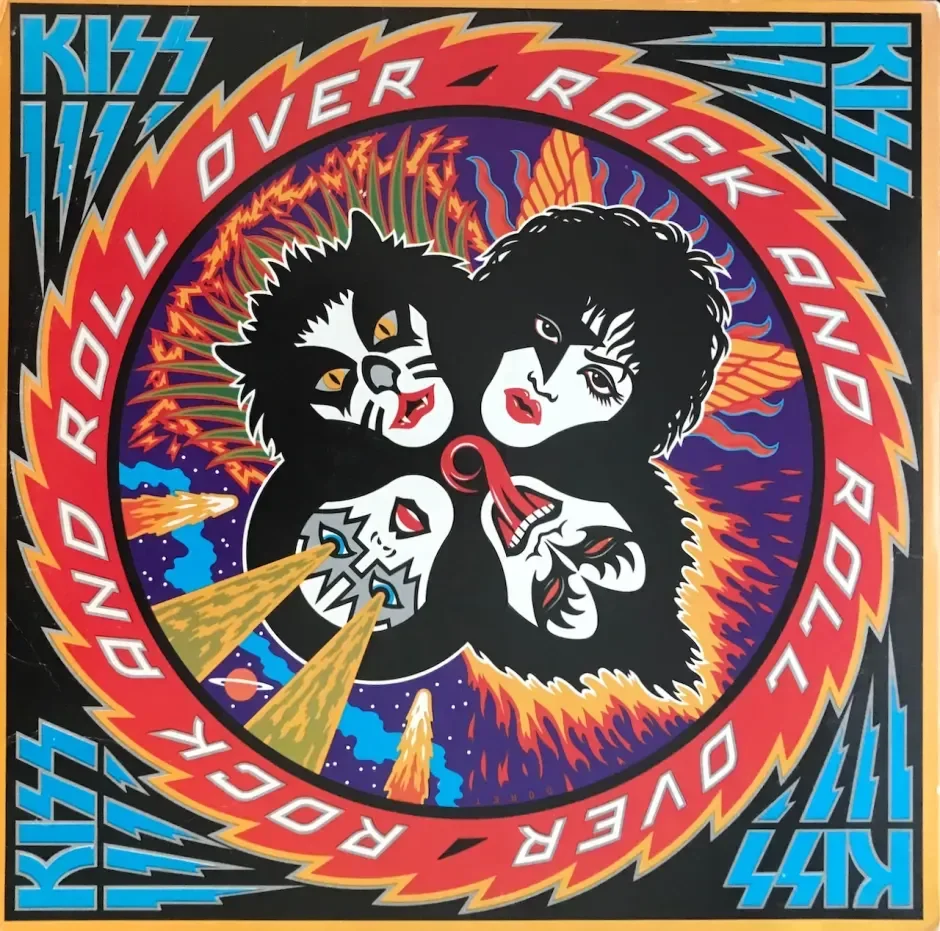
It was flat. That doesn’t sound like a compliment, but it is. There was no ruined city, no stage, no photograph and no attempt to make the four members be action heroes. Instead, their faces rotated around a perfect - and I mean Perfect - circular design: Gene, Paul, Peter and Ace transformed into flat symbols, locked together in red, yellow, blue and silver. The image had the symmetry of a seal, a badge, a patch, something you could actually draw if you were so inclined and the logic of something you might find painted on the side of a fairground ride shortly before it detached itself from the machinery and rolled down the hill.
Frankly, it looked complete.
The cover was designed by Michael Doret, although his name was not announced across the front. You would have thought they could spare one line of seven point text to give a brother a few props but album-cover artists rarely received that sort of treatment. Having said that, there’s barely anything on here beyond the bare essentials. It’s all geared up to be nothing but that wonderful circle that contains a whole world inside of it.
He knew very little about Kiss when he was given the job, so the band had to explain the four individual characters to him. Gene belonged to fire, Ace to outer space, Peter to the jungle and Paul to some celestial realm of stars, wings and women.
Without knowing this to be a fact, it is tempting for me to see the cover as the moment the ‘icon’ characters properly came into focus. The makeup already existed, as did the raw ingredients of each personality, but the Demon, Starchild, Catman and Spaceman had not yet been publicly nailed down in the way the world understands them now. The Marvel comic would do that the following year and Phantom of the Park would give them superpowers in 1978. Perhaps that distance helped? Instead of repeating the stage show or painting another heroic tableau, he reduced Kiss to their essential components: four faces and one logo in constant motion.
Regardless of all this, Doret later described it as a “mandala surrounded by a sawtooth blade” which is probably all anybody really needs to know. Nobody makes album covers like this anymore.
The cover is a large part of why Rock and Roll Over remains my favourite studio album by the original line-up. No long-standing Kiss fan of any worth will lay it all at the feet of the music. It’s wrong, but that’s the way it is in KissWorld.
Kiss (or maybe rather Neil Bogart at Casablanca) understood more than anybody that the experience began before the needle reached the vinyl. The logo mattered. The make-up mattered. The object in your hands mattered. You didn’t merely listen to a Kiss album. You entered into a life-long blood pact with it.
Anyway, I handed the album over when I got home, as promised and so began The Long Wait…
ROLLING BACK THE MACHINE
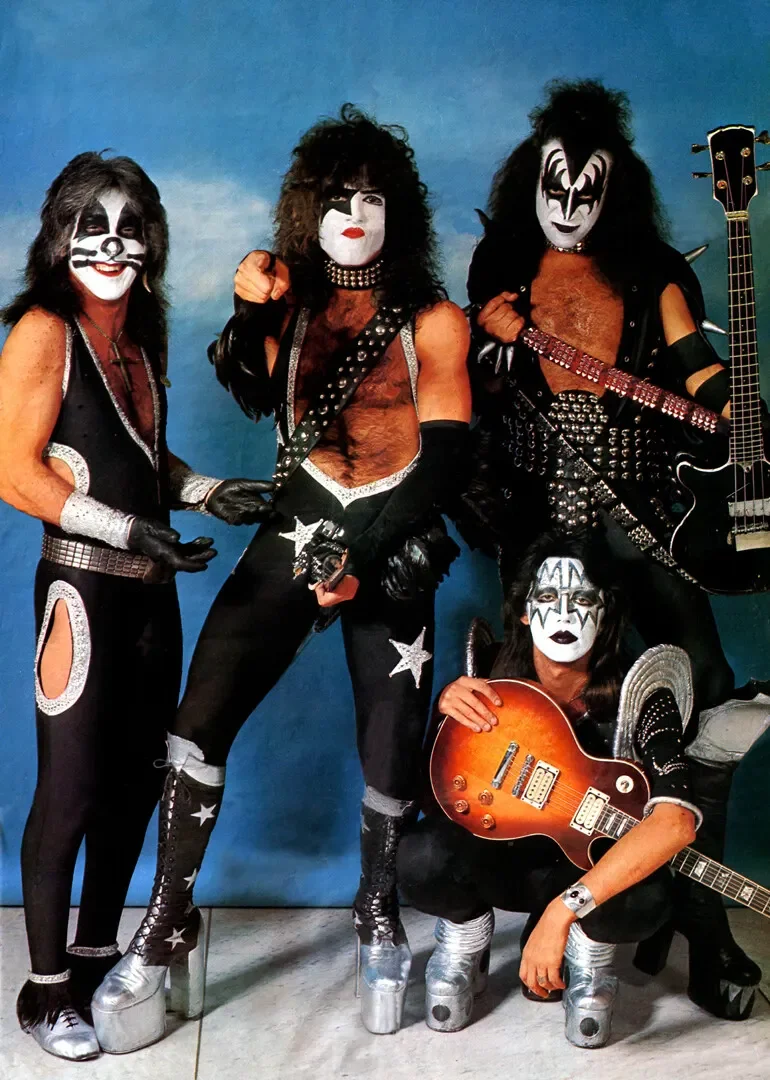
Rock and Roll Over was released on 11 November 1976, only eight months after Destroyer. Eight months! Some bands now spend longer than that announcing a box set.
Kiss had moved from imminent financial disaster to national obsession with barely enough time to notice the scenery changing. Alive! saved them. Destroyer turned the rescue into an empire, adding orchestras, choirs, sound effects, Bob Ezrin and enough cinematic ambition to make the first three records look as though they had been recorded in somebody’s garage because, spiritually at least, they had.
It was apparently a brilliant album (everybody too lazy to listen says so) and yet also my least favourite of the OG line-up studio albums because it was also not quite the way Kiss naturally breathed.
For this follow-up, they returned to Eddie Kramer, the man who had captured Alive!and understood that polishing Kiss until you could see your face in the mirror rather missed the point. The solution was to record in the Star Theatre, an empty venue in Nanuet, New York, and treat the studio album like a live performance without the inconvenient business of an audience throwing stuff at you.
They ran cables through the building. Peter played high above the others in a bathroom, linked by video camera, so the drums could acquire the natural echo of the space. The band played together and repaired mistakes afterwards. Kramer has always argued that this is the best way to record a group: get everybody playing, capture the performance, then fix whatever fell off. It’s also a good way to live your life but that’s another story…
The approach suited Kiss because the band was never supposed to sound as though it had been assembled with tweezers. Mutt Lange is not welcome in this building. Kiss needed movement - four people pushing the same object and occasionally disagreeing about the direction.
The guitars have room to breathe. Gene’s bass does not need permission to wander off and do its own thing. Peter’s drums sound like drums being hit by a man in a tiled room because that’s pretty much what happened. Ace’s guitar appears from whichever side is least supervised and Paul’s voice sits at the centre like a man who has already seen the stage design because he built it.
Ten songs. Thirty-three minutes. No orchestra. No choir of children asking whether anybody is lonely. No car crash. No concept beyond making Kiss sound like Kiss again.
Rock n Roll Over is indeed, a masterpiece. I’m going to take it apart because if there’s one thing I detest in rock n roll, it’s revisionist history:
I WANT YOU
The album begins by lying to you. I Want You opens with Paul’s twelve-string acoustic guitar and a voice that suggests we may be entering reflective territory. Perhaps Destroyer has changed them? Perhaps everybody has read a book and drinks Darjeeling in the evening.
Nah. Then the band kicks the door in.
It is one of the great Kiss openings because it contains the entire album’s argument inside its first few seconds: texture without fuss, drama without decoration and a sudden reminder that this is meant to be played loudly and annoy the shit out of the previous generation. The song moves through riffs and stops without ever losing the straight line running through it. Paul sings the title as though wanting something is sufficient proof of ownership. Truth be told, he sounds fucking fantastic.
It rises, drops back, pretends to finish and returns with the guitars making sounds that suggest the theatre’s wiring has become involved. The gentle opening returns at the end, but nobody believes it anymore.
TAKE ME
Take Me does not waste time with the acoustic deception. Written by Paul with Sean Delaney, it is Kiss operating in its most shameless register. The lyric contains the kind of sexual invitation that only works if delivered from a stage while wearing seven-inch heels and surrounded by explosions. Read quietly from a sheet of paper, it may constitute evidence. This is both its secret sauce and its downfall outside of the Kiss Kamp.
Paul does not sound like a man whispering into somebody’s ear. He sounds like the leader of a rally whose cause has not been fully explained. The backing vocals answer him, the guitars push everything forward and Peter gives the beat enough looseness to stop it becoming a march.
This is where Kiss’s alleged stupidity becomes extremely clever. The words are simple. The construction isn’t. Each gap, response and shift in weight is doing a job. A song can be direct without being basic, just as a man in make-up can sing about the rocket in his pocket without lacking professional discipline.
Sometimes, people analyse and think about rock n roll far too much because they have to find something to say in order to pay their rent. An easy target is an easy target but you know what, fuck those guys. Take Me is exactly what we all came for.
CALLING DR. LOVE
Gene Simmons saw the Three Stooges short Men in Black, heard its hospital announcement calling for three doctors and did what any responsible songwriter would do. He made himself one of them.
Calling Dr. Love is the Demon at his most efficient. The riff is blunt, the beat sits back and Gene hands over his medical qualifications with the confidence of a man who has never actually been asked to provide proof. His bedside manner would get a real doctor struck off before the second chorus - and probably did.
It’s also one of those Kiss songs that proves how much space matters. There is no frantic attempt to fill every second. The riff is simple, leaves a mark and gets out of the way for the story. Peter’s drums poodle along behind it. Ace throws in exactly the right amount of dirt. The backing vocals turn a private fantasy into one of the greatest backing vocal singalongs since Roxanne. Technically speaking, this came first but you know what I mean.
By 1976, the four characters seem to have established their departments of authority. Paul dealt in stars and seduction. Ace came from space (natch). Peter supplied street-corner humanity. Gene had blood, monsters, fire and a private healthcare practice.
By 1976, public opinion had also lined up with this theory and like they always promised, Kiss gave the people what they wanted. I’d love to know if this was a conversation that actually happened. I need to do a podcast episode with Gene one day…
LADIES ROOM
On the surface, Ladies Room is Gene converting a queue for the toilet into a romantic destination whilst apparently singing, “Meet, meet you in the ladies room.”
That’s not what I heard.
For far longer than I will ever admit, I thought he was singing, “I make speeches in the ladies room,” which honestly seems like an entirely reasonable thing for Gene Simmons to be doing. Where else would the Demon hold a press conference? The main room was probably too busy and the men’s toilets would already be full of guys applying Paul Stanley make-up in the mirror…
There was no internet waiting to correct all your sins back then. If an album didn’t include a lyric sheet - and Kiss albums generally had more pressing things to squeeze inside them - you listened, made your best guess and lived with the result. Eventually, the wrong words become the song and by the time somebody told you otherwise, it was too late. Your version had squatter’s rights.
I can see the video even as I write this: Gene delivering his keynote address from between the sinks while Paul checks his outfit, Peter runs the taps for atmosphere and Ace tries to work out how the hand dryer operates. Gene slams both hands onto the cubicle door, smoke pours from the cubicles and the sinks explode at the end of the chorus.
Picture it and kneel before me. ”I make speeches in the ladies room” is better. My version has production values.
This is not one of the album’s monuments. It’s better than that. The riff has an easy, rolling quality, less threatening than Calling Dr. Love but carrying the same belief that Gene’s presence will improve any woman’s evening whether she has requested assistance or not. The title is cookie-cutter Kiss: simply take something ordinary, add appetite and behave as if the transformation is doing the world a favour.
Songs like this on Rock and Roll Over do not feel like filler because the album has zero interest in changing scale. Ladies Room belongs beside the ‘better’ tracks. It contributes to the flow, the personality and the feeling of four people playing rather than pausing every few minutes to erect a landmark.
Not every song needs to be Stairway to Heaven. Sometimes a door with an easily identifiable gender sticker on it will do just fine.
BABY DRIVER
Peter Criss takes the wheel. I love it when Peter does his thing. Every band needs a break from singing about their dick.
Co-written with Stan Penridge and developed from material dating back to Peter’s pre-Kiss band Lips, Baby Driver is rougher around the edges than the Stanley and Simmons songs and that’s exactly why it matters.
Peter’s voice cannot help sounding lived in. Paul commands. Gene performs menace. Peter sounds as if he has already had the evening the others are promising and moved on long ago. His vocal gives the album grain - and dare I say - depth!
The song is not as elegant as I Want You or as inevitable as Calling Dr. Love, but Peter attacks it as though the title grants him a licence to unleash the voice inside him. The swagger of this song is pretty much perfect.
This is the original line-up functioning as advertised: not four identical musicians beneath matching make-up, but four different problems sharing a logo. Remove Peter’s personality and Kiss becomes more precise and somehow, less alive. Sad but true, Kiss fans.
Chemistry is chemistry no matter how you slice it.
The barbecue of side one ends here. Five songs, no wasted motion and not a burnt sausage among them.
LOVE ‘EM AND LEAVE ‘EM
Side two returns to Gene, who has reduced the entire romantic process to a collection-and-disposal service. This song is shit. As a fan, you have to point these things out sometimes.
It’s not subtle, kind or especially interested in what happens after breakfast. It is, however, built around a groove that works for the most part with Gene’s bass moving underneath the guitars with more agility than the Demon usually gets any credit for.
The song began life in an earlier form called Rock and Rolls-Royce (which was probably also shit), because even Gene’s discarded titles arrive wearing jewellery. By the time it reached the album, the machinery had been stripped back and the central proposition clarified.
I could live without this being on the album at all. Looks to me like they were trying to be fair about the split of writing credits more than anything. They should have resurrected the song It’s Not Smoke and kept powering on.
MR. SPEED
… and maybe the reason they didn’t is because it sounds remarkably similar to this one.
Every Kiss fan has at least one song they believe the rest of civilisation has criminally neglected and Mr. Speed has an entire support group.
Written by Paul and Sean Delaney, it is three and a half minutes of filthy confidence. The riff doesn’t need to shout. It simply rolls. Paul sings from the point of view of a man proud of the speed with which he can pick up women (natch, again), a skill that sounds less impressive the longer adulthood is allowed to inspect it but there’s that revisionist thing again. Let’s not do that because Mr Speed is interstellar. It is Paul being efficient in the extreme.
What makes the track so loved is not the lyrical boast but the ease. It asks nothing hard of you. Kiss are not trying to write another anthem - they’re playing a song that fits the four of them. Ace decorates it without taking it hostage. Gene and Peter sit inside the groove. Paul sounds as though the vocal requires no effort at all. Maybe it doesn’t.
The anniversary campaign has sensibly chosen Eddie Kramer’s 2026 mix of Mr. Speedfor a seven-inch single. Fifty years later, the neglected song has finally received a promotion.
Fast worker.
(At which point, an unanswered question in my Kiss memory banks is why, with songs like this kicking around, did they choose to make side four of Alive II, studio tracks. I mean, I dig those songs but there was no need for them to turn up at at the end of Alive II. They could have kept them kicking around and the next album would have been off to a great start.)
SEE YOU IN YOUR DREAMS
See You in Your Dreams is possibly the closest Rock and Roll Over comes to a lesser track, which is another way of saying the album is annoyingly consistent.
Gene would later record it again for his 1978 solo album, apparently either because he was unconvinced that Kiss had found the final version or because he’s lazy. The remake added polish and guests, but the original at least has the advantage of sounding like it belongs here. It is lean, slightly awkward and held together by the band sticking tape on things rather than the idea of Gene Simmons as an independent entertainment industry.
The chorus is catchy without becoming permanent. Ace’s guitar gives it some life while Peter pushes it harder than the song strictly requires. It’s the sort of track that reveals its usefulness when heard in sequence and loses some of its reason for existing when isolated.
Albums used to be full of such creatures, they really did. Should have handed the vocal to Peter on this one. It would at least have given it some grit.
HARD LUCK WOMAN
Paul Stanley wrote Hard Luck Woman with Rod Stewart in mind and you can hear why. The acoustic guitars, folk-rock movement and narrative shape all belong near Maggie May and You Wear It Well. Paul thought he might offer it to Rod, but with Beth becoming an unexpected hit and Kiss suddenly requiring another song sung by Peter that radio stations could play without frightening the neighbours, so it goes.
Paul could have sung Hard Luck Woman beautifully - maybe he did at some point but Peter makes it sound true. His rasp carries regret without needing to perform it. He sounds like somebody leaving because staying has become worse, not like a rock star demonstrating sensitivity between flash-bombs going off.
The song might have been an attempt to follow Beth, but it is not Beth II. It is better integrated than that. The acoustic instruments feel physical. Ace’s guitar belongs to the arrangement rather than arriving to remind everybody which group this is. Peter as always, remains recognisably Peter.
It also proves that stripping back after Destroyer didn’t mean abandoning ambition or texture. Rock and Roll Over is not ten versions of Deuce. The empty theatre gave the band room to be quiet as well as loud.
The song even escaped the album and lived a separate life, later returning through Garth Brooks, country radio and enough cover versions to demonstrate that a great Kiss song remains a great song after you remove the Kiss.
…and not every band survives that test.
MAKIN’ LOVE
The album ends as though somebody has noticed the venue is booked for another event and increased the voltage.
Makin’ Love is Paul Stanley at full operating temperature. The riff is urgent, Peter drives it forward and the lyric leaves no ambiguity about the evening’s intended destination. After the warmth of Hard Luck Woman, Kiss immediately puts the furniture back against the wall.
It’s exactly the right ending because Rock and Roll Over does not require resolution. There is no story to complete, no ruined city to revisit and no child asking whether the Demon is lonely. The album’s job is to sound like the band playing - so they play until they hit a brick wall.
Then you turn it back over and the circle they promised begins again.
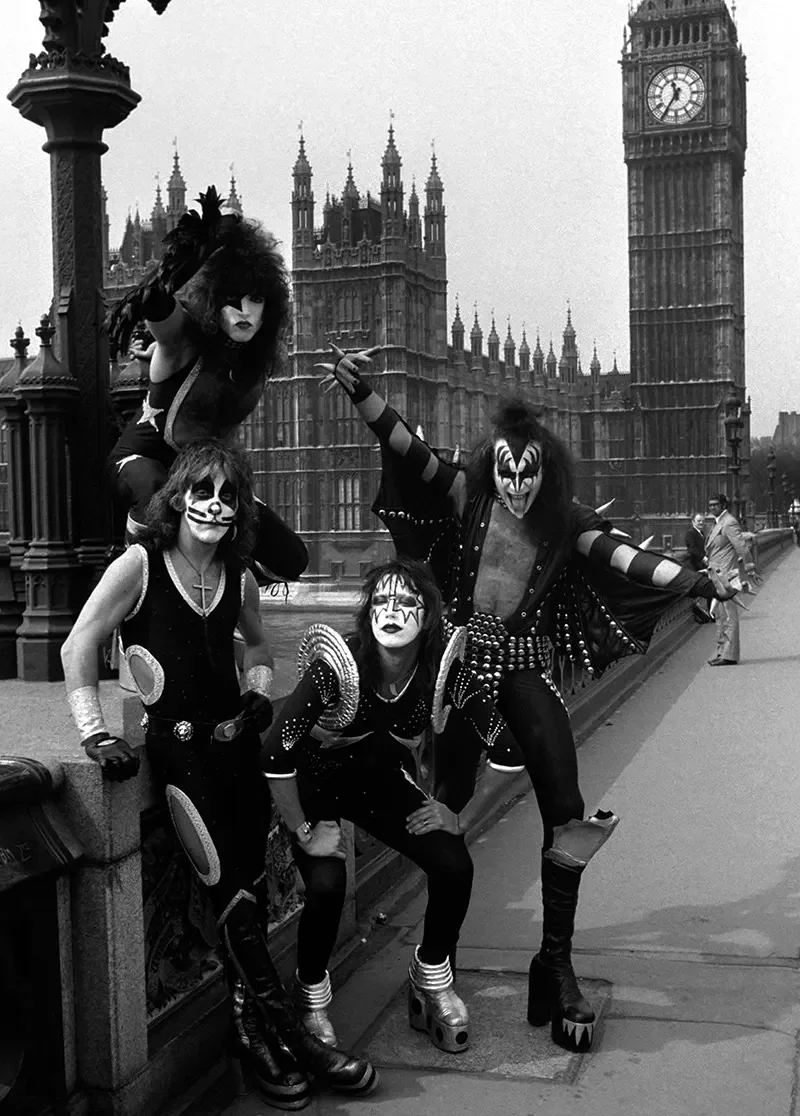
The infamous London photo shoot. May 1976.
HALF A CENTURY AGO? REALLY?
The new 50th-anniversary edition is built around an irresistible proposition: Eddie Kramer has returned to the original analogue multitrack tapes and created a completely new 2026 mix of the album he recorded half a century ago.
That is more interesting than another remaster with the volume moved slightly to the right, which is how most of them go - though I say this without actually hearing it first because I trust him.
There is also enough surrounding material to fill your garage: 22 unreleased demos, alternate mixes and outtakes; nine Gene Simmons demos (hmmm); the unfinished instrumental Queen For A Day; selections newly mixed from all four 1977 Budokan shows (yay); a 104-page book (double yay); Dolby Atmos and 5.1 mixes (my ears don’t work well enough to be excited by that and it’s all their fault); and sufficient collectible material to ensure that Kiss remain committed to the ancient principle that affection should occupy shelf space.
I’m looking forward to hearing the new mix, but part of me is a little wary because Rock and Roll Over does not need improving. I mean, Stephen King is probably a better writer now than he was in the seventies but I don’t need him to rewrite Carrie to prove it. Its sound is part of the memory: the physical drums, the space around the guitars and the grubby sense that everything is happening at once in some kind of emergency is why I love it.
Clean it too thoroughly and you risk removing the fingerprints.
Kramer, at least, understands what made it work because he put the fingerprints there. A good new mix will not make the album modern. It will let us stand somewhere else in the theatre. Not that I want to but perhaps we will hear Peter’s bathroom differently.
There’s a sentence nobody expected to read today.
The anniversary also gives the cover another turn. Doret’s design has been recoloured in gold, red and black for some editions, animated on a zoetrope disc for another and pressed onto enough formats to keep collectors awake making financial decisions and I hate them all because it messes with what I saw on my bus ride.
The original has no depth because it does not need any. It does not show Kiss performing, posing or conquering. It takes the four faces and turns them into a lethal machine that continues moving when the record stops and that’s what the album does too.
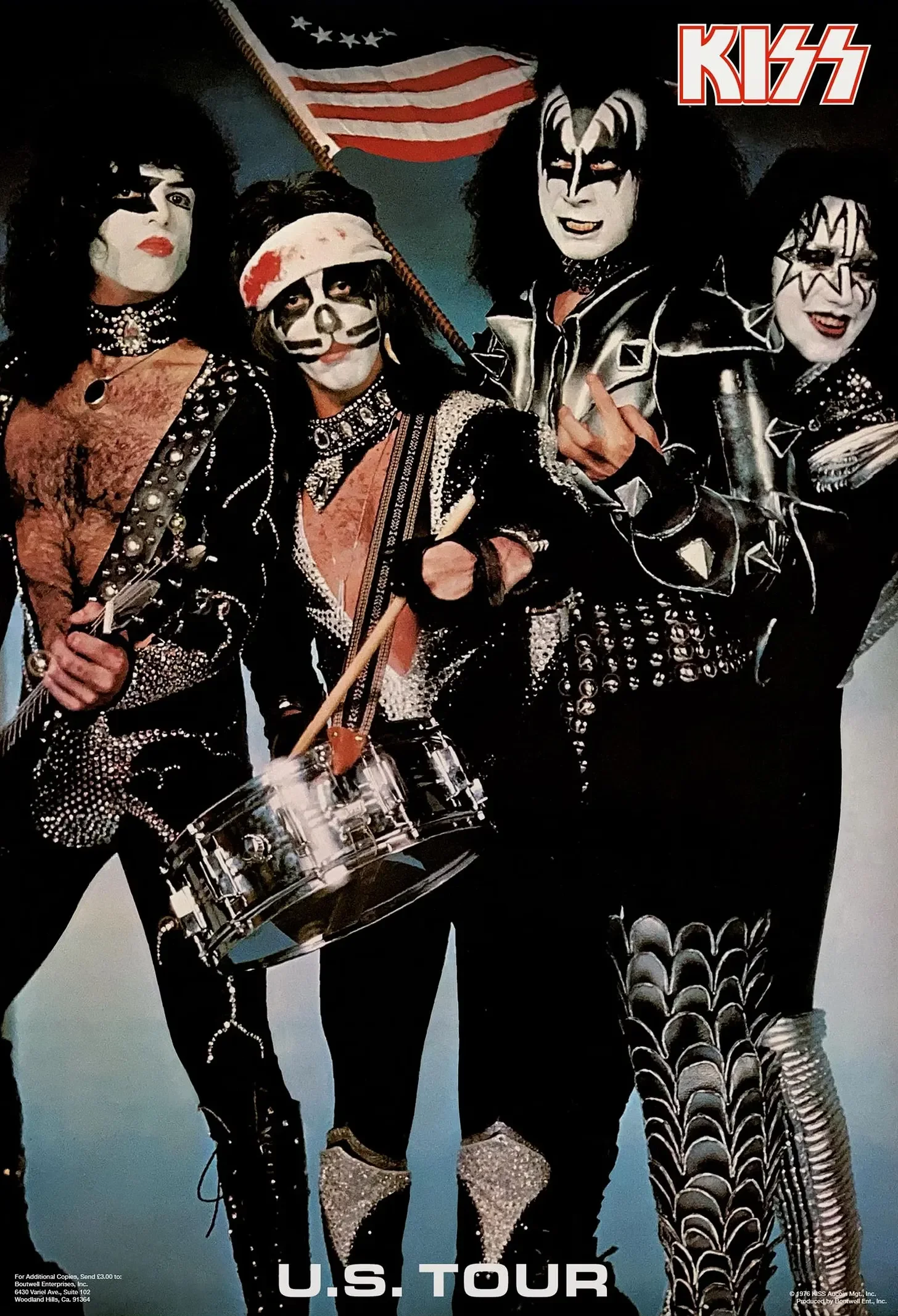
…featuring Peter and his oddly bandaged head. The pose parodies Archibald Willard’s famous patriotic painting The Spirit of ’76, showing Revolutionary musicians marching through battle beneath an American flag. In the original painting, the fife player has a bloodied bandage around his head; Peter has inherited that detail while carrying the marching drum. The other members didn't seem to get this memo….
NO CORRECT WAY UP
I can make a case for Destroyer as the grand Kiss album if I have to. I can also explain why the first record contains the blueprint, why Hotter Than Hell has the filth, why Alive! is the document that made everything possible and why Love Gun catches the original four at the precise moment victory starts developing a bit of a crack in the wall, but Rock and Roll Over is my favourite.
Favourite is not a court judgment. It is not assembled from production values, cultural importance and a weighted average of the songs. Favourite is the record you carried home on a bus and studied because you were not yet allowed to play it.
It is anticipation preserved in a very, very cool cardboard sleeve.
By Christmas morning in 1980, Kiss had already moved on. The world had moved on. Peter was leaving, the sound was changing and the four faces turning around that sleeve no longer represented a stable fact.
None of that mattered to me in the slightest. I was even largely unaware (or unwilling to see) that anything untoward was going on at all. Wrexham is a long way from New York, and when the needle finally dropped into I Want You, the album was new to me and that’s all that mattered… and should still be all that ever matters.
That distinction has almost disappeared. Now everything is available at the drop of a hat, very little has time to become an object of desire. We can hear an album the second curiosity occurs and abandon it before the bus reaches the next stop, but I had weeks to imagine what Rock and Roll Over sounded like and the miracle of Christmas is that it sounded better.
Fifty years after Kiss made it, and forty-six years after I sat guarding it on the journey home, I can still look at Doret’s cover and feel some part of that delay. The four faces turn. The title goes around and around. There is no top or bottom, no beginning or end and no indication that any of them are getting off.
There is only Rock n Roll. Over and over and over.
As for the box set? Take my money. As always, take my money. I’ll only spend it on something dumb like food or petrol.

AEW and the Rule Book
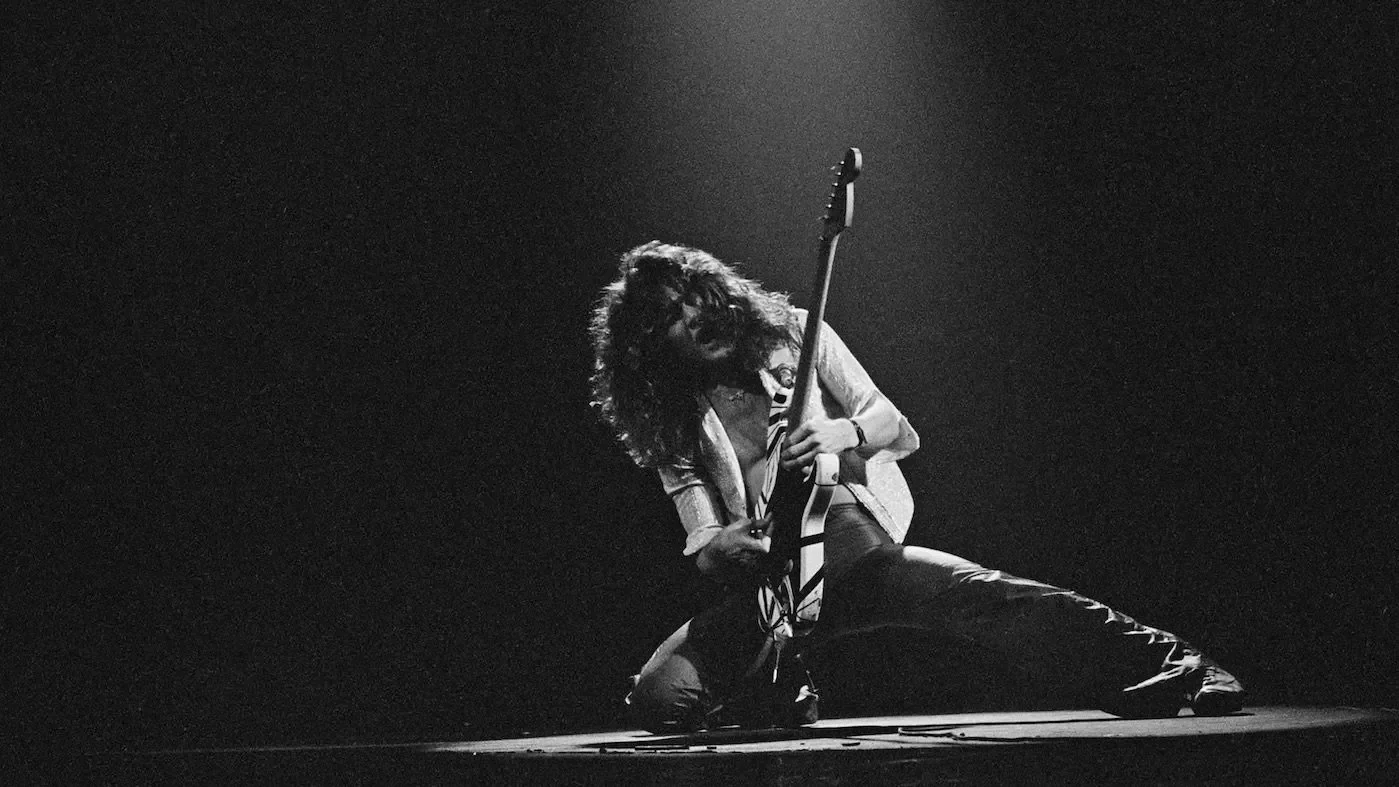
In 1978, Black Sabbath made what must have seemed like a perfectly sensible decision. They took Van Halen on tour.
Sabbath were Black Sabbath. They had already effectively invented a sizeable proportion of heavy metal and were established enough that nobody needed convincing they belonged at the top of the bill.
Van Halen had made one album and were the support band. The problem was that nobody had explained this to Van Halen.
Every night they came out like four men escaping a burning building. Eddie Van Halen was doing things with a guitar that appeared to involve technology not yet available to the general public, and David Lee Roth behaved as though trousers were an unnecessary concession to civilisation. They jumped, kicked, screamed and played as if management had told them they had 45 minutes to become the biggest band in the world or they would be working in Starbucks by Thursday.

In 1978, Black Sabbath made what must have seemed like a perfectly sensible decision. They took Van Halen on tour.
Sabbath were Black Sabbath. They had already effectively invented a sizeable proportion of heavy metal and were established enough that nobody needed convincing they belonged at the top of the bill.
Van Halen had made one album and were the support band. The problem was that nobody had explained this to Van Halen.
Every night they came out like four men escaping a burning building. Eddie Van Halen was doing things with a guitar that appeared to involve technology not yet available to the general public, and David Lee Roth behaved as though trousers were an unnecessary concession to civilisation. They jumped, kicked, screamed and played as if management had told them they had 45 minutes to become the biggest band in the world or they would be working in Starbucks by Thursday.
Tony Iommi later remembered the problem: “We didn’t know where we were going — and Van Halen were really going somewhere. They were jumping all over the stage, and we were like old farts in comparison.”
Van Halen weren’t doing anything wrong. It wasn’t a competition, but it’s a story as old as the hills.
Watching AEW All In London this week, my head came up with this analogy because WWE have turned into Black Sabbath and AEW, increasingly, is Van Halen.
This isn’t an argument about which company makes more money. It isn’t an argument about which company is more famous, nor a fistfight about which company has the bigger stars. The answer to all those questions is WWE. It’s not even about the talent pool.
See, professional wrestling has the wonderful property of making all of that irrelevant the moment somebody rings a bell, and at All In London, AEW came out like the support band with something to prove — again, which is the important word.
Because having recently watched AEW Grand Slam Mexico, I came away thinking I’d seen wrestling better than anything WWE had produced at its major events this year. I wrote about it right here and wondered whether I’d simply caught AEW on one of those nights when everything happened to work, because that happens too.
But All In answered that question.
No.
SOME THOUGHT APPEARS TO HAVE GONE INTO THIS
This shouldn’t be noteworthy. It really shouldn’t, but one of the things that stuck out during All In was that somebody appeared to have sat down beforehand and thought: what would make this particular wrestling match interesting?
Not what does an AEW match look like, how many finishers do we need — and certainly not where does the commercial break go?
But what can these people in the ring do together that somebody else couldn’t?
That’s a very different question. And you could see the answer changing throughout the card. There was variety again — different styles, different speeds, different kinds of storytelling. People weren’t simply performing variations on the same match while wearing different trousers.
Professional wrestling shouldn’t have a house font. I said that after Grand Slam Mexico and I’m increasingly convinced it’s one of the reasons AEW’s big events are working for me. If there’s a downside, it’s that AEW is rather like a rock n roll band that refuses to use backing tapes to keep everything in line. One night it can be on fire and the next it can fall off a cliff.
Frankly, that’s exactly how I like my rock n roll — nobody handed Van Halen a click track either.
Whether you know it or not, we’ve become accustomed to entertainment being streamlined to the nth degree of perfection. Everything is tested, branded, packaged and delivered according to a format that somebody somewhere has established works for the most number of people and the accountants.
WWE may be the ultimate expression of that in professional wrestling, because nothing looks better, nothing is slicker — almost nothing is allowed to go genuinely wrong, and yet in doing so, things seem to go wrong a lot in WWE. Conversely, AEW still occasionally looks as though it might drive the car through the wall. Let’s dig around a little in what made All In worth a damn.
HOW ARE COPELAND AND CHRISTIAN STILL DOING THIS?
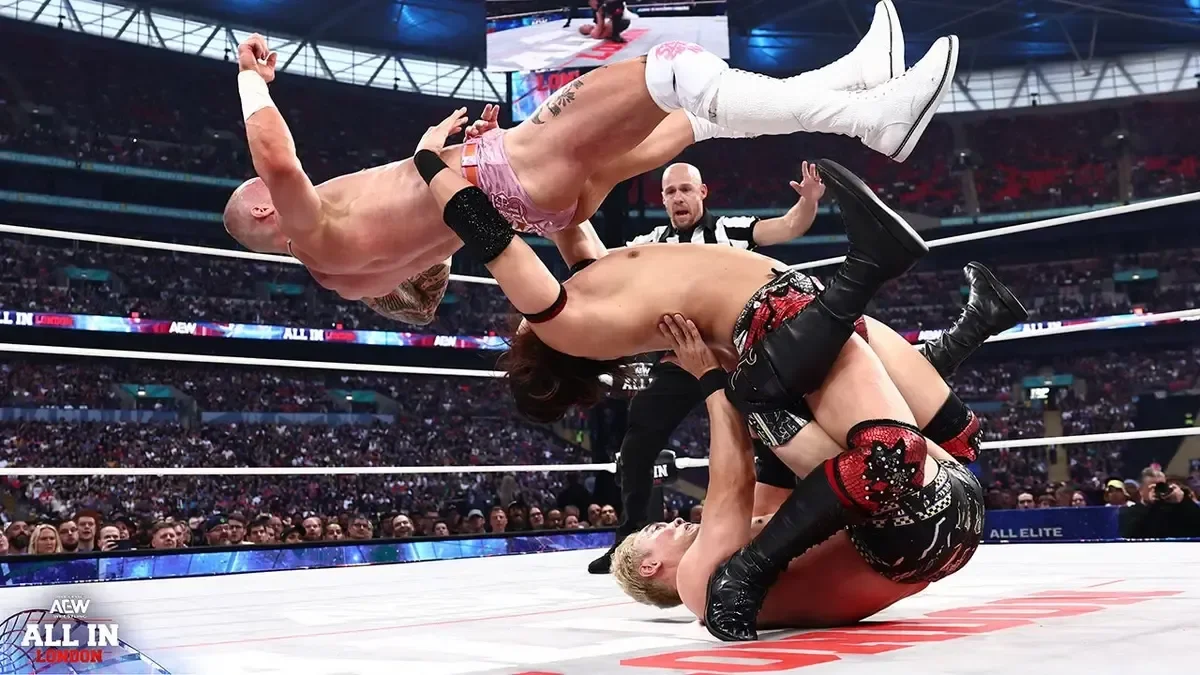
Adam Copeland and Christian Cage against the Young Bucks shouldn’t work. Copeland is 52. Christian is 51. That’s not an insult, it’s the interesting part.
Between them they have been wrestling professionally for something approaching sixty years. The Young Bucks have spent their careers helping accelerate professional wrestling into the frantic, hyper-athletic form we now recognise. So you can’t pretend they’re the same.
Put the generations in the ring and let the difference become the match — that’s what happens. The Bucks are quicker but Copeland and Christian know things. That is wrestling. Not everybody needs to be capable of doing the same things. In fact, wrestling becomes considerably less interesting when they are.
Christian Cage may be one of the greatest examples currently working of a wrestler who understands that knowing when to do something is more valuable than knowing how to do everything.
Somehow, in 2026, Copeland and Christian aren’t appearing at Wembley as two legends wheeled out to receive applause for things they did twenty-five years ago — they’re relevant as relevant can be.
Wrestling has historically been terrible at this. Eventually the legend comes back, does the entrance, hits the familiar moves and everybody applauds because they remember when it mattered. I watched Serena Williams at Wimbledon and it left a bad taste. This was not that.
Copeland and Christian mattered today. The past was useful because it gave the match history, but nostalgia wasn’t required to make the wrestling work. That’s another thing AEW seems increasingly good at when it’s on form: understanding that a wrestler’s history is something to use rather than something to recreate.

THREE DIFFERENT ROADS THROUGH JAPAN
Then there was Kazuchika Okada, Konosuke Takeshita and Kyle Fletcher — the match that, for my money, was the first of the night’s three main events, even though nobody billed it that way.
On paper, you could simply describe this as three of the best wrestlers in the world being given fourteen minutes at Wembley and leave it there, but that misses almost everything that made it interesting. All three have been shaped by Japanese wrestling, but in completely different ways.
Kazuchika Okada is practically modern New Japan history. He was the face of NJPW, multiple-time IWGP champion and one of the wrestlers responsible for introducing a generation of Western fans to just how extraordinary contemporary Japanese wrestling could be.
Konosuke Takeshita isn’t a New Japan creation at all. He came through DDT — another Japanese wrestling tradition entirely — before joining AEW and subsequently marching into NJPW, competing in the G1 and winning the World Television Championship.
Kyle Fletcher is Australian, but Japan was one of the places he learned his trade before becoming an AEW contender. It all counts.
So what happens when you put those three different wrestling educations into the same ring? Apparently, they start stealing each other’s homework.
Takeshita hits Okada with his own Rainmaker. Fletcher steals Takeshita’s Raging Fire. Everybody knows everybody else’s answers, and crucially, the moves aren’t simply there because they look spectacular — they’re saying something about the people using them.
Better still, there’s an actual story underneath all of it.
Fletcher and Okada are supposed to be on the same side. Don Callis doesn’t particularly care which of them leaves with the International Championship because either way the belt remains in his family. This lasts approximately as long as you’d expect when one of the men involved is Kazuchika Okada. Fletcher does the damage to Takeshita and leaves him on the floor. Okada could take advantage of that and pin Takeshita — the Don Callis Family wins. Everybody goes home reasonably happy.
Except Okada hits Fletcher with the Rainmaker and pins the champion instead. Just to make sure everybody understands exactly what has happened, Fletcher has to hand Okada the belt and raise his arm.
Nobody needed to spend twenty minutes in the ring beforehand explaining their motivation. Nobody needed to point at a giant photograph of the championship. The characters made decisions while wrestling and those decisions told us who they were. Somebody really had thought about this match.
I’ve spent years watching American wrestling companies acquire extraordinary Japanese wrestlers and then have no idea what to do with them.
WWE is particularly frustrating in this regard because it has repeatedly proved that it knows exactly how good these people are. Asuka has been a world champion. IYO SKY has been a world champion. Shinsuke Nakamura won the Royal Rumble. Kairi Sane won the Mae Young Classic and became NXT Women’s Champion. Giulia arrived with enough reputation that WWE immediately presented her as somebody who mattered.
So what’s the problem?
I think it’s that WWE still has a tendency to regard success in WWE as the final stage of the wrestler’s development. You arrive from Japan and eventually you become a WWE Superstar. But AEW seems more willing to ask a different question: what was so fucking good about you in the first place?
That’s why watching Okada and Takeshita at Wembley feels important. AEW didn’t need Kazuchika Okada to become an American wrestler. It needed Kazuchika Okada. It didn’t need Konosuke Takeshita to become one either, and neither man looked remotely out of place in a match that could easily have headlined the entire event.
That’s the crime when talent like this gets buried halfway down somebody else’s card. Championships are props — I’m talking about position. Okada can easily headline a pay-per-view and so can Takeshita. IYO SKY, Asuka, Kairi Sane can headline a pay-per-view. Nakamura could have headlined pay-per-views for years. In fact, Nakamura won the bloody Royal Rumble in 2018 by eliminating Roman Reigns and went on to challenge AJ Styles for the WWE Championship at WrestleMania, so WWE knew this as well — and then, somehow, forgot.
We’ve somehow reached an era in which some of the most accomplished professional wrestlers on Earth can be treated as though they’re missing an ingredient because they don’t fit neatly into the established American television template. But maybe the template is missing the ingredient.
Because when Okada, Takeshita and Fletcher walked into Wembley, AEW didn’t spend twenty minutes explaining Japanese style wrestling to me. It just put three brilliant professional wrestlers in a ring and assumed we’d keep up.
Which we did.
This isn’t 1985. Wrestling fans aren’t restricted to whatever happens to be broadcast in their local television market. We’ve watched NJPW, Stardom, CMLL and AAA. We’ve watched wrestling from Britain, Japan, Mexico, America and everywhere else we can find it, because that’s what we do. If something isn’t officially available, wrestling fans have historically demonstrated a remarkable ability to find it anyway, and the audience has become internationally literate. So stop worrying that we won’t understand, and trust us.
A LITTLE BIT OF BLOOD
And while we’re trusting wrestling fans, can we talk about blood, because professional wrestling has developed a slightly peculiar relationship with it.
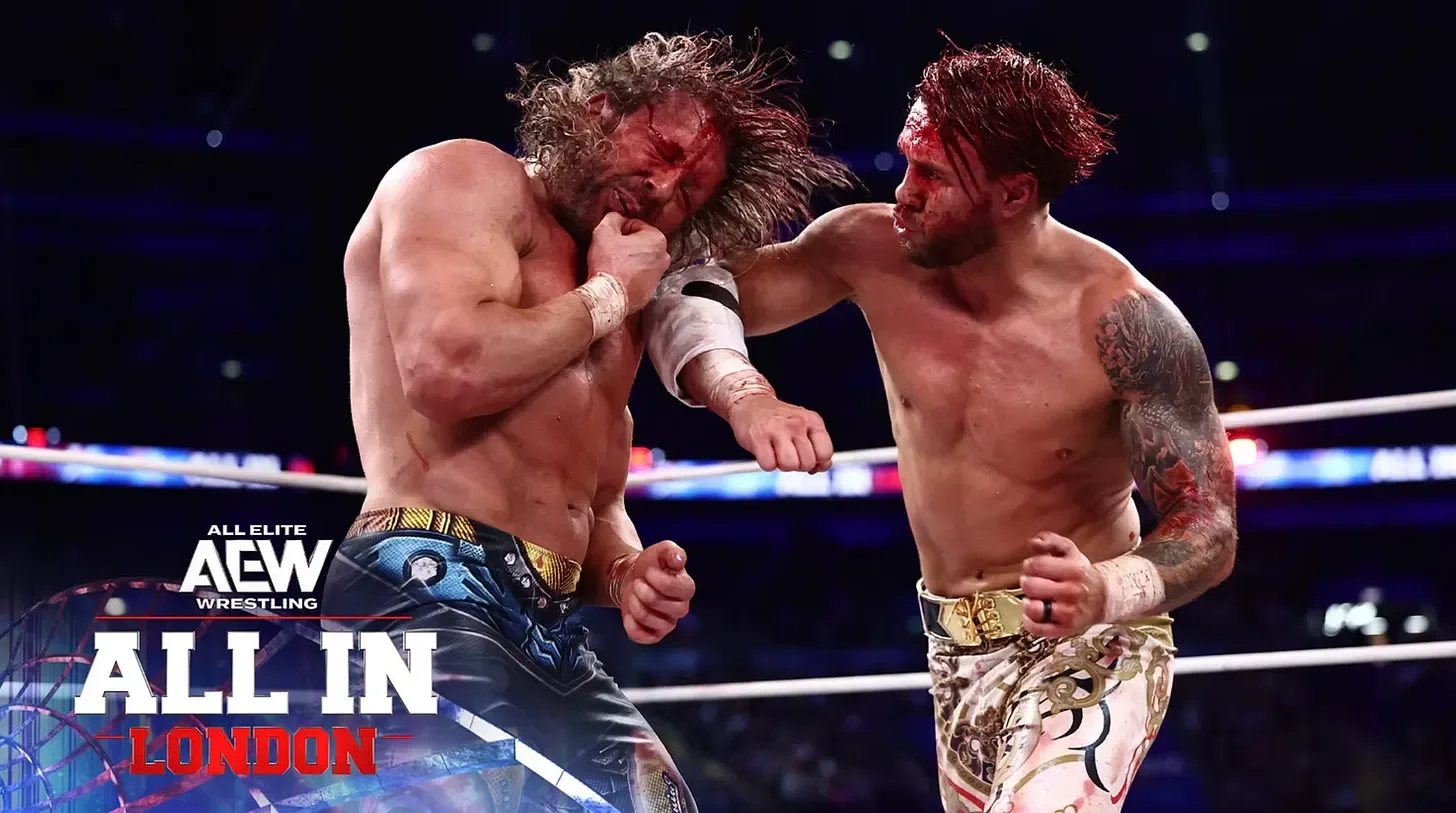
There have been eras when everybody bled constantly and it stopped meaning anything. There have been other eras when companies became so terrified of blood that somebody could be thrown through a plate-glass window and emerge looking as though they’d just returned from Waitrose. Neither works, but All In got it about right. Blood should mean something. It should tell you that something has changed.
There is a reason certain photographs become permanently embedded in wrestling history. Steve Austin at WrestleMania 13 is the obvious example. His face covered in blood while trapped in Bret Hart’s Sharpshooter is probably more famous than almost anything else that happened in the match. The photograph made him look immortal, and that’s what blood can do in wrestling when you don’t squander it.
Darby Allin understands this perhaps better than almost anybody currently wrestling, because everything about Darby already looks as though it might end badly. Add blood and suddenly the still photographs don’t look like publicity pictures but more like evidence, and that’s historically valuable because wrestling exists after the event in photographs more than we sometimes realise. A wrestler bleeding at exactly the right moment can look like a legend before the match has even finished.
Use it rarely, use it properly, and let the photographer do the rest.
TWO MORE MAIN EVENTS
Then All In did something else I loved — it finished twice, on top of the Okada match earlier in the card. Willow Nightingale and Mercedes Moné, then Kenny Omega and Will Ospreay. Those aren’t a semi-main event followed by the match we’re all actually waiting for. Between the three of them, this was a card with three main events in it.

Mercedes Moné is already a star. Willow has become one — what a contender for match of the year. They could have finished the show with that and nobody would have gone home disappointed. But no, the game is raised to follow that with Kenny Omega and Will Ospreay.
There’s a danger when you construct a card like this that the audience simply runs out of energy. They’ve seen too much, cheered too much and already had their climax. Now you want them to do it again.
That’s where Ospreay and Omega come in. There isn’t much I can say about Will Ospreay that watching him wrestle won’t explain considerably better. He may be the best professional wrestler in the world and is certainly one of the best I’ve ever seen, and after fifty years of tuning in, that’s not something I say because somebody did an impressive flip. Ospreay understands spectacle, certainly, but he also understands why the spectacle matters.
Then again, Kenny Omega is Kenny Omega and the other best professional wrestler in the world.
So you’ve got an audience at Wembley that has already watched a huge wrestling event and already been given something that could legitimately have closed the show. Now go out there and make them care again. That’s the job.
THE SUPPORT BAND PROBLEM
And this is where I come back to Van Halen.
WWE isn’t bad. Far from it. I’ve watched WWE for most of my life and I want WWE to be magnificent because it has extraordinary wrestlers and unbelievable resources. It also has global reach AEW can currently only dream about. Its production can make somebody walking towards a wrestling ring feel like the second coming, but perhaps that’s also the danger.
WWE knows the rules of engagement because they built the damn things. It knows how long the entrance lasts. It knows where the camera goes. It knows when the promo happens. It knows where the story beat belongs. It knows how you make a WWE Superstar. It knows what WrestleMania looks like — it knows what success looks like because it has spent decades defining it.
AEW sometimes doesn’t appear to know any of those things, and sometimes that’s a disaster. But occasionally it means somebody says: what if we put these three together? What if we let Okada be Okada? What if we give the women enough time to make this feel like a main event? What if we put another main event immediately afterwards? What if the fifty-something legends wrestle the Young Bucks and we don’t pretend they’re young? What if we just let them wrestle?
That’s Van Halen opening for Black Sabbath. The headliner knows how to headline. The support band only knows that this might be its chance. Hunger is very difficult to manufacture.
IT WASN’T A FLUKE
So: AEW: Grand Slam Mexico surprised me and AEW: All In London convinced me.
AEW’s major events are currently giving me something WWE increasingly struggles to provide. The feeling that I genuinely don’t know what the next match is going to feel like. Not who is going to win, but what is this going to be. That’s exciting, because pro wrestling is supposed to be exciting. It seems almost insulting to have to write that down.
I don’t need everything to be perfect and I don’t particularly want everything to be perfect. I want somebody occasionally to try something that might not work, and I want wrestlers from different traditions to collide hard. I want a fifty-two-year-old wrestler to use the fact that he’s fifty-two rather than pretending he isn’t. I want a Japanese wrestler to be Japanese and a Mexican wrestler to speak Spanish. I want women to headline and I want blood when blood makes the match better. I want somebody backstage to look at three wrestlers who don’t appear to fit together and think: fuck it, let’s see.
The irony is that none of this is particularly revolutionary. It’s professional wrestling. And perhaps that’s what WWE could learn from AEW right now — not how to be AEW. God forbid. WWE should be WWE, but perhaps it could occasionally stop being quite so good at being WWE long enough to remember that the enormous machine exists to facilitate something beautifully simple.
••••
Two more shows this week put that theory back to the test: Triplemanía XXXIV that I will watch after posting this, and WWE’s Penta-vs-Roman-Reigns title match in Mexico City tomorrow. If somebody hands Penta the belt, I’ll believe WWE’s actually been paying attention to my rules of engagement:
Here are some wrestlers.
Ring the fucking bell.
Footnote: It took me ages to find All In - it’s on ITVX (free) but you have to search for ‘wrestling’ as opposed to ‘AEW’ - which is the dumbest thing in the world. If anybody is reading at ITV… please fix it.
Fifty Years On, Wrestling Surprised Me Again
I’ve been watching professional wrestling for fifty years. Maybe longer but it’s a good ballpark. I’ve defended it during every single year because if I don’t, then who will…
This is important to establish before I start because I’m not somebody who has recently discovered that wrestling exists outside of WWE. I’ve watched wrestling change shape more times than I care to remember. I have seen it presented as sport, carnival, soap opera, cartoon, rock concert and something approaching performance art. I have watched dedicated TV shows and magazines come and go, Hulkamania arrive and die, ECW tear up the rulebook, WCW briefly conquer the world, the Monday Night Wars, the Attitude Era, the rise and export of NJPW wrestlers from Japan and the strange experiment that was Lucha Underground which handed us the best wrestling ever seen on the face of the planet.
When you put your mind to it, you can always find a way to watch things you’ve logistically been excluded from.
Bottom line: I’ve seen enough wrestling that very little surprises me any more.
For the last couple of years, because life is busy, I’ve followed WWE pretty loyally. Not exclusively, but enough that Raw and SmackDown have become my default idea of what weekly wrestling television looks like. Netflix made WWE ridiculously easy to follow in the UK, and I guess that was rather the point of its $5.2 billion deal. With at least two substantial shows a week, it works on a global scale and it’s been great…
Until this last week when I watched AEW Grand Slam Mexico (which for UK viewers at least, is amazingly free on ITVX - along with AEW’s own two shows a week programming. Hell, for a few quid, you can even kill the very few adverts pushed at you).
Somewhere during those few hours in Arena México I had an uncomfortable feeling - this is way better than a WWE Pay-Per-View.

On all levels: better. Better wrestling, certainly, but, more surprisingly, I thought much of the storytelling was better too.
That second part is crucial because one of the accepted criticisms of AEW has always been that WWE tells stories while AEW puts on matches. WWE gives you characters, motivations and carefully constructed narratives while AEW occasionally appears to throw two excellent wrestlers into a ring and tell them to have the best match humanly possible.
There might be some truth in that criticism, but I’m not 100% there’s nearly as much truth in it now…
THE CATHEDRAL
Grand Slam Mexico took place in Arena México - whose full capacity is 16,000.

Arena México running at full tilt
There are wrestling venues and then there are wrestling buildings. Arena México is most definitely the latter.
The home of CMLL (Consejo Mundial de Lucha Libre, which translates roughly as World Wrestling Council) is known as the Cathedral of Lucha Libre and, watching Grand Slam Mexico, you will understand why. The place is absolutely rammed to the roof. Not television-full, with carefully positioned cameras and black curtains hiding empty sections, but properly, gloriously full and more importantly, it felt full.
Even the ring is different. The commentators pointed out that Arena México’s ring is considerably less forgiving than the one AEW’s wrestlers usually work in. This wasn’t simply AEW television with Mexico City written on the screen. They were wrestling on somebody else’s turf in almost every sense - if you’ve watched any Lucha at all, you’ll have figured out already that the mat has much less bounce to it. When you hit the floor… you really do hit the floor.
The steep banks of spectators rise around the ring until the wrestlers appear to be performing at the bottom of a human crater. The audience isn’t somewhere in the background. It surrounds everything and that changes wrestling.
A wrestling crowd is not the same thing as an audience at the theatre. It is part of the performance. It decides who matters. It can rescue something that isn’t working and occasionally destroy something that is. A great wrestling crowd can turn a good match into something memorable simply by believing in it.
On this night, the Arena México crowd believed in everything.
Perhaps that’s cultural. Lucha libre isn’t an exotic import being presented to a Mexican audience. It belongs there. The masks and rituals have meaning before anybody has even thrown a punch.
AEW was also smart enough not to arrive and attempt to Americanise the building. Grand Slam Mexico felt like AEW had entered somebody else’s world and was enjoying the privilege.
That’s an important distinction because it means this wasn’t WWE going overseas and presenting exactly the same programme with a different city written on the LED screens.
Arena México wasn’t scenery - it was also one of the performers.
AND THEN THE BELL RANG…
The card was ridiculous.
Copeland, Christian Cage and the Young Bucks against the Death Riders. Andrade against Tommaso Ciampa and Komander. Kris Statlander against CMLL Women’s World Champion Persephone. Willow Nightingale and the Brawling Birds against Mercedes Moné and Divine Dominion. Kyle Fletcher against Mike Bailey. Místico, Chris Jericho and Darby Allin against the Don Callis Family. Hangman Adam Page, Bandido and Brody King challenging The Demand for the Trios titles.

Adam Copeland… yeah, you probably remember him as Edge…
And finally Will Ospreay (one of two best wrestlers of all time - but we’ll come to that) and Mark Davis attempting to murder one another in a Mexico City Street Fight.
That’s an enormous amount of actual wrestling… and the variety was off the hook.
This is one of AEW’s great strengths and, depending on your point of view, occasionally one of its weaknesses. AEW doesn’t appear particularly interested in deciding what an AEW match is supposed to look like and that’s a good thing because professional wrestling shouldn’t have a house font. The downside is… well, it’s much like watching a proper rock n roll band. One night it’s on fire, but the next night can fall off a cliff. I’d forgotten how much I like that in an age when everything is streamlined to the nth degree of perfection.
On this show we had American television wrestling rubbing shoulders with lucha libre, Japanese influences, old-fashioned tag wrestling, spectacular aerial work, technical wrestling and outright violence. Nobody seemed to be working towards the same template with different costumes and the contrast between performers became part of the attraction.
That’s what wrestling has always been at its best.
FLETCHER AND BAILEY
If I wanted to show somebody what I mean by the difference between telling a story about a wrestling match and telling one through a wrestling match, Kyle Fletcher against “Speedball” Mike Bailey would be a good place to start.
There was already a story.
Bailey had beaten Fletcher clean during the Continental Classic. When they met again, Bailey believed Fletcher had needed the Don Callis Family to get past him. Bailey then won the right to challenge for the International Championship and specifically chose Grand Slam Mexico for the third encounter.
So the match didn’t begin at zero - there was history and then they wrestled - and bloody hell, they wrestled.

Fletcher and Bailey
This is where wrestling storytelling becomes difficult to explain to somebody who doesn’t watch wrestling. It isn’t necessarily about somebody standing backstage explaining their motivation into a microphone.
It’s accumulated information - for want of a better word, a soap opera I guess.
The story exists in bodies rather than dialogue.
Fletcher and Bailey are great at this because both are capable of top level wrestling without allowing the spectacle to become meaningless.
There’s always a danger with modern wrestling that athleticism becomes the whole point. If everybody can perform miracles, miracles become mundane but this was far from mundane. It was competitive and that’s the magic trick.
I know professional wrestling is ‘predetermined’ - it has to be to make television work. I’ve known that for rather a long time, but for the duration of a great match, that knowledge becomes irrelevant.
You never, ever sit there thinking about who has been booked to win.
You want to know who is going to win and that’s a whole different ballgame.
WRESTLING AS STORY
That feeling ran through Grand Slam Mexico and it made me reconsider WWE.
WWE talks constantly about storytelling like it’s been drilled into their skulls by a power-tool. Its wrestlers talk about storytelling. Its commentators talk about storytelling. Fans talk about long-term storytelling, but somewhere along the way we’ve allowed “storytelling” to become synonymous with people talking, when that’s the last thing it should be.
The wrestling match is the story and somewhere along the way, WWE has started acting like that app that tells you what the book is about rather than letting you read it for yourself. In fact, the entire peculiar genius of professional wrestling is that the story can be told physically.
A wrestler favouring an injured knee is storytelling. A champion discovering that his usual tricks aren’t working is storytelling. A wrestler going back to a move that failed ten minutes earlier is storytelling. Two opponents knowing each other so well that they begin countering counters is storytelling.
A crowd gradually changing its allegiance is storytelling.
You don’t need a microphone for any of this - you need wrestlers and Grand Slam Mexico was full of them.
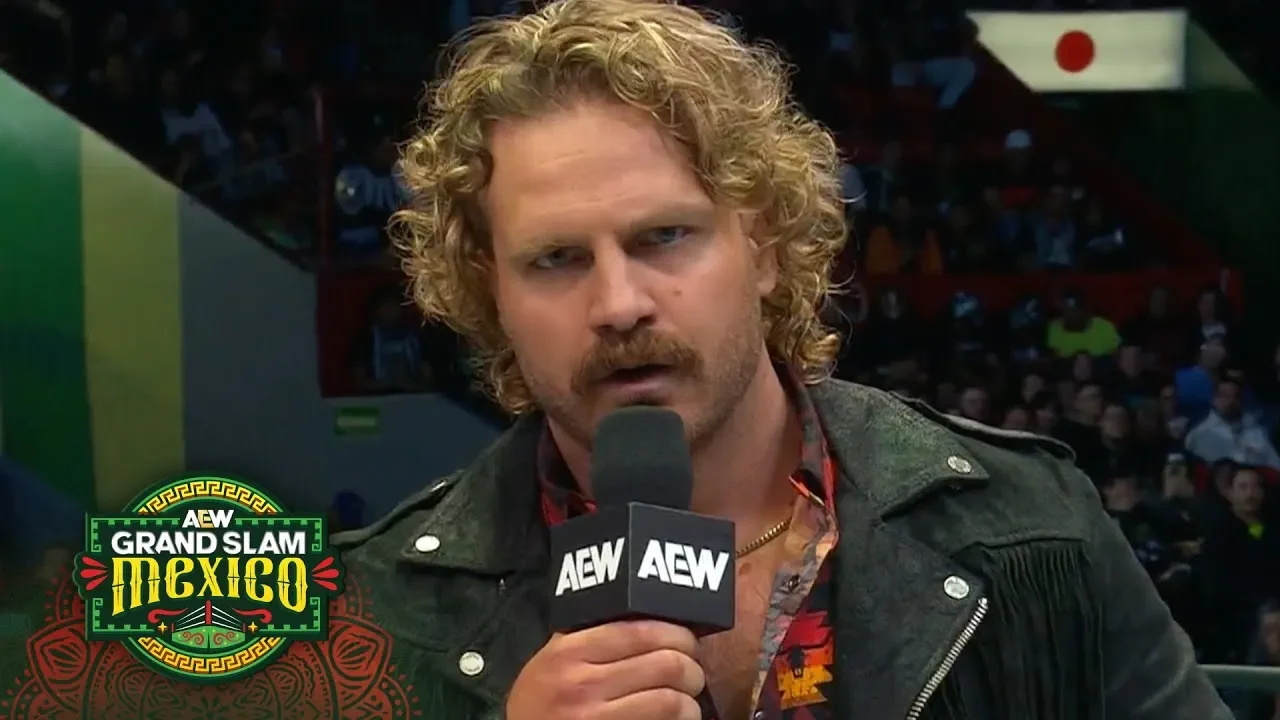
Hangman Page returning to competition and immediately finding himself fighting for championship gold alongside Bandido and Brody King told a story before the match even started. The Demand had only just captured those Trios belts. Hangman had returned from the exile created by his Revolution defeat and the stipulation preventing him from challenging for the men’s world championship again.
Then he, Bandido and Brody King won.
Hangman Page
Likewise Ospreay and Mark Davis. (I have nothing but great things to say about Ospreay. It’s not often a British wrestler gets the opportunity to climb the ladder to the top, but it’s becoming much less rare with him at the helm).
By the time they arrived at the Street Fight, violence wasn’t a substitute for a story. Violence was the consequence of the story.
Davis had previously already attacked Ospreay after his match with Daniel Garcia. Ospreay had only just walked away from the Death Riders after becoming increasingly uncomfortable with their methods. Davis then attacked him and taunted him about no longer having the Death Riders there to save him. Ospreay’s response was to demand a Mexico City Street Fight and prove there was “no hesitation left.”
So when chairs and assorted pieces of Mexico City began making an in ring appearance, it didn’t feel as though somebody had pressed the HARDCORE MATCH button.
They had arrived - and that’s storytelling.
THE WWE PROBLEM
Which brings me to WWE and I have to say upfront: WWE isn’t bad. I’d be a fool to claim it is because I love it and always have.
The company is in an extraordinary period of commercial success. Its production is astonishing. It has some superb wrestlers. It can make a performer feel like the most important human being on Earth simply by dimming the lights and playing their music (though nothing has quite eclipsed Stone Cold’s broken glass intro yet).
When WWE gets something right, nobody presents it better.
But watching Grand Slam Mexico made me realise how tired I’ve become of waiting for WWE television to get on with it. There’s adverts - both commercial and for their own programming - promos, recaps, backstage segments, the entrance, clips of what happened last week, somebody standing in the ring talking about what they’re going to do later. More adverts. Far too often I find myself wondering whether the wrestling is interrupting the wrestling programme and this is particularly damaging because WWE has some of the best professional wrestlers in the world.
They don’t need protecting from wrestling, so let them fucking wrestle.
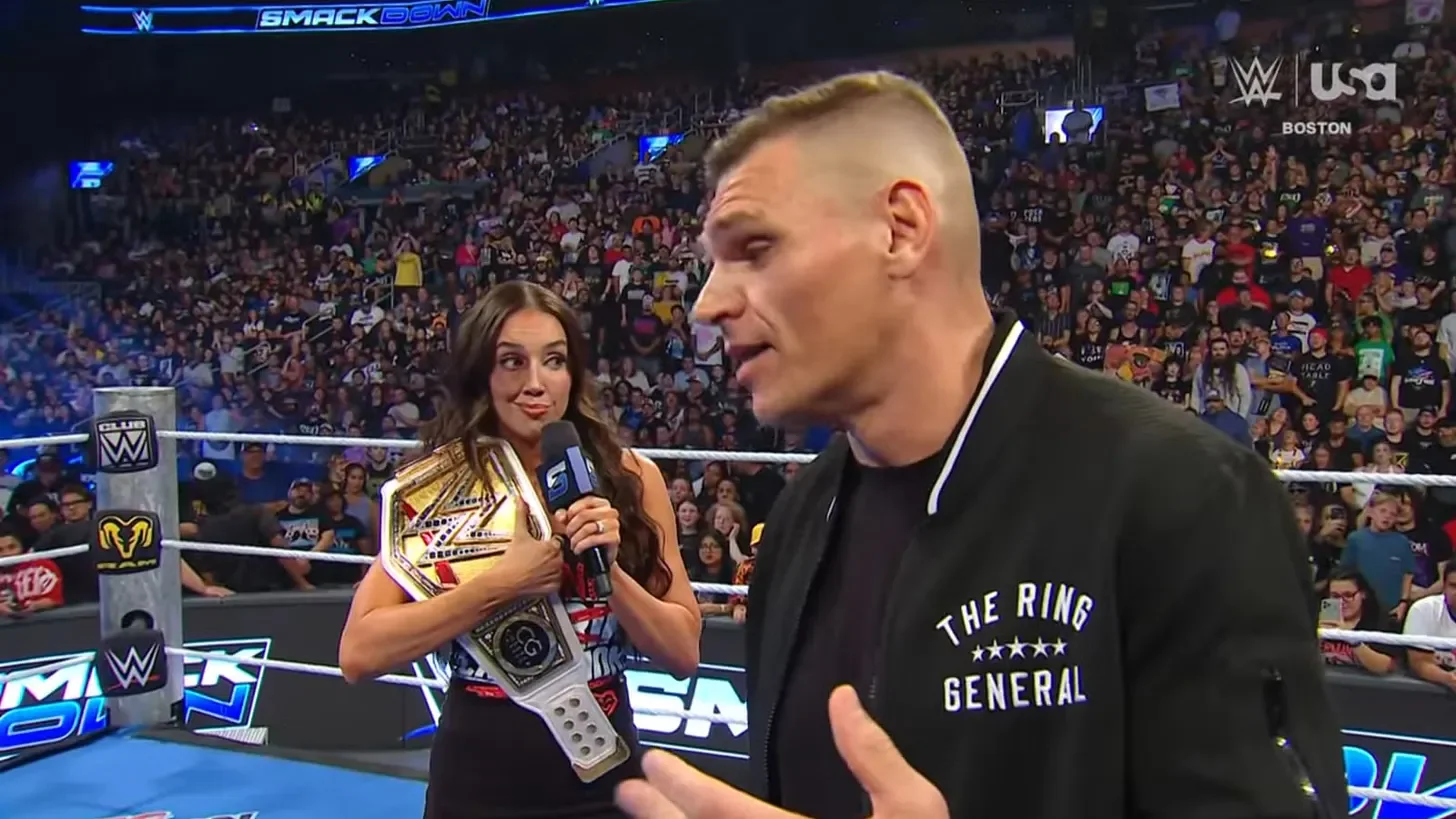
Chelsea Green and Gunther wittering on when there could be wrestling - if you have the means, go and find a video of Chelsea wrestling Penta in Mexico…
The modern WWE television product sometimes feels as though it doesn’t entirely trust its audience to remain interested unless something is constantly being explained, promoted or recapped. Having just sat through the FIFA World Cup with its hydration breaks and endless promotional garbage, it is perhaps, not exclusive to wrestling. Maybe it’s more of an American culture thing that US programmers thinks the audience can’t sit still for 10 minutes before they need to go and get a snack?
But don’t come to an international stage and expect the rest of the world to accept it without complaint.
Grand Slam Mexico trusted me - it said, here are some wrestlers: ring the bell.
THE PENTA PROBLEM
Which brings me, oddly enough, to Penta. He’s a useful illustration of what I think WWE sometimes gets wrong because Penta is ‘the other best wrestler’ in the world and WWE is making him boring.
And that should be almost impossible.
I’ve watched Penta for years and perhaps the best version of him appeared in the gloriously unhinged Lucha Underground series - all four seasons are currently available on Amazon.
Lucha Underground understood Penta and what it didn’t need to do with him.

Pentagon Jr in Lucha Underground
Pentagón Jr. (as he was then) didn’t require endless explanation. He didn’t need to become an American television character with a previously defined series of moves who happened to be Mexican.
He was Penta!
He spoke Spanish. He broke arms. He looked dangerous and he felt dangerous because he was. There was mystery around him and Lucha Underground had enough confidence in the character not to explain the mystery away - although to be fair, they never did that with any of their wrestlers because Mexico has forgotten more about wrestling than the rest of the world will ever actually know.
His programme with Vampiro was mad, violent, theatrical wrestling at its finest and it worked because Lucha Underground presented Penta rather than processed him.
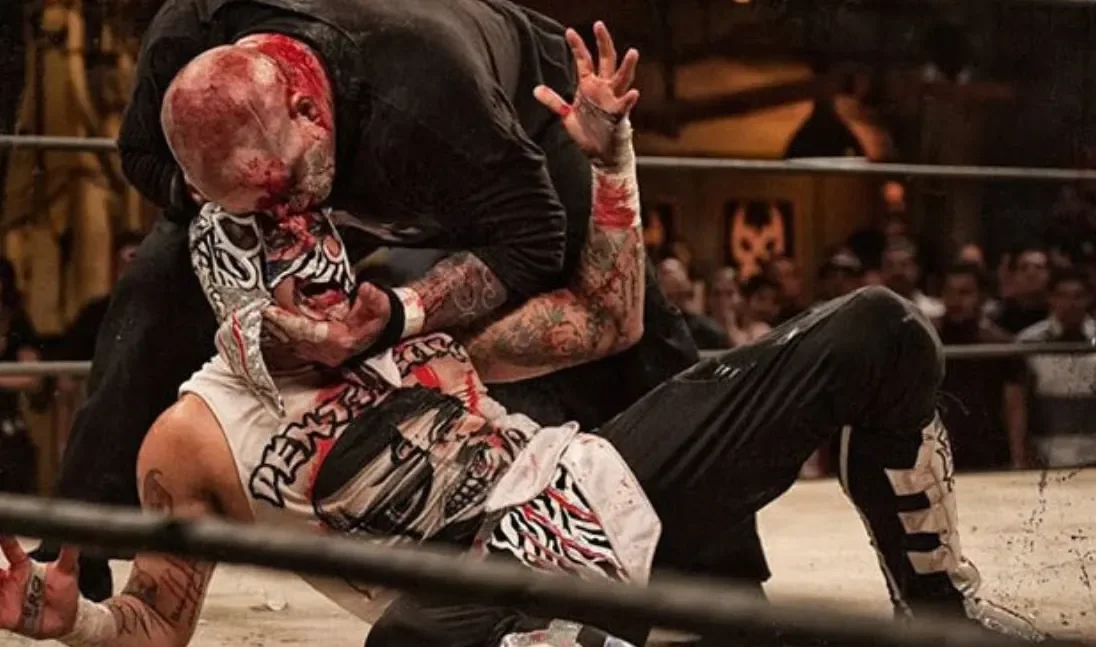
Pentagon Jr vs Vampiro - lucha at its finest.
WWE now has one of the most naturally charismatic wrestlers alive and yet increasingly seems determined to squeeze him through the same machinery as everybody else.
Why shouldn’t Penta speak Spanish? It’s a good question. Let him speak his own language. Subtitle it. Have somebody translate when necessary. Better still, occasionally don’t translate it at all - we’re wrestling fans and will get it.
Every attempt to make Penta conform to the rhythms of conventional WWE television removes a tiny piece of the thing that made him special in the first place and that makes me so sad. It was absolutely the right move for him because WWE is still the top of the commercial tree, but don’t handcuff him when he gets there!
Watching Arena México made that seem even more obvious. You don’t make wrestling universal by sanding off the differences. The differences are what make it universal.
THE BEAUTIFUL MESS
AEW is far from perfect.
Sometimes the freedom that produces something wonderful also produces chaos. Matches can contain too much. Everybody can kick out of everything. Spectacular moves can pile on top of spectacular moves until the audience becomes numb to them. Sometimes AEW badly needs somebody backstage to say no, but I’d rather watch a wrestling company occasionally fail because it attempted too much than one become so polished that all the rough edges disappear.
Grand Slam Mexico had rough edges and that’s good because wrestling needs them.
The entire form is ridiculous when examined too closely (but then again, what isn’t). Two people pretend to fight while secretly cooperating to tell us a story whose outcome has already been decided is something that shouldn’t work, but it’s had its way with me for my whole life.
I didn’t think about this once during Grand Slam Mexico.
FIFTY YEARS LATER
I didn’t walk away from Grand Slam Mexico thinking I was suddenly an AEW fan instead of a WWE fan. I’m too old for that nonsense and I don’t work like that.
Wrestling companies aren’t football teams. I don’t have to swear allegiance to one and hope the others are relegated. I want all of them to be brilliant because that’s the biggest win of all.
WWE being brilliant makes AEW better. AEW being brilliant should make WWE better… CMLL being brilliant gives both of them something else to learn from.
What I did finish Grand Slam Mexico thinking was that perhaps I’ve been accepting something from WWE television that I don’t particularly enjoy simply because I’ve become accustomed to it.
The dead time and constant interruptions are a royal grind. The sense that the match itself is sometimes merely one ingredient in a television product constructed from branding, advertising, promotion and content.
Grand Slam Mexico reversed that on the spot - the wrestling was the product and everything else existed to make me care about the wrestling… and when the wrestling began, it was allowed to tell me everything else I needed to know.
After all this time, that’s what I want. I don’t need professional wrestling to convince me it’s real or to reinvent itself and I sure as hell don’t need another authority figure explaining why two people are going to fight.
And I really don’t need somebody standing in the ring for twenty minutes telling me how important next month’s premium live event is going to be. I’ve been here before and so has everybody else.
I’ve seen it all thanks. I’ve watched wrestling become unfashionable, fashionable and unfashionable again. I’ve watched it be amazing and also watched it dredge the barrel for a rating. When it’s wonderful, it’s the best thing ever. When it’s at its worst, well… I guess that just makes the good stuff better.
After half a century, the greatest thing wrestling can do for me isn’t make me believe that it’s real - it’s to make me forget how long I’ve been watching, and for a few hours in Arena México, with thousands of people seemingly hanging over the ring and some insanely talented professional wrestlers throwing everything they had at one another, I wasn’t analysing television formats or thinking about advertising breaks or wondering how somebody was being booked.
I was actually watching wrestling.
AEW were on fire that night - it was leagues ahead of every major event WWE has broadcast this year and that’s about the highest praise I can give it.
Sion Smith | August 2026
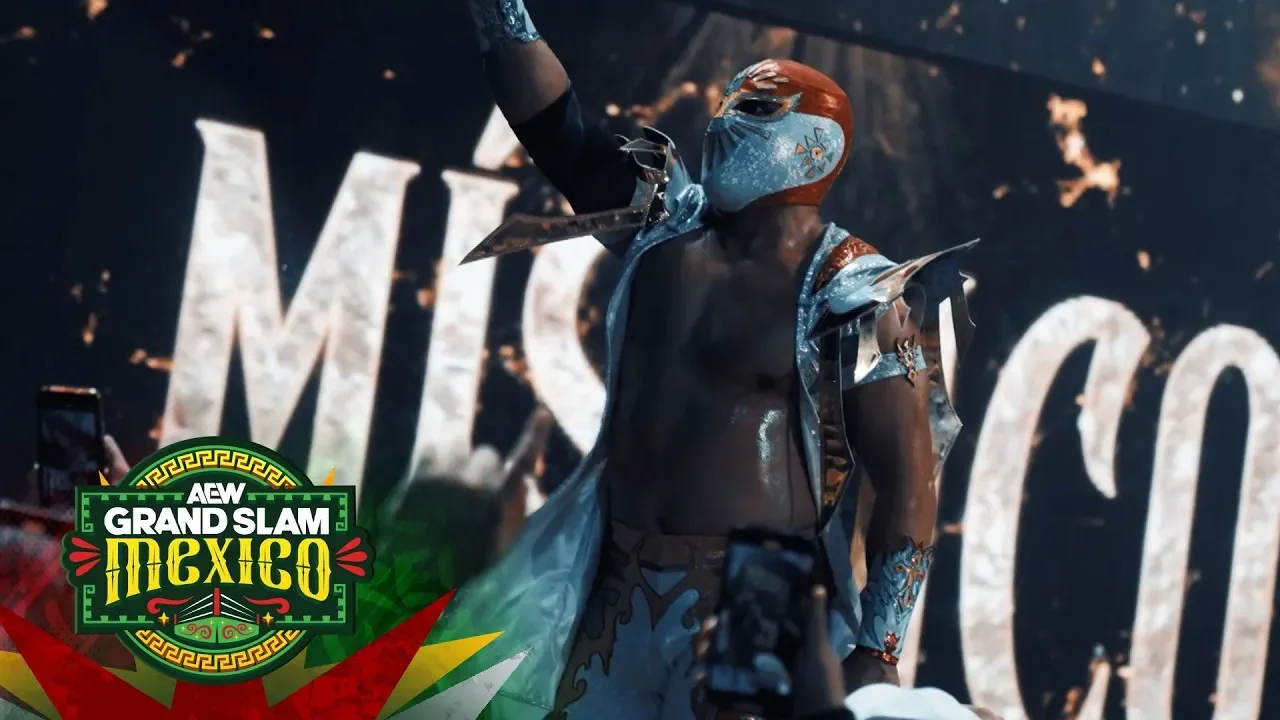
Mistico… under-rated and under-used. They will figure it out eventually.
The Fiction Will See You Now
Late August, 2005: I was running ZERO magazine when Good Apollo arrived. It was not accompanied by a host of angels or blinding flashes of light and came in a padded envelope with all the others. Truth be told, back then, the postman used to bring me so many CDs for review, we agreed that I would leave my car unlocked and he would simply dump them all on the back seat. At the time, I lived opposite a nursing home, so they weren’t going anywhere with a hundred old people across the road with nothing better to do than look out of the window.
Essays on my favourite albums of all time
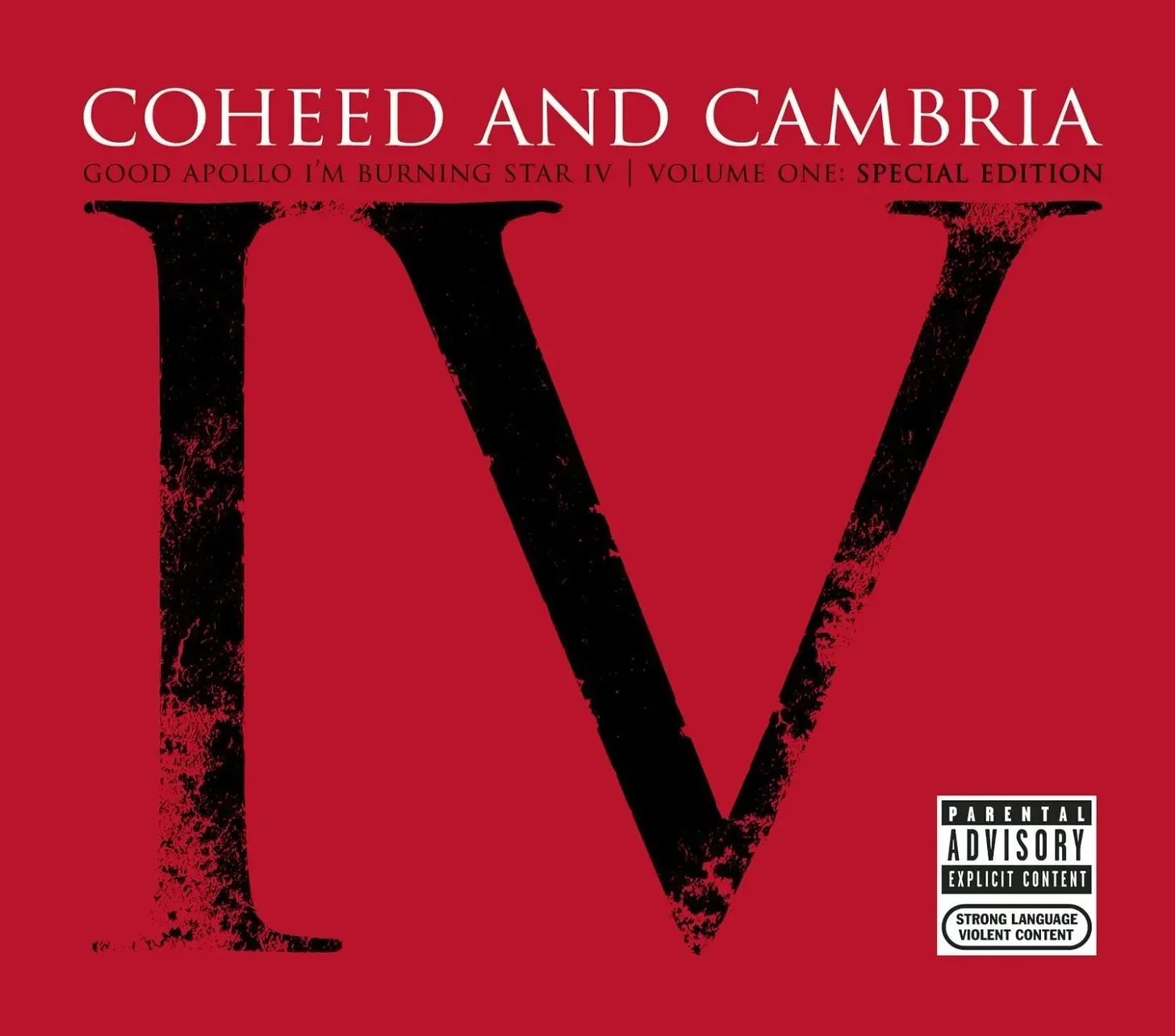
A swan dive into Coheed and Cambria’s Good Apollo, I’m Burning Star IV, Volume One: From Fear Through the Eyes of Madness - which may also be the bravest album title known to man.
Late August, 2005: I was running ZERO magazine when Good Apollo arrived. It was not accompanied by a host of angels or blinding flashes of light and came in a padded envelope with all the others. Truth be told, back then, the postman used to bring me so many CDs for review, we agreed that I would leave my car unlocked and he would simply dump them all on the back seat. At the time, I lived opposite a nursing home, so they weren’t going anywhere with a hundred old people across the road with nothing better to do than look out of the window.
How are you supposed to know your life is about to change from the outside of a Jiffy bag when every single day brought another deluge of padded envelopes, press releases and records claiming to be the most important thing I’d hear all year?
Coheed and Cambria weren’t new to me. I’d already fallen in love with Blood Red Summer when it came out as a single from the Secrets of Silent Earth album, so the name meant something, but I wasn’t waiting on anything else given that the rest of Silent Earth kind of lost me. I knew nothing about Good Apollo before I put it on, but it went on the pile of artists I’d heard of because you have to have some kind of system.
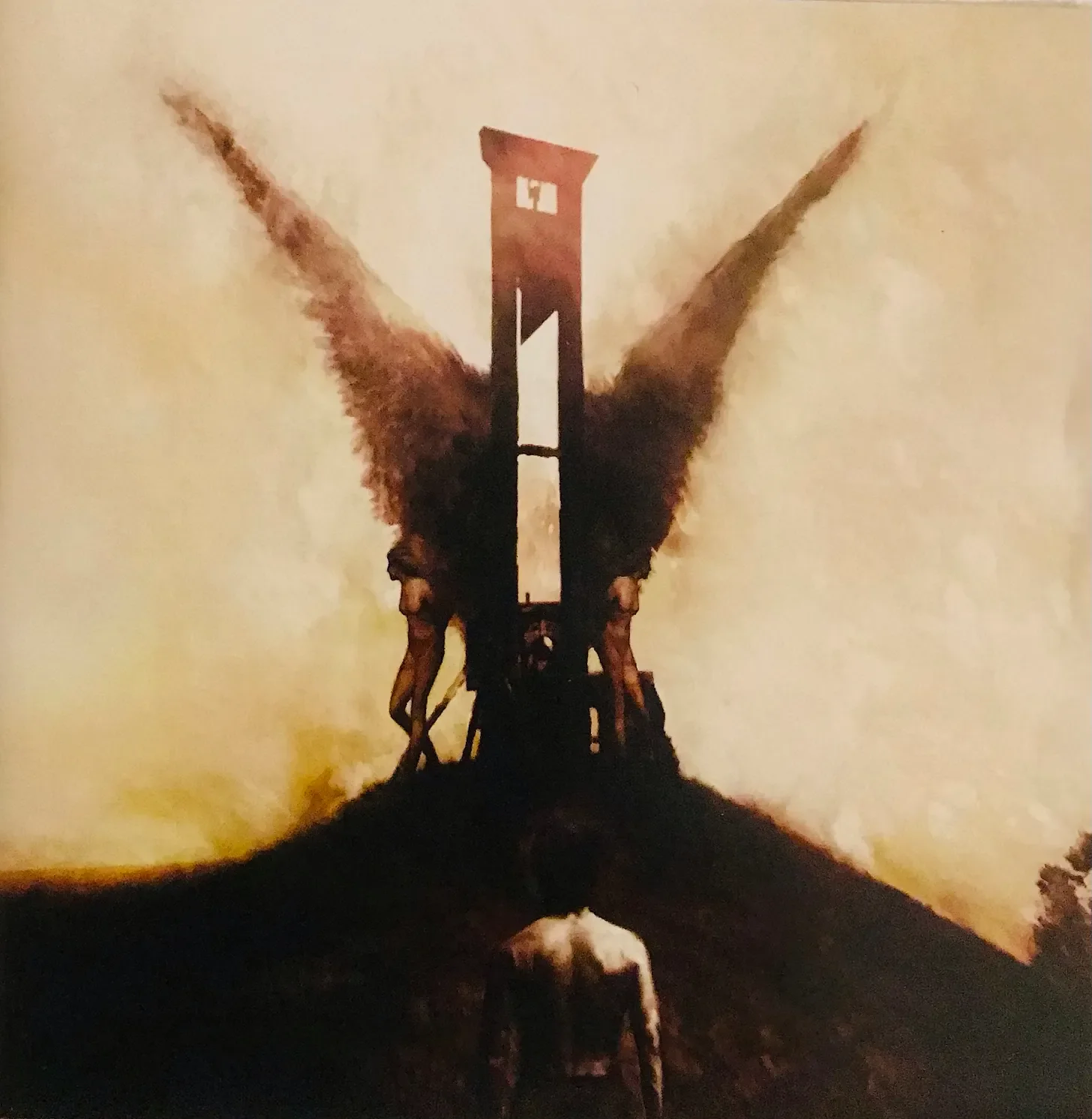
I liked the cover though and sometimes, that’s enough.
So I put it on. Then I played it again. And again…
By the end of the day, it was like Nicole Kidman had delivered it by hand and asked me out for dinner. By the end of the week, it had taken over my life. By the end of the month, I was still trying to work out what the hell had happened.
This wasn’t another collection of songs about your poor little broken heart that passed through the office (aka: the kitchen table). There was heartbreak in there - quite a lot of it as it turns out, but it had been fed through something different until it came back wearing… armour? There were characters and recurring themes. Deaths, prophecies, far away planets, arguments with God… and a bicycle that was great at offering creative advice.
It was like somebody had handed me a book and was using guitars instead of paragraphs.
Twenty years on, it all seems kind of obvious if you’ve ever lent the band your ears. We’re used to Coheed and Cambria arriving with enough mythology to need scaffolding to hold it up but back then, hearing Good Apollo cold, the story wasn’t homework. It was in fact, something I didn’t know what to do with.
I didn’t know who everybody was or exactly what they were doing, but I knew the album went somewhere special. Songs were more like doors that opened and slammed in equal measures. Characters returned. Melodies carried information from one part of the record into another - hell, even the backing vocals had a story of their own to tell.
By the time The Willing Well arrived, it felt as though the curio I’d lifted from the day’s slush pile on the whim of a cool cover had built an entire world around me and wasn’t about to let me go home anytime soon.
Note: don’t ever let anybody tell you that cover design isn’t important.
When it was released in September 2005, Good Apollo was Coheed and Cambria’s third album, their major commercial breakthrough (I use the word commercial loosely) and also gave us the moment when the band stopped sounding like an ambitious group trying to build a universe and started sounding like they might actually own one. It hit number seven on the American album chart. Welcome Home escaped the mothership and even went off to live a separate life in video games and film trailers.
But its success is probably the least interesting thing about it.
Good Apollo is a break-up album disguised as a science-fiction opera disguised as a hard-rock record disguised as something you could easily explain if only everybody would stop interrupting and you could get your head around it.
It is angry, wounded, melodic, spiteful, funny, pompous and often, also beautiful. It has strings. It has children singing. It has a four-song closing movement called The Willing Well that lasts for the better part of half an hour. It has a dog in the title and as mentioned, a demon bicycle as part of the plot.
It should collapse under its own weight, but instead, it flies...
IN SPACE, EVERYBODY CAN HEAR YOU SCREAM
There is a version of this article that spends the next thousand words explaining the Amory Wars - which is the overriding thread of Coheed’s entire output - but nobody wants that version and I don’t want to write it either. It is currently trapped in a filing cabinet somewhere, yelling to be let out but that’s not going to happen.
Here is what we need:
Coheed and Cambria’s early records form part of a science-fiction story created by singer and guitarist Claudio Sanchez. The setting is Heaven’s Fence, a collection of planets held together by beams of energy called the Keywork. The central family is named Kilgannon. The parents are Coheed and Cambria. Their surviving son is Claudio (natch). There are wars, prophecies, viruses, murder, tyranny and enough capitalised nouns to make a fantasy novelist reach for the emergency brake, get out of their own inferior car and go home.
The first two albums, The Second Stage Turbine Blade and In Keeping Secrets of Silent Earth: 3, placed us largely inside that fiction. You didn’t need to understand what was going on to feel the songs - the music understood that you were here because your heart had been broken and the guitars sounded magnificent.
Then Good Apollo did something dangerous.
It pulled the camera backwards into a massive birds eye view.
The story now revealed a Writer (capitalised noun alert) living outside Heaven’s Fence, creating and controlling the people inside it. He had relationship problems of his own. Erica Court had rejected him, or betrayed him, or failed to behave according to the version of her he had written in his head. His anger leaked into the fiction. The characters suffered because their creator suffered. Ambellina, the woman guiding Claudio Kilgannon towards his destiny, became entangled with the Writer’s feelings about Erica. If he could not control the real woman, perhaps he could control the fictional one. If you thought that was a royal head-fuck, this is the point where a bicycle starts talking…
I had it explained to me by Claudio when we hooked up at Jurys hotel somewhere around the corner from the British Museum when they came over in support of the record… and still had to have it explained to me again later.
Writing from the Writer’s perspective allowed him to put more of himself into the lyrics. Twenty years later, he was even more direct about the emotional source: he had experienced heartbreak, did not know how to process it and funnelled it into musical anger. The Writer was not a neat autobiographical portrait, but he was no longer safely hidden behind the stars either.
Most concept albums ask us to believe in the story. Good Apollo asks whether the storyteller can be trusted. The man playing God is having a breakdown. His characters are at the mercy of somebody who cannot manage his own emotions, and he is beginning to confuse authorship with ownership which makes it a bad relationship with a notebook rather than a science fiction soap opera.
Note: I am not the world’s biggest fan of science fiction and have never termed Good Apolloas such in my own head even when the rest of the world seems to disagree with me.
It also builds an entire ‘mega-frame’ around its own songwriting process. The Writer isn’t simply another character wandering around inside the story. He is the man making it, breaking down in real time, feeding pieces of his life into the machinery and discovering that fiction is not a secure container. The album never lets us settle on whether we are hearing a fictional man’s grief or Claudio’s real one.
Is it a trick of the light? It might as well be…
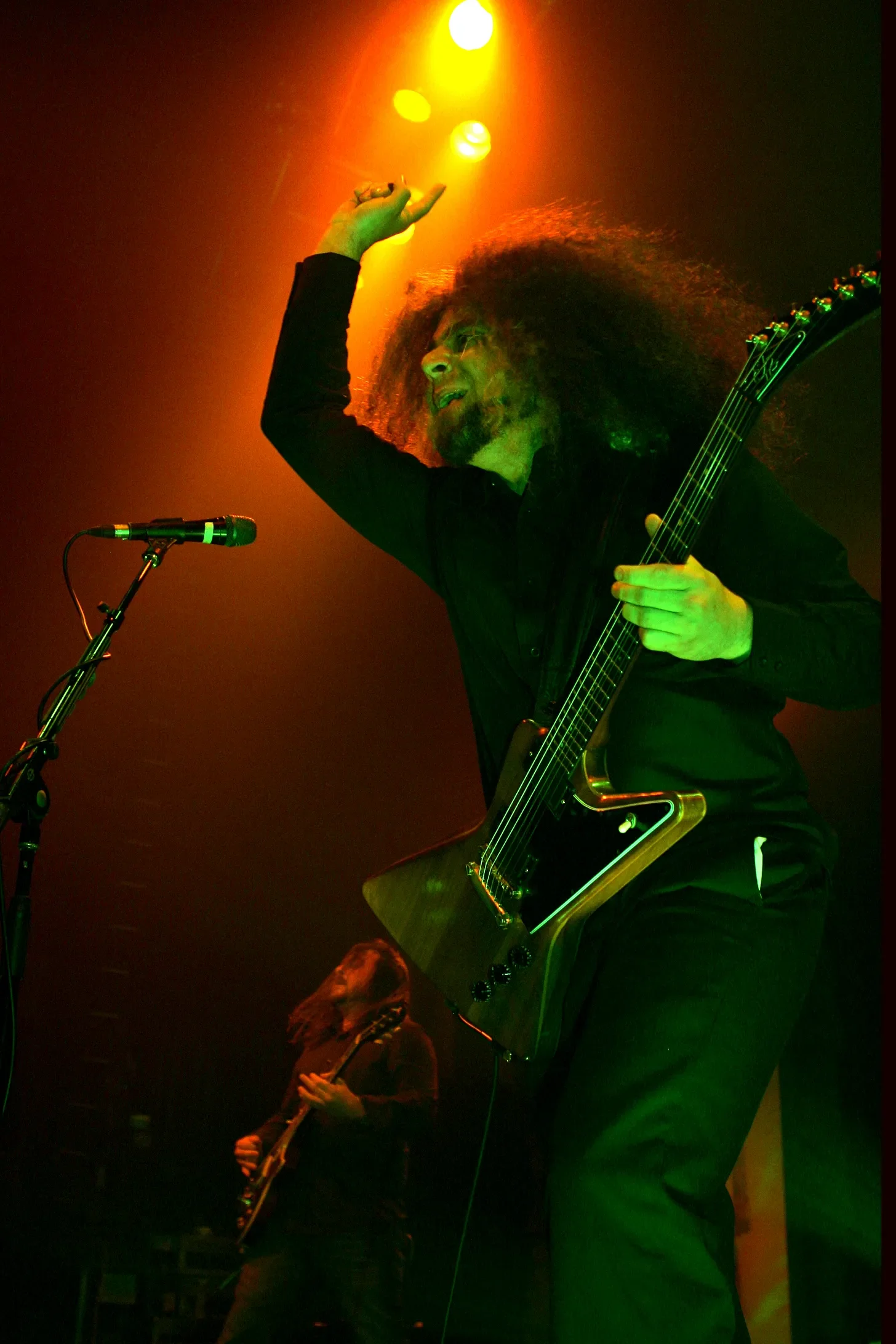
WELCOME TO THE MACHINE
The album begins innocuously enough because it knows what is coming to beat you around the head.
Keeping the Blade is a short orchestral introduction built around a melody that had already appeared in the band’s work. It feels less like a new beginning than an old door opening - a bonus feature if you will and were already familiar with what had gone on before. Coheed understood the value of recurring musical ideas long before the mythology became available in expensive hardcover editions. A melody returns and, even if you cannot name it, your body knows you’ve driven past that place at some point in your life.
Then we have Always & Never, all acoustic guitar wrapped up in nursery-room menace. Children’s voices lurk behind Sanchez’ own... the song sounds intimate, almost harmless, which is pretty much how horror films persuade you to go upstairs.
And then comes the Hammer of the Writer in the shape of Welcome Home.
There are riffs and there are Riffs. The opening of Welcome Home is the announcement that should have played when the postman threw it in the back of my car. It does not enter the room; it repossesses it. The guitar curls downward with the weight of something I’d never heard before (or since), followed by drums that pound as if somebody has released the horses. Strings gather around the band and Sanchez arrives hurt and furious, then spends six minutes trying to find ever larger jars to contain the fury.
He wrote the central riff at his parents’ house, still working an ordinary job (in a pet shop, if I recall correctly), and has recalled being discovered by his mother while playing it in his underwear.
Rock history likes to pretend that enormous songs are delivered on mountaintops by lightning but sometimes your mum walks in because she needs to do the laundry.
Musically, Welcome Home is Coheed making a claim to other rock icons and it is not embarrassed by any of this.
Embarrassment is for bands who have not yet written Welcome Home.
This is not dignified heartbreak. It is accusation, humiliation and violent fantasy, followed by the admission that love remains trapped inside the anger. The Writer wants Erica punished for transforming him into this new person, as though she arrived with a toolbox and carried out the conversion herself.
When we are young, this kind of rage can feel like truth because it is loud enough to drown out every competing witness. Somebody hurt us. Therefore, they are the villain. We are bleeding. Therefore, we are innocent.
Adulthood, the irritating bastard that it is, tends to introduce paperwork.
It is now possible to hear Welcome Home as both a great rock song and a record of emotional failure. In fact, that tension may be why it survives. Sanchez has called it mean-spirited and still plays it. He and Chondra Echert, the real person standing somewhere behind Erica Court, eventually reconciled and married. The song did not become false when the relationship changed. It became fuel: here is what heartbreak sounded like before anybody involved knew the ending.
The band wanted it as the lead single. Their label preferred the more obviously accessible The Suffering. As usual, the band was right in the long run. Welcome Homebecame their signature song, eventually going platinum in the United States. It is the door through which thousands of listeners first entered Heaven’s Fence, even if many of them took one look at the map and decide they would be much safer standing in the gift shop…
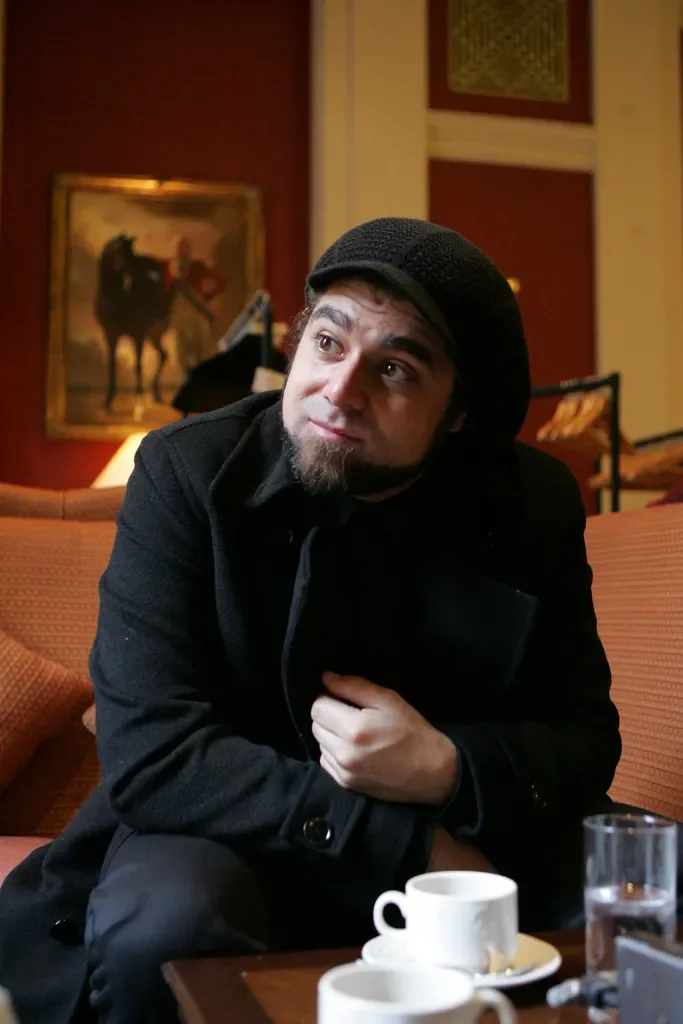
Taken from my interview at Jury’s with Claudio - pic credit: the inimitable and wonderful Chiaki Nozu. No idea what we were talking about here but from the look on Claudio’s face I was probably knee-deep in relaying what I thought of the album…
GOD RIDES A TEN-SPEED
After Welcome Home, most albums would offer you a bottle water and somewhere to sit. Perhaps even a biscuit.
Instead, Good Apollo chooses to give us The Bicycle.
Ten Speed (of God’s Blood & Burial) is where the album’s absurdity and intelligence shake hands. The song is spring-loaded like some demonic pinball machine from the first note. Drums, bass and guitar lock into a riff that feels as though it is forever leaning around the next corner. The chorus is huge (sorry: Huge) without being heavy, and has one of those Coheed melodies that makes a complicated song behave like pop music for a few glorious seconds. It owes a lot to Blood Red Summer but I can’t put my finger on why. I don’t understand how the backing vocal lines have been constructed either.
Inside the story, Ten Speed is the Writer’s demonic adviser, pushing him towards violence and control. Psychologically, it is the voice that tells him his worst impulses are not only reasonable but necessary. Artists have always blamed the muse but in this instance, Coheed simply gave the muse some handlebars, which is just about the coolest idea ever. The Writer’s madness does not appear as a dragon or a machine god. It appears as a bike he already owns. It doesn’t kick down the front door dressed as Satan/Santa/Santana but sits in the corner of the room and waits until you are tired enough to answer.
The song also proves how little the concept restricts the band - and this is the entire genius of the band. On paper, “man argues with evil bicycle about murdering his former partner through symbolic interference in a parallel science-fiction narrative” is not radio material. In practice, it is one of the tightest songs on the record and yes, easily my favourite.
All that said, put the song on and none of it matters…
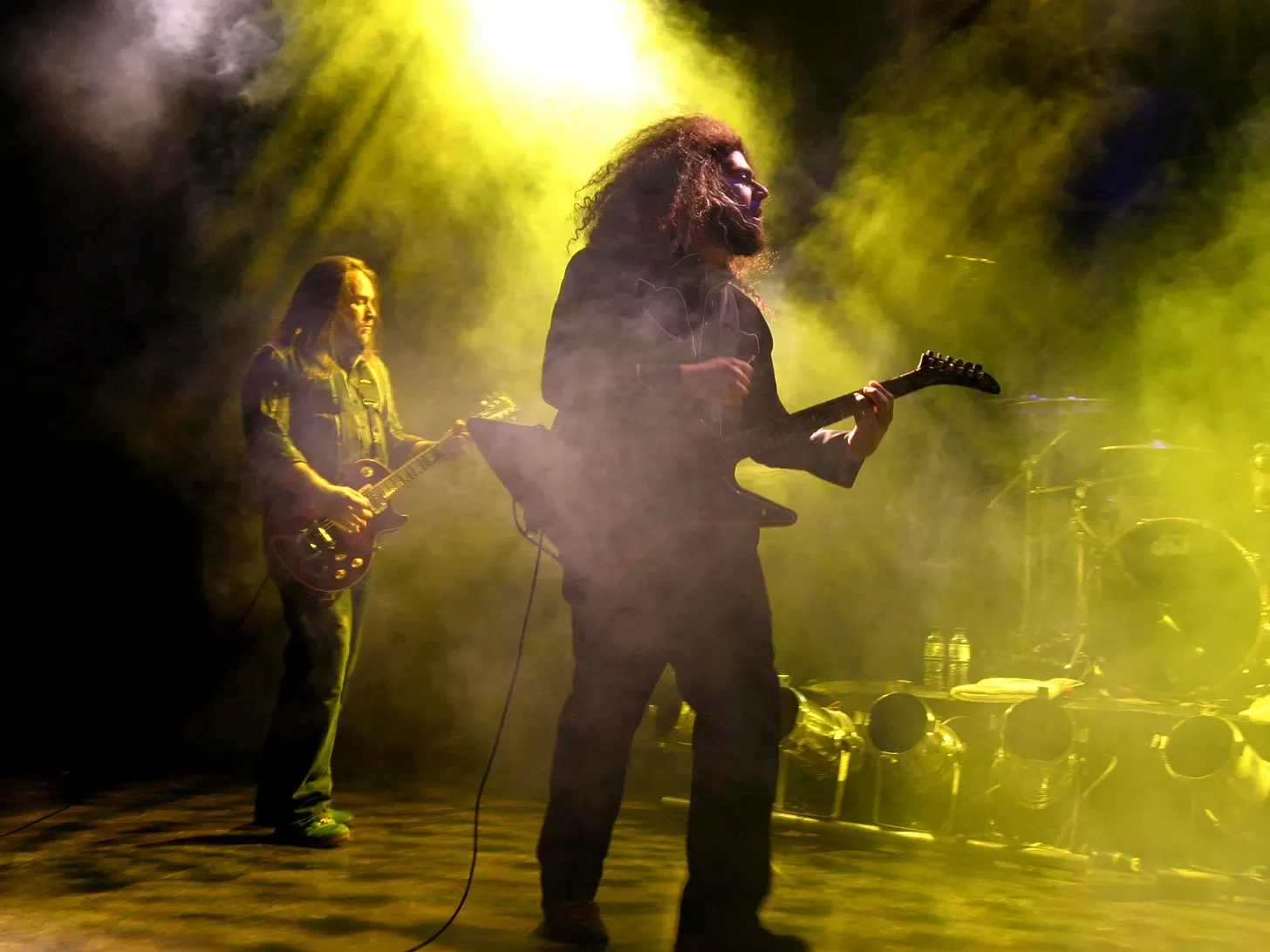
LOVE SONGS FOR PEOPLE WITH EVIDENCE BAGS
The middle of Good Apollo is where the album becomes more interesting than its reputation - it’s my favourite part of the album by a long distance.
It’s easy to remember the opening assault and the closing suite in the shape of The Willing Well, but between them sits a run of songs that chipped off from the same damaged relationship.
Crossing the Frame is compact and powered by the sort of melodic bass movement that keeps Coheed’s songs from becoming unwieldy blocks of guitar. It feels like pursuit. The Writer cannot leave Erica alone because he cannot leave his idea of her alone. The title itself even suggests a boundary being crossed.
Apollo I: The Writing Writer slows the machinery down and lets the dread breathe. It’s one of the album’s central pieces, though it does not announce itself with the blunt force of Welcome Home. The Writer addresses Apollo, his dog, while trying to understand what he has become and what he intends to do. The ordinary tenderness of speaking to an animal sits beside the monstrous power he holds over his characters.
Good Apollo, good dog. Burning Star IV, bad everything else.
The title that once looked like decorative prog nonsense now becomes strangely intimate. Apollo is a witness. The dog cannot answer, judge or leave. Anybody who has ever explained the collapse of their life to an animal knows the arrangement. You provide both sides of the conversation and the animal has the decency not to point out the holes in your best laid plans.
Once Upon Your Dead Body follows with a title that could belong to a paperback found rotating beside the till at a bus station - and there’s nothing wrong with that in any world. The music, however, is almost playful. That’s another Coheed speciality: hide the knife in a melody of cake people want to eat together - and the contrast raises a question that follows the entire record. How seriously are we supposed to take the violence?
The Writer is not presented as a healthy being whose conclusions deserve our support. He is a cracked lens through which the fiction is being burned. The album does not always make that distinction comfortable, especially when its most venomous lines arrive dressed in its most triumphant music, but discomfort is not endorsement. Sometimes art puts you inside an ugly mind because the view from the pavement tells you nothing about the room upstairs.
Then Wake Up appears and complicates the prosecution.
It is the album’s naked love song: acoustic, orchestral and painfully direct. Removed from the surrounding story, it sounds like devotion. Placed where it is, devotion starts to look a lot like fixation. The Writer who has spent the album condemning Erica can still imagine escape, reunion and permanence. Of course he can - anger and longing are often make wonderful housemates. It’s beautiful, but beauty is not proof of good intentions. Every terrible relationship has at least one song it thinks belongs to it…
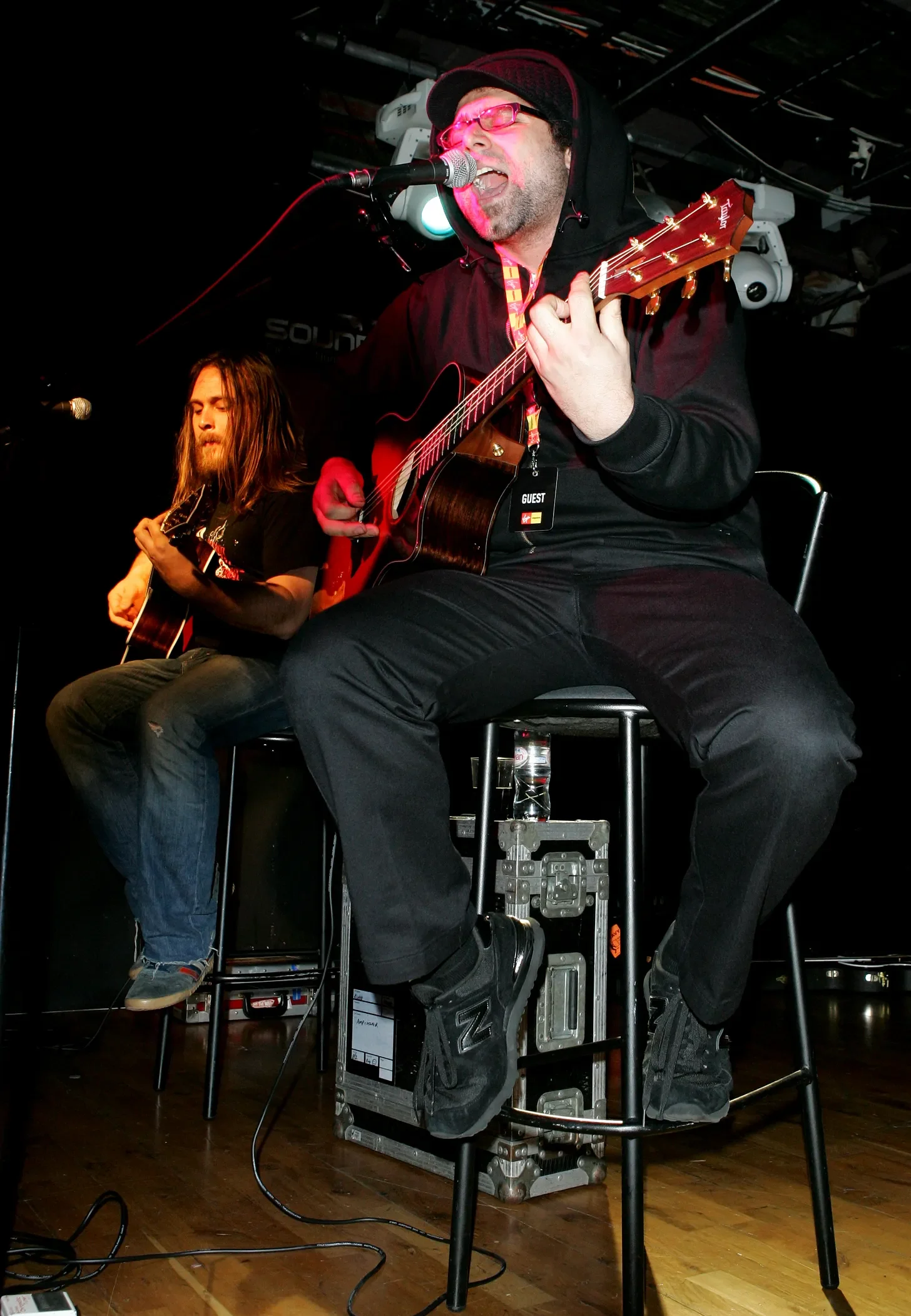
THE SUFFERING SELLS
If Welcome Home was the song Coheed believed would represent them, The Sufferingwas the song that demonstrated how good they had become at smuggling themselves into daylight and it is ridiculous pop-rock engineering of the highest level.
The rhythm bounces. The guitars leave space. Claudio’s vocal leaps through a melody designed to sound inevitable after you have heard it once. The chorus is immediate enough to survive outside the concept, while the arrangement keeps twitching at the edges so nobody mistakes accessibility for simplicity. Simple is the last word on anybody’s lips to describe this song.
The video placed the band in a fantasy landscape full of mythological creatures, ensuring that anybody who thought the story might be easy to grasp was punished with a kendo stick for their optimism.
Lyrically, The Suffering stages rejection and self-pity as theatre. The Writer asks what he did to deserve this and whether he might have been the right man under different circumstances. It is a more charming performance than Welcome Home, which makes it no more reliable.
Such is the trap of Good Apollo: the Writer keeps making excellent song after excellent song out of reasons we should distrust him.
The Lying Lies & Dirty Secrets of Miss Erica Court does not believe in subtle titles. It sounds buoyant while its groove carries a case for the prosecution built mainly from jealousy. The Writer’s Erica is less a person than an accumulation of charges. We do not know her. We know what he needs her to represent.
Returning to the album twenty years later with a microscope can become uncomfortable. The language of the wronged young man once arrived without much resistance. Rock music had spent decades teaching us that a woman who left was cruel, a woman who stayed was salvation, and a woman who exercised independent judgement was probably about to acquire an unpleasant nickname before the second verse.
Good Apollo does not escape that tradition. It fires it into space, but it also does something else. By making the narrator a Writer with literal power over women inside his fiction, the album exposes the machinery of grievance. He is not merely describing Erica. He is rewriting the universe to make his pain cosmically correct.
Every writer should be able to see the genius of the wizard behind the curtain here… or at least find it a little bit terrifying.
Mother May I closes the album’s (conventional?) middle section with a slinking, stop-start menace. By now, individual songs are beginning to feel less like chapters than rooms in the same house. The argument has gone on too long. Everybody is exhausted because it is exhausting.
Then the floor opens…
THE WILLING WELL
To complete the cycle, four songs lasting nearly half an hour. Recurring melodies, shifting time signatures, collapsing identities, guitar solos, screams, callbacks and enough plot to totally invalidate your home insurance.
A lot of Coheed fans think this is the best part of Good Apollo.
But I don’t.
Most of the time, I stop the album here. Not because I think The Willing Well is badly played or carelessly constructed, I’m not completely unhinged, but because this is where the record I love turns into a record I have to admire from a safe distance. After eleven songs that carry the story without buckling beneath it, the mythology finally grabs the steering wheel and drives us directly into prog country… and I don’t like prog so much.
But it would be remiss of me to spend this long digging around inside Good Apollo only to quietly slip out through the fire exit before the final act. This is where the Writer moves closer to his creation, where the division between real heartbreak and fictional catastrophe finally starts to collapse. It matters to the story even if it doesn’t do much for me as a collection of songs.
So, one more time unto the breach.
The Willing Well I: Fuel for the Feeding End begins in motion, the band playing with a kind of disciplined panic. Josh Eppard’s drums refuse to simply keep time, choosing instead to argue with it. Michael Todd’s bass moves beneath the guitars like a second narrative, while Travis Stever and Sanchez build parts that interlock rather than merely pile up.
For all the attention I’ve paid to the story here, Coheed and Cambria are a frighteningly good band. This is also as good a place as any to point out how important Travis is to the dynamic. I don’t think they would be half the band they became without him, but that’s another story altogether.
Concept is cheap. Any fool can invent twelve planets and a prophecy, but can you write a chorus that lays waste to all who look upon it?
Probably not.
The problem, for me, is that Fuel for the Feeding End keeps changing shape so often that I stop caring which shape it has become. I can hear the craft. I can hear the band pushing at the edges of what a Coheed song can contain. I know other people hear those sudden turns and shifting sections as the sound of the group taking flight but I hear a song refusing to sit still long enough for me to love it.
The story, meanwhile, is moving in the opposite direction. The characters inside Heaven’s Fence are being pulled towards the Writer as the creator moves closer to his own creation. The distance between personal grievance and cosmic catastrophe is disappearing.
The Willing Well II: From Fear Through the Eyes of Madness is darker and even more disorientating. Fear is not simply something the Writer feels; it is how he sees. Everything passing through it comes out altered and this may actually be the album’s real subject.
The Writer sees betrayal and builds a universe that confirms it. Claudio Kilgannon sees destiny and tries to resist it. The listener sees an elaborate science-fiction record and may miss the small human collapse generating the entire machine.
I understand what the song is doing but I simply don’t have the heart to hear it doing it.
That may sound unfair, but music isn’t a complicated exam in which recognising the correct answer means you have to enjoy it. Sometimes you can see every piece being moved across the board and still wish everybody would hurry up and finish the game.
The Willing Well III: Apollo II: The Telling Truth returns to the musical shape of The Writing Writer, changing the words and perspective. Earlier Coheed songs begin surfacing inside it. The band’s catalogue folds in on itself, turning familiar phrases into evidence that the fiction has always been contaminated by the life of its author.
Now that is clever. Possibly too clever for me but clever nevertheless.
All writers do this, of course. They take a person, remove the name, change the hair, put them on Mars and act surprised when they are recognised. Sanchez has simply built an entire solar system around the evidence.
The suite ends with The Willing Well IV: The Final Cut, a slow, blues-heavy piece owing more to Pink Floyd than to the nervous energy that first carried the band. Guitars wail across open space and the rhythm lumbers with intent. After an album full of words, the extended instrumental passages allow the emotion to escape the plot.
Or I guess that’s the theory behind it.
By this point, I have usually escaped the album myself.
For those who remain, The Final Cut offers aftermath rather than resolution. The Writer’s anger has burned through argument and arrived at emptiness. The grand machinery slows, voices gather and instruments peel away before the record wanders into a hidden acoustic coda—Bron-Y-Aur, a small Led Zeppelin tribute tucked behind nearly half an hour of musical warfare.
I can respect The Willing Well. I can understand why it inspires the kind of devotion normally reserved for religious apparitions and limited-edition vinyl. It is ambitious, beautifully played and structurally central to everything the album is trying to do.
I just don’t particularly like listening to it.
Perhaps that is the final trick Good Apollo plays on me. It arrived like a book written with guitars instead of paragraphs, held me captive for eleven songs and then ended with four chapters I have spent twenty years pretending I’ll finish one day.
I probably won’t.
That doesn’t mean I love the book any less.
(Nobody likes the stupid Spider ending at the end of It, but that doesn’t make it a shitty book.)
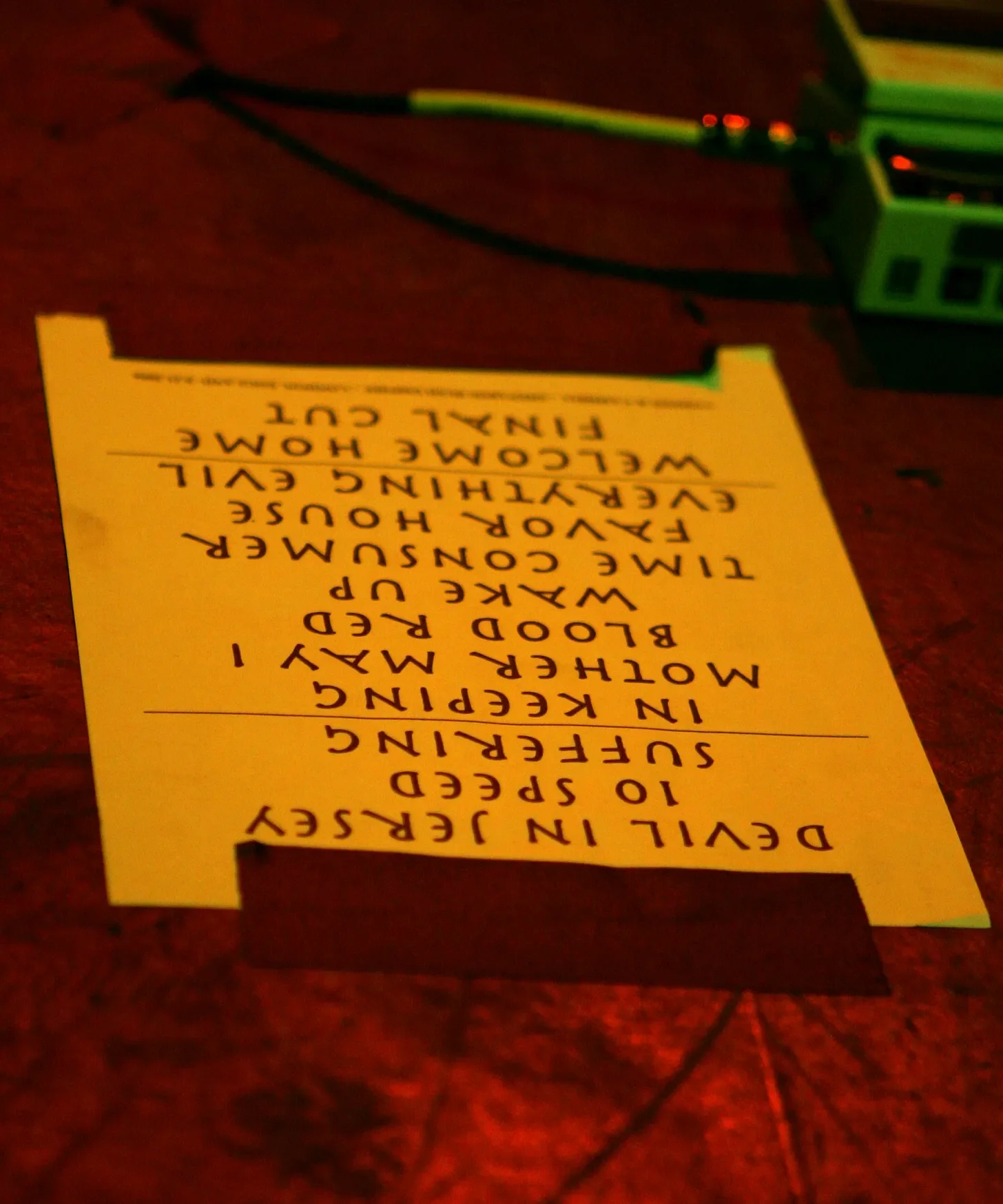
THE BAND INSIDE THE STORY
It is easy to talk about Coheed as though Claudio Sanchez invented the universe and everybody else turned up to provide weather.
This is the sound of a band becoming capable of the singer’s vision and ambition. Sanchez supplies the architecture, voice and much of the guitar language, but the record moves because four musicians understand tension differently. If I understood jazz even a little bit, I could probably even make some useful comparisons.
Josh Eppard is central to it. His drumming is busy without becoming cluttered, technical without asking for a certificate. He can make the pop songs bounce and the progressive sections feel as if they are coming apart at precisely the intended speed.
Michael Todd’s bass is not buried beneath the concept. It prowls. Listen past the vocal melodies and there is another version of the album happening underneath, less interested in Heaven’s Fence than in getting from one chord to the next by the most interesting available route.
Travis Stever’s guitar work gives the songs texture and friction. Coheed’s riffs rarely sound like one enormous instrument copied across the stereo field. The parts speak to each other, disagree and occasionally form a small committee. Like I said - Travis is a key part of this story. Claudio might not need him as such but he is better with him than without. (For reference give Travis’ Davenport Cabinet project a whirl).
Producers Michael Birnbaum and Chris Bittner let the record be large without sanding away the band (which is something of a miracle considering the amount of layers). The strings matter. The vocal layers matter. The strange transitions matter. But underneath the theatre, you can still hear four people in a room discovering that they can push further than they did last time.
There is more going on around them than you might consciously notice too. Ukulele. Lap steel. Additional percussion. A didgeridoo buried somewhere in the machinery. Sanchez’s niece, Janiris, supplies the child’s voice on Always & Never and again near the end of the record. None of this arrives waving a flag to tell you how clever the arrangements are. It adds colour at the edges, the musical equivalent of details in a novel that make a room exist even when you cannot remember every object inside it.
That was what I heard before I understood any of the story. Not a collection of tracks dressed up with a concept, but a record built to be... what? Experienced rather than listened to? It’s not like you can turn up and have a great 4/4 time cooking in the kitchen to it. Well, you can and I have but you get my drift.
This was 2005. Rock was busy splitting itself into marketable tribes. Emo over there. Metal in the corner. Post-hardcore by the fire exit. Prog was permitted back into the building provided it did not make eye contact with anybody.
Coheed took what they needed from all of it and stormed off in a direction all of their own.
Sanchez’s instantly recognisable voice made categorisation even harder. To some listeners it was the locked door. To others it was the entire house. Once accepted, it gave the band access to emotional territory a more conventionally masculine rock voice could not have reached. He could sound wounded, vicious, theatrical, childlike and absurd, sometimes all within the same line.
It was, and still is, quite magical.

TWENTY YEARS LATER
Records do not change, which is kind of inconvenient because we do.
In 2005, Good Apollo could be seen as the enormous next step from a band whose mythology seemed to expand every time somebody asked a straightforward question. It was an album to decode. Fans traded interpretations, fitted lyrics to comic-book events and argued over names that sounded like passwords for a boiler.
Now, the code is easier to find. The Amory Wars has been expanded, revised and published across comics and collected editions. Interviews have clarified what was once guesswork. You can find diagrams for God’s sake. You can find explanations. You can probably even find somebody willing to tell you the bicycle’s motivation in seventeen parts. Hell, somewhere on a hard drive around here, I have a collection of Children of the Fence tattoos I discovered. That’s how obsessive we became.
And yet the album has become less stable, not more.
The passage of time changes the human material. Claudio and Chondra reconciled, married and became creative partners. The furious document of their separation remained. Every performance of Welcome Home became a public return to a private catastrophe that no longer existed in the same form.
There is something generous in not disowning it.
Sanchez has not pretended the song came from a noble place. He has described the anger, acknowledged the meanness and continued to recognise the song’s power. That is healthier than rewriting the past until everybody behaved perfectly. Nobody did. That is why there was an album.
The record survives because its excess now feels refreshing. Good Apollo has no interest in behaving like content. It does not arrive pre-cut into fifteen-second pieces. It wants, maybe even demands, seventy minutes of your life, some familiarity with two previous albums and a willingness to accept that the final act may involve a metaphysical confrontation between an author and the people he invented. None of which you may understand for a very long time.
It is not ashamed of asking too much.
We have become suspicious of that kind of ambition because we have seen it fall on its face too many times. Double albums, concept records, rock operas: the road is littered with abandoned scenery of such projects, but failure is part of the attraction.
Nobody needs an artist to attempt this. That is precisely why it matters when they do.
Coheed could have made a cleaner album. They could have followed In Keeping Secretswith twelve efficient songs, explained nothing and watched the career proceed in a professional manner.
Instead, they put God on a bicycle, bypassed all the gate-keepers and cycled through a back door into our hearts, where they lived quite comfortably for the next twenty years…

NO EXIT
So, what exactly is Good Apollo, I'm Burning Star IV, Volume One: From Fear Through the Eyes of Madness?
It’s the album where Coheed and Cambria became themselves so completely that everybody else had to adjust around them.
It is a progressive-rock record with pop instincts, a metal record with an acoustic heart and a break-up album that deals with its pain by making fictional people suffer. It contains the band’s biggest song and some of their least penetrable music. It is juvenile in places because heartbreak is juvenile. It is sophisticated in others because transforming pain into structure requires craft, even when the pain itself is throwing plates.
Most importantly, it understands something ugly about creation.
Writers like to imagine that making art from experience is an act of rescue. Take the terrible thing, turn it into a song, a book, a painting, and now it has purpose. Maybe. But art does not automatically purify its source. Sometimes it preserves the poison.
The Writer in Good Apollo believes he controls the story. In reality, the story has become the shape of his obsession. He can kill characters, alter destinies and split the universe open, but he cannot make Erica love him. Omnipotence turns out to have its limits. This singular fact is likely the reason I love this album so much.
That is why the record’s absurdity matters. The cosmic scale does not make the heartbreak larger. It reveals how large heartbreak already feels to the person trapped inside it. Every abandoned young man thinks the stars have moved. Claudio Sanchez had the courtesy to build the stars first.
There is also a band playing at the absolute edge of what it thought it could do. There is a young writer exposing more of himself than he may have understood or could ever replicate again. There are melodies that across albums like memories nobody successfully buried. There is anger we can recognise without admiring, tenderness we cannot entirely trust and ambition pouring from every available opening.
You can’t anything away from a man with nothing left to lose.
•••
A lot of other records arrived to be looked at that day and in the days that followed.
Out of hundreds upon hundreds, I could honestly name four or five. They arrived, joined the pile on the table, took their turn and disappeared. That’s not necessarily a judgement on any of them, though sometimes it’s very much a judgement on them - and I said so whenever I got the opportunity because it’s important to be honest about what you hear.
Most music passes through your life because there is too much of it for anything else to happen.
But this one wouldn't go home.
It stayed all day. All week. All month. Then it kept going, long after the advance copy had stopped being an advance and the world had caught up with it.
All because I liked the look of the cover more than the others.
I still haven’t finished reading it.
Sion Smith | August 18, 2026

The Book Cover That Ate Itself
A heavily made-up young girl, wide-eyed and doll-blank, draped in pink feathers, sitting on what appears to be her mother’s lap. It reminds me of that bizarre documentary, Living Dolls: The Making of a Child Beauty Queen (HBO, 2001).
What book is this destined to be wrapped around?
If your answer was Lolita, you’d be in good company. Or Valley of the Dolls, maybe. Something by Patricia Highsmith? When Penguin posted this image on Facebook in August 2014 and asked followers to guess which classic it would be gracing, those were exactly the answers that came back. Nobody guessed correctly, even with the hint that the answer was “worth more than a golden ticket”.
This shouldn't have taken a month to write, but it did…
Take a look at this:

A heavily made-up young girl, wide-eyed and doll-blank, draped in pink feathers, sitting on what appears to be her mother’s lap. It reminds me of that bizarre documentary, Living Dolls: The Making of a Child Beauty Queen (HBO, 2001).
What book is this destined to be wrapped around?
If your answer was Lolita, you’d be in good company. Or Valley of the Dolls, maybe. Something by Patricia Highsmith? When Penguin posted this image on Facebook in August 2014 and asked followers to guess which classic it would be gracing, those were exactly the answers that came back. Nobody guessed correctly, even with the hint that the answer was “worth more than a golden ticket”.
If I’d been in the room, I would have been sticking my hand in the air and claiming that somebody had made a terrible mistake, but it found itself wrapped itself around Roald Dahl’s Charlie and the Chocolate Factory anyway (published by Penguin Modern Classics to mark the book’s 50th anniversary) and became one of the most talked about book covers (for all the wrong reasons) in living memory.
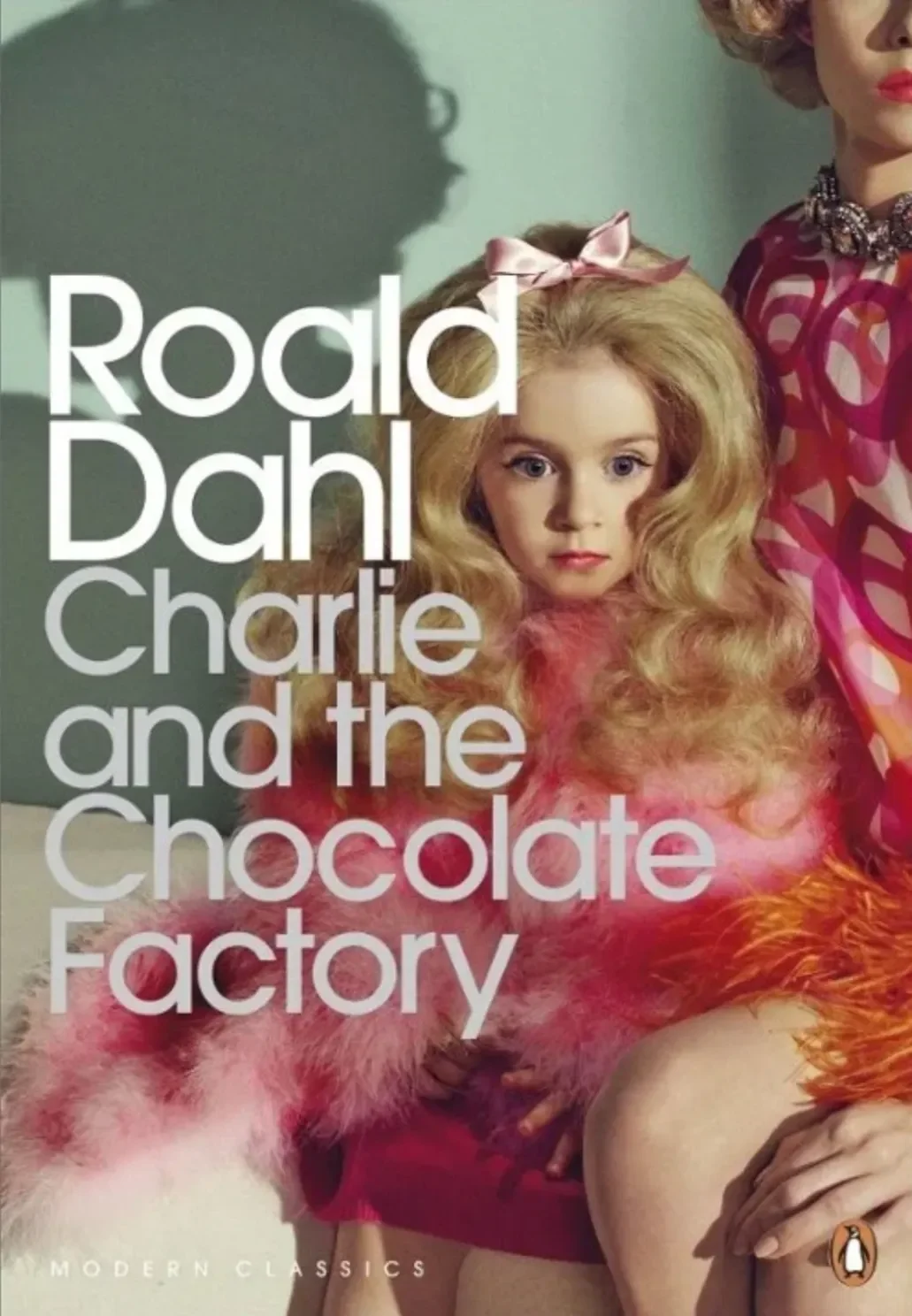
So far as my research will take me, this is the story of how it happened, why it was always going to go wrong, and what the whole sorry episode reveals about the relationship between a book, its cover, and the readers who feel they own both.
First, the Book Deserves Better Than This
Before we get to the disaster, let’s talk about what a good Charlie and the Chocolate Factory cover looks like — because the book has had a few.
The first US edition, published by Knopf in 1964, was illustrated by Joseph Schindelman. Dahl’s first choice had actually been Maurice Sendak (good choice) who was then in the process of writing Where the Wild Things Are, whose sensibility, with its roots in northern European folklore and its unsentimental view of childhood, would have been a natural fit. Sendak wanted too large a cut of the profits, however, and was also otherwise occupied making one of the great picture books of the twentieth century. Thus, Schindelman got the job.
It was a happy accident. Schindelman approached the book with what he described as a “Dickensian” feeling — all pen and ink, Victorian in spirit, slightly sinister (maybe) in execution. The illustrations understood that Charlie and the Chocolate Factory is not, at heart, a cosy book. It is a book about appetite and punishment, about the thin line between delight and dread. Schindelman drew that line.
The first UK edition, published by George Allen & Unwin in 1967, was illustrated by Faith Jaques and gave us a warmer, more domestic cover much closer in spirit to the classic British children’s book tradition:
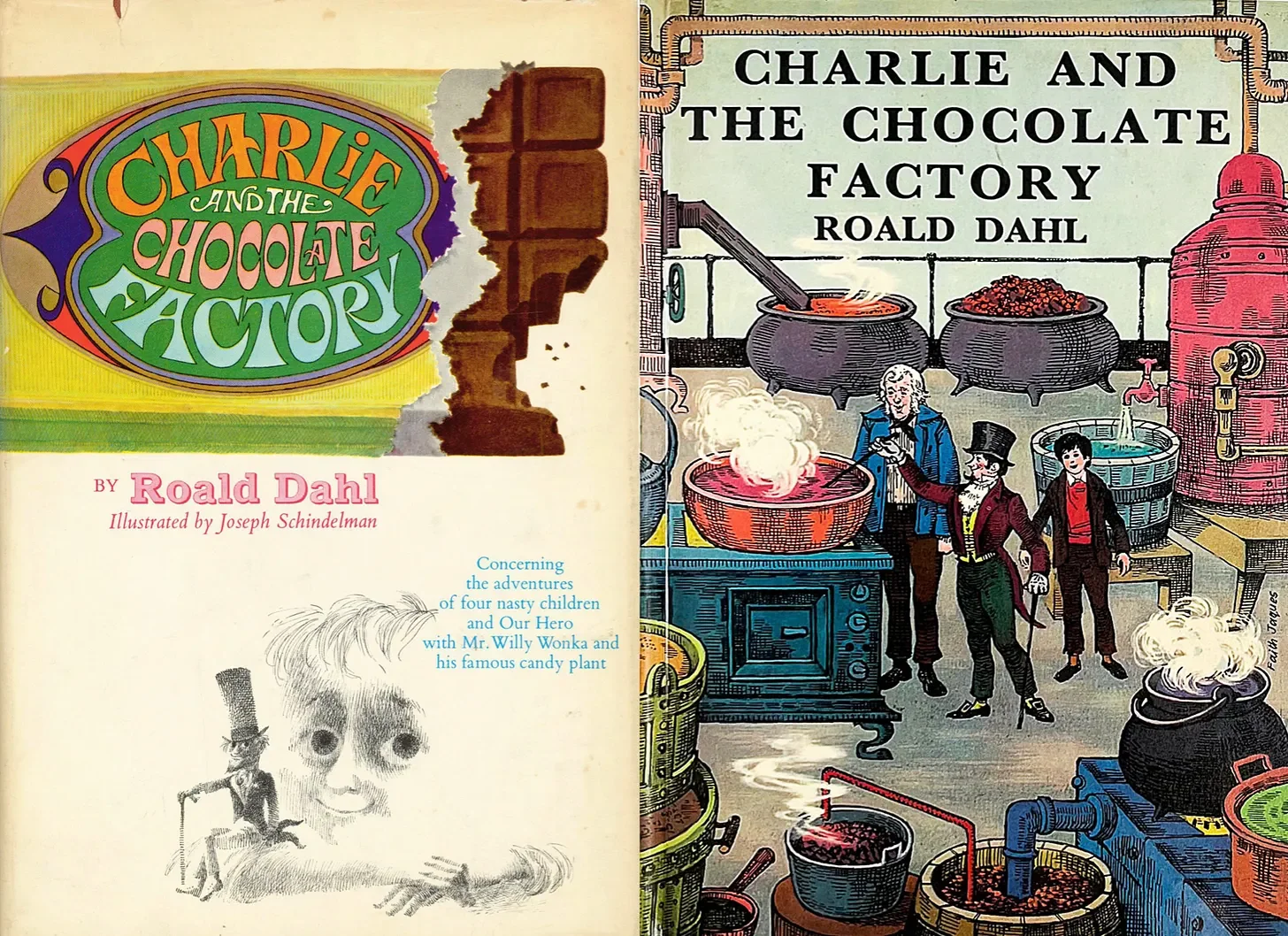
Then, in 1995 came Quentin Blake (I thought it was earlier than that too, but I triple checked), who was already Dahl’s most celebrated visual collaborator, whose scratchy, anarchic line drawings became the definitive visual language for the book in most readers’ minds. Blake’s illustrations have a quality that’s easy to underestimate: they look chaotic and spontaneous, but they’re so much more than that. His Wonka is thin and angular and slightly manic. His factory has genuine menace beneath the whimsy. His children are caricatures, yes — but caricatures in the tradition of Daumier, where exaggeration is a tool of moral judgement.
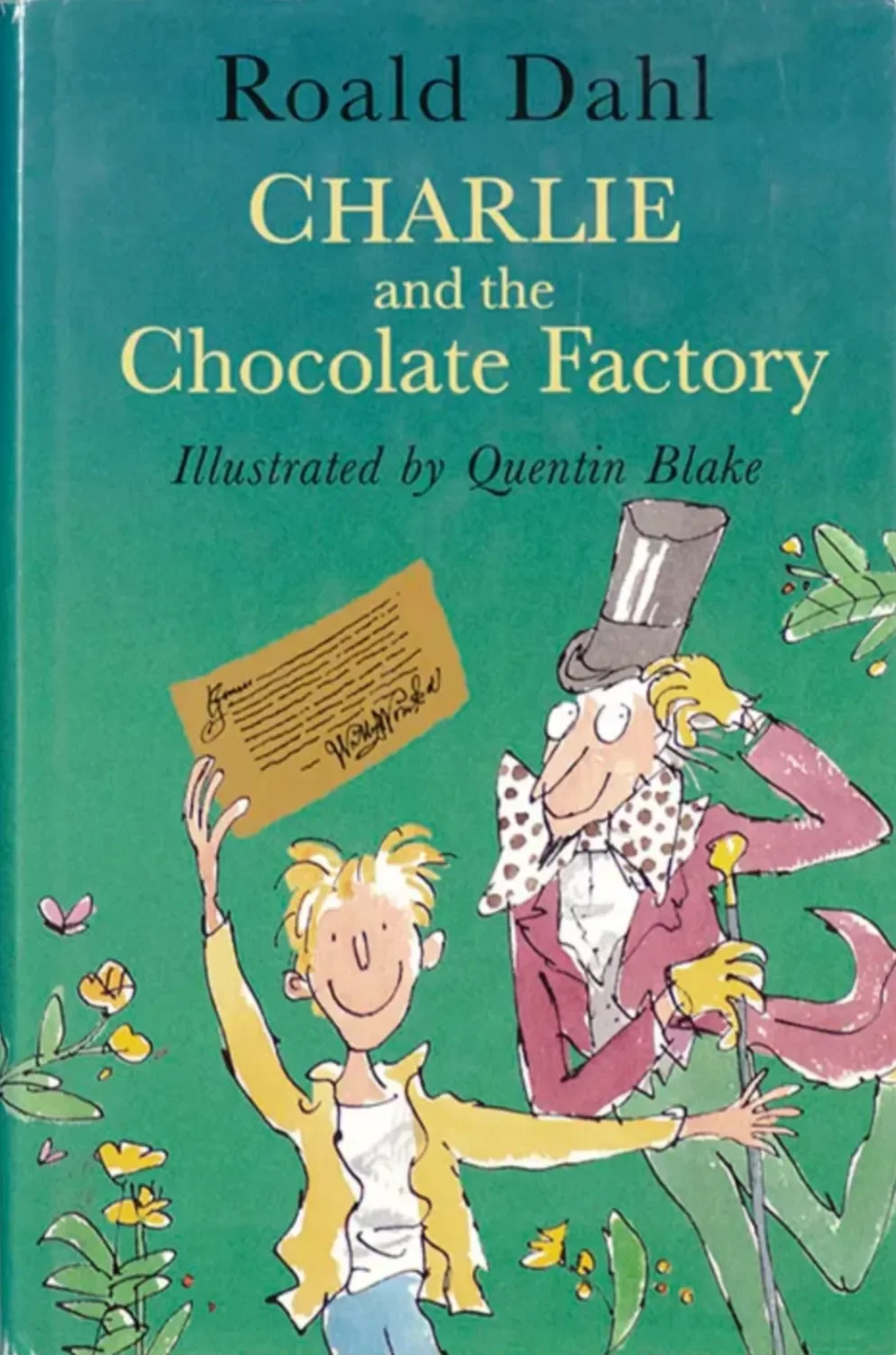
The point is: by the time Penguin got to the 50th anniversary edition, there was already a rich visual tradition around this book. Not a straightforward one, but a tradition that had always understood that Charlie operates on multiple registers. It is funny and dark and morally clear and visually inventive. Any cover worth the name should be at least some of those things… shouldn’t it?
The Penguin Modern Classics cover is none of them.
The Cover Nobody Commissioned
Notably, Penguin didn’t commission a photographer to create something new for Charlie and the Chocolate Factory at all. They licensed an existing image.
The photograph was taken by Argentinian photography duo Sofia Sanchez and Mauro Mongiello, a pair of talented artists who met in Buenos Aires, moved to Paris, won the prestigious Picto Prize for young photographers in 2002, and went on to shoot for Numéro, Vogue, The New York Times, The New Yorker, and a string of major fashion houses including Armani and Lanvin. Their work is characterised by what one profile described as “just the right amount of colour, a splash of surrealism, intelligent references and a perfect sense of dress.”
The specific image that Penguin used was cropped from a shoot that originally appeared in Numéro magazine in 2008 - that’s the image at the top of the post. The shoot was themed around Mommie Dearest, which means Joan Crawford, toxic motherhood and the grotesque performance of feminine perfection. The doll-like child in pink feathers, the cropped-out mother figure in garish fabric: in the context of a high-fashion editorial about performative parenting and maternal narcissism, is bang on the nose. It’s a knowing, sophisticated image making a pointed cultural reference.
Lifted out of that context, it becomes something else entirely. Let’s look at it again:
This is one of the fundamental problems with the cover, and it’s one that got very little attention in the subsequent furore: nobody designed this cover for the book. A designer, presumably someone at Penguin (who has never been named so far as I can tell), went looking in a picture library, found a photograph they thought was suggestive of Dahl’s “darker themes,” and licensed it. The gap between what the image was made to do and what it was being asked to do is enormous - you simply can’t build a bridge that big in the human mind and readers, even those who couldn’t articulate exactly why the cover was wrong, felt it in their bones.
The Facebook Reveal: A Masterclass in Accidental Honesty
Penguin unveiled the cover on their Facebook page with a teaser. They posted the image alone, without the title, and invited followers to guess which classic it would accompany. “We could give you a clue,” they wrote, “but that would be worth more than a golden ticket.”
It was, in retrospect, one of the more self-defeating pieces of marketing in recent publishing history.
The golden ticket reference was unambiguous. And yet, even with that clue, almost nobody guessed Charlie and the Chocolate Factory. As I said, the overwhelming responses were Lolita and Valley of the Dolls. When Penguin revealed the answer, the backlash was instant… which can’t have surprised anybody.
A cover’s first job is to communicate something — not everything, but something — about the book it contains. If the cover produces the wrong associations in almost every person who sees it, it has failed at the most basic level of its function. Penguin’s own teaser campaign proved the cover didn’t work before the book even went on sale. They just didn’t notice, didn’t care or maybe the Art Editor was on holiday.
The comments on the Facebook post numbered 677, and they were not kind. “Creepy.” “Sexualised.” “Inappropriate garbage.” Lolita jokes multiplied. Jon Benét Ramsey was mentioned repeatedly. Author Joanne Harris (Chocolat) tweeted: “I’m not sure why adults need a different cover anyway, but who was it who decided that ‘adult’ meant ‘inappropriately sexualised’?” Patrick Ness (A Monster Calls and stacks of others) went further, describing the cover as a publishing mistake on a par with the Hitler Diaries. The Guardian named it one of the worst book covers ever made.
Independent booksellers reported that they wouldn’t stock it. One called it “so postmodern, it’s not even relevant to the story.” A floor manager at a Washington DC bookshop, when asked about the cover, responded: “You mean, the worst cover ever?”
Penguin’s Defence (Which Made Everything Worse)
Penguin defended the cover. Repeatedly and with increasing desperation. Reading between the lines, it sounds like there was a budget and it had all been spent, so the book was coming out regardless.
Helen Conford, publishing director at Penguin Press, told The Bookseller: “We wanted something that spoke about the other qualities in the book.” The official statement released by the publisher read:
“This new image looks at the children at the centre of the story, and highlights the way Roald Dahl’s writing manages to embrace both the light and the dark aspects of life.”
Hmmmm.
They also clarified, apparently in all seriousness, that the girl in the image was not intended to represent either Violet Beauregarde or Veruca Salt, but was instead a representation of the “twisted” parent-child relationships depicted in the book. The cover, they explained, had also been approved by Dahl’s literary estate (which is a very long podcast interview I’d love to listen to).
Go figure.
Creative Review, the design industry’s trade bible, weighed in supportively, arguing that the image touched on “one of the main undercurrents in the book: the relationship between children and their parents, and what can happen when fame and fortune enter into their lives.”
If I’m generous here for a moment and engage with this defence on its own terms, is Penguin right that Charlie and the Chocolate Factory is a dark book? Yes. Is it right that the adult edition warrants a cover that signals that darkness? Possibly. Is the twisted parent-child relationship a genuine theme of the novel? It is.
But a cover that requires a 200-word explanatory press release to justify its connection to the book it’s covering has already failed. Design that needs to be explained isn’t working. The connection between image and content has to be felt, not decoded. Those are the basic rules of book design because it only has one job.
The defence also missed the central objection entirely. Most people weren’t angry because the cover was too dark for a children’s book. They were angry because it looked like something it shouldn’t. A child sexualised in a way that, whatever the artistic intentions of the original Numéro shoot, read as deeply inappropriate when attached to a book that generations of children had grown up loving. The image didn’t just fail to communicate Charlie. It communicated something disturbing instead.
What the Cover Gets WILDLY WRONG About Dahl’s Darkness
Roald Dahl’s darkness is not the darkness of Numéro fashion editorials. It is not sophisticated or ironic or knowing. It is the darkness of fairy tales. When Augustus Gloop falls into the chocolate river, it is funny and horrible. When Veruca Salt goes down the rubbish chute, it is a punishment that fits the crime with the satisfying precision of a fable. The darkness in Dahl is theatrical. It’s exaggerated and designed to give the child reader a shudder.
The Numéro photograph is none of those things. It is cold, not warm. It is alienating, not involving. It looks at the viewer from a place of fashionable detachment. It is entirely, fundamentally, the wrong kind of dark.
A cover that understood Dahl’s darkness might have been unsettling in a way that felt right — something with the quality of Schindelman’s original illustrations, or Edward Gorey at his most playful-sinister, or even a well-executed piece of graphic design that captured the heightened, artificial world of the factory. Penguin’s Modern Classics line has produced brilliant covers — the photographic editions of Fitzgerald and Kerouac are both excellent, both giving up something real about their books. The Charlie cover isn’t a case of the wrong approach. It’s a case of an image being selected without any thought whatsoever about what the book actually is.
Who Does a Book Belong To?
The row over the cover brings up a question that runs through all of book design but rarely gets asked: who does a beloved book belong to?
Chip Kidd, (I salute you, Sir) one of the most celebrated book cover designers working today, put it well when he was asked about the controversy:
“People respond the way they do because they care, and they care about the book the way they remember it.”
That’s the crux. Charlie and the Chocolate Factory doesn’t belong to Penguin. It doesn’t belong to the Dahl estate. It belongs, in the only way that matters, to the millions of people who read it as children, who carry it in their memories, who gave it to their own children. For those readers, the cover is not a neutral piece of packaging. It is part of the book. Changing it feels like a punch in the mouth, because in a very real sense, it is one.
This doesn’t mean beloved books should never be redesigned. The publishing history of Charlie shows that covers can and should evolve. From Schindelman to Faith Jaques to Blake, each iteration found something new and true to say about the book. Redesigns fail not when they change, but when they change in a direction that feels false — that imposes a sensibility alien to the book’s own spirit, that treats the book’s readers as an obstacle to be overcome rather than an audience to be served.
The Penguin Modern Classics cover treated its readers as people who needed to be told that Dahl was dark and sophisticated and adult, when those readers already knew that. They didn’t need educating.
All they needed was a cover that made them want to read the book again.
A Last Word
The Jaws cover — which I wrote about a few weeks back — is a story about how a great cover emerged from chaos and argument and accident. This is, in some ways, its mirror image: a story about how a bad cover emerged from overconfidence and a fundamental misunderstanding of what the book actually needed.
The lesson is the same in both cases. A cover’s job is not to express the publisher’s ideas about a book. It is not to signal sophistication, or challenge assumptions, or demonstrate that the editorial team has read their Freud. Its job is to create a bridge between the book and the reader, to find the image that makes the right reader pick it up and feel, before they’ve read a single word, that this is a book they need.
This one built a wall instead of a bridge, and then, when readers objected to the wall, Penguin explained at some length why the wall was actually a very interesting architectural statement about the nature of walls.
When really it was just shit.
Footnote: I looked through the first ten pages of a search on amazon and eBay for a copy of this anniversary edition and couldn’t see it. There is however, a single copy available on World of Books if you feel like adding it your collection.
Linda Perry: Let It Die Here
Am I excited about Let It Die Here? Apparently so. I do have a fair amount of enthusiasm for this album to come out and on those grounds, I guess I would also have to say I’m eager too but I think we can all agree that so far as definitions go, that one is pretty lousy and I expected more.
I’m not spinning my wheels like a kid who has half an inkling that the big box under the tree does indeed contain the Six Million Dollar Man action figure I wanted so badly but it’s probably close. I have been in awe of great songwriters for most of my life and, if we’re going to stick with the Christmas analogy, Linda Perry is right up there next to the five pointed star that’s almost touching the ceiling.
According to the Oxford English Dictionary:
Excitement
noun
a feeling of great enthusiasm and eagerness.
Am I excited about Let It Die Here? Apparently so. I do have a fair amount of enthusiasm for this album to come out and on those grounds, I guess I would also have to say I’m eager too but I think we can all agree that so far as definitions go, that one is pretty lousy and I expected more.
I’m not spinning my wheels like a kid who has half an inkling that the big box under the tree does indeed contain the Six Million Dollar Man action figure I wanted so badly but it’s probably close. I have been in awe of great songwriters for most of my life and, if we’re going to stick with the Christmas analogy, Linda Perry is right up there next to the five pointed star that’s almost touching the ceiling.
You know who she is even if you don’t know who she is. The former lead singer/songwriter of 4 Non Blondes (and with over 2 billion views on YouTube alone of What’s Up, you really do know who she is) didn’t get what she wanted/needed from that project and wandered off to do other things… sometimes amazing other things when it comes to songs. Christina Aguilera spotted her talent a mile off and no matter what music you’re into, you cannot deny that Beautiful is as close to perfect as you’re likely to get when it comes to pop:
But as is my way, I have shovels in the boot of the car both to bury bodies and dig them up. So whilst I am hugely appreciative of perfectly crafted and produced songs, my heart lies with the imperfect, the lo-fi… with the person that grabbed a guitar, sang a song that was in the moment and with that being enough, then took the dog out for a walk and grabbed a coffee on the way home. Thus, across the years, I discovered this mighty gem called It Fucking Hurts - which pounds Beautiful into the dirt:
I so wish I had written that. Everybody who writes songs should be sitting around wishing they had written that. It doesn’t stop there. From the same album (Deep Dark Robot - 8 Songs About A Girl), we also have You Mean Nothing To Me:
At which point, you should go and buy your own shovel and dig. Not everything worth finding is backed by a multi million dollar press campaign.
Anyway, all of this is a prelude to the forthcoming album, Let It Die Here, which ties in with a documentary of the same name, directed by Don Hardy, which is structured as a very personal portrait of Perry at a crossroads in her life and career and follows her as she reflects on decades in the music industry. I’m not sure whether I’m looking forward to the album or the documentary more but I’ll take both because I can, thank you very much.
Here’s the trailer:
Neither are due out until May - the doc even has a theatrical release - so I’m doing nothing more than throwing mud at the wall here, but following its unleashing I expect to go out into the world only to find many, many girls wandering the streets wearing crazy hats for no reason at all. Maybe they will even learn how to play guitar or piano - I believe it’s known as the ‘Scully Effect’1. That’s how you know your work is done and you were right all along.
Let’s wrap up with Linda and Billy Morrison performing Chasing Shadows because, well, Billy Morrison and Linda Perry. No justification needed:
Damn, I love great songs… he said, reaching for his Gretsch.

** The Scully Effect is the name given to a phenomenon where the number of women starting careers in typical STEM (Science / Technology / Engineering / Mathematics) professions saw a noticeable increase following the airing of the X-Files in the early 1990s. This impact is attributed to the prominence of Dana Scully, an FBI agent and medical doctor who is able to establish herself a career where women are underrepresented, subverting traditional gender roles and using her cognitive and professional abilities instead of her physical attributes.
AN EXTRACT FROM CITIES OF THE DEAD - PARIS
Until a few moments ago, I would have poured scorn upon any grown adult too timid to grab life by the horns and shake it upside down to see what fell out of its pockets, but as I perch here on a ‘seen better days bed' in a Parisian hotel that's barely one step up from somewhere George Orwell might have stayed, spreading cream cheese onto a bread roll using my finger as a knife, maybe I am the one who got it wrong.
I have taken an impromptu road trip to play in the Garden of the Reaper. There's something about the memorials the living set up for their dead that draws a bow across the soul-strings of our own mortality.
I’ve decided not to do any reprints of Cities of the Dead, though there are few copies left. It’s not that I don’t think it’s good–I think it’s great but it was never long enough. Just as I was hitting my stride with it, the old lockdown hit and the wheels came off the travel. Now that the world is normal once more (although that rather depends where you’re standing), I find myself in a place to pick up the pieces again. Anyway, I figured I’d let a few pieces roam for free here on the blog and what better place to begin than Paris. Let’s do this:

Photograph courtesy of my good friend Dirk Behlau
Until a few moments ago, I would have poured scorn upon any grown adult too timid to grab life by the horns and shake it upside down to see what fell out of its pockets, but as I perch here on a ‘seen better days bed' in a Parisian hotel that's barely one step up from somewhere George Orwell might have stayed, spreading cream cheese onto a bread roll using my finger as a knife, maybe I am the one who got it wrong.
I have taken an impromptu road trip to play in the Garden of the Reaper. There's something about the memorials the living set up for their dead that draws a bow across the soul-strings of our own mortality.
I have little doubt that across the world, there are millions of people who think about running away from their current lives every single day of the week. There will be those who think about little else to the point of distraction but are powerless to act through a lack of either resources or imagination.
There are likely to be just as many who don't act because the fear of the unknown holds them back. It is said that every man should know what he's running from and what he's running to - which is a simple enough equation as it stands, but believe it or not, most are too afraid to even look over the wall to see what shade of green the grass is.
I digress. Let’s go back to the beginning:
I woke this morning with an overwhelming desire to make the day count. I needed to do something to announce that I was still alive and not simply a slave to technology, children and dogs - and the best way to confirm blood was still flowing through my veins was by moving this body of flesh and blood to a place in which such things had run out. For this, I needed the assistance of a cemetery and the bigger the better. I made a few calls and little more than an hour later, I was in the familiar company of a designer cup of styrofoam coffee at Ashford International waiting for the Eurostar.
Destination? Paris.
To be more exact, Père Lachaise and the final resting place of a Mr James Douglas Morrison. If the name is unfamiliar to you, it's probably best that you walk away now. Having made that sweeping statement, we will also meet others along the way who may be also be interesting, so maybe it is worth sticking around.
Ashford International is satisfactory to say the least. Nothing more and nothing less than a place at which you show your ticket and then wait, clinically, for what ought to be one of the greatest trains on the planet to arrive.
The Eurostar is not a major event to tell your friends and family about in the way that say, the Orient Express is, but it's as good as it gets in the substance over style world we now live in. That it flies beneath the English Channel so fast that France is a reality in less time than it would take me to drive into London, is absolutely its biggest draw but it's not without its flaws.
Today, there is a very large man sitting in my booked seat. When I challenge him, he produces an equally valid ticket for the exact same seat - which rained on my parade somewhat. There are dozens of other empty seats in the same carriage so I sit in one of those instead. This has worked out fine. I get to sit by myself and the other guy? He keeps glancing over at me far too often, seething that the long haired one doesn’t have to sit with three strangers, all of whom are reading broadsheets and taking up far more room than the Bill of Human Rights should allow. Moving out of his line of sight, I shuffle across to the window so that he can't look at me anymore.
Today, I am travelling so light, I should be arrested. I packed no luggage - a suit will suffice. It has enough pockets to carry money, cigarettes, a passport and my phone. Does anybody really need any more than this for a two day trip? Any work that cannot be accomplished on a phone is not work that I want any part of. As for a change of clothes? I’m sure the suit can handle two days in Paris. Tomorrow, I will go shopping, buy a new set of underwear and a shirt and leave the old in the hotel - or maybe I will see if any of the homeless along the bank of the river would appreciate it.
The homeless who live on the Seine could not be more different than those of London. It looks very community minded and there are men shaving in mirrors. Only in Paris could it be imperative that you shave for your homeless day ahead. If I had more time here, I would like to talk to some of them and see if life here is really as it appears from up on the bridge - or as I suspect it to be, merely a brutal rest-stop between life and death in the garden.
I’ve travelled enough to know that the best way to discover the heart of a city - particular one that wears it on its sleeve - is to get well and truly lost in a Thomas O’Malley kind of way. The first thing you can’t help but notice is that certain companies have made it everywhere. Some, such as Starbucks are more than welcome for no other reason than I like their coffee. Others seem out of place. Why would Paris be accepting of a branch of Clare’s Accessories? If there was one thing Paris doesn’t need, it’s bringing down to that level but thinking about it, you would think the same if you were Parisian and found yourself in London. Which only really goes to prove that young girls across the whole of Europe like to be able to lay their hands on cheap garbage whenever possible.
The decline of western civilisation has settled in for the long haul.
I take a random turn into a side street and discover an art shop selling beautiful original oils and watercolours by local artists who will not be famous when they are dead - but that’s not to say the talent isn’t there because it certainly is. It’s not the first art shop I’ve dropped into since I arrived. None of them are average. They are all un-routinely beautiful and wonderful in their own way. The bigger problem is choice. If you are seriously in the market for a painting anywhere in Paris, you will struggle to commit - with each subsequent visit throwing up further canvases that will make you windswept and interesting by association. By the time you get all the way to the other side of the city, you’ll be too lost and too tired to go back and pick up the one you really wanted. If you want my advice, buy the first picture you fall for and make plans to come back for more.
The same cannot be said for the standard of chocolate for sale in Paris. The city has more than its fair share of places more than willing to contribute to your waist. The saving grace in all of this being if you choose to take on Paris by foot, you can walk most of it off along the way.
Jean-Paul Hévin is one store that I’d certainly recommend stepping into. I didn’t quite spend as much time in there as I would in, say, a bookstore, but walking in through one of his doors (there are several branches in the city) is a little like falling into a hot pool after walking the dog on a winter morning. Sampling is allowed and indeed totally encouraged by the staff which leaves you with a little guilt over not intending to buy anything. I don’t like to be thought of as a bad person - particularly in Paris as I have every intention of coming back here many times still - and I find myself leaving with a ‘barre aux épices' which I honestly have every intention of handing over to somebody as a gift when I return, but curiosity gets the better of me and this peculiar spicy bar finds itself non-existent very shortly.
Surely, this must be the pinnacle of a chocolatiers career? I stand in the street trying to inconspicuously remove spice shrapnel from my teeth with my tongue and notice that above the stores on both sides of the Rue Saint Honore there are apartments, rising four maybe five levels up. I have no idea what renting an apartment in the centre of Paris costs. I would imagine it to be similar to that of London, but I don’t know what that costs either. In a population of something like two million people, I imagine the people who actually live up there to be ‘interesting’. It’s probably better to imagine that they are interesting than to know the truth - which is that they work so hard, when they get home, they turn on the television and flake out before doing it all again the next day.
Paris, as you can see, is full of distractions. I’d like to keep my appointment with the reaper before it gets dark and reorient myself. Weaving through the districts of the city known as the 3rd and 4th arrondissement, is time consuming but essential. All of life is here. I get properly lost more than once simply from not paying attention. One moment I am contemplating whether I would like to live and die in the Rue D’Orleans and the next I have become captivated by the number of Americans who are (still) flocking to the Louvre - not so much in the name of art but in the name of Dan Brown. They can be heard saying exactly that out loud. I love America and a lot of my great friends are American but I think the smart ones amongst them would be the first to admit that an appreciation of classical art is not the best export to come from there.
I think Dan Brown may have achieved more for European tourism than the combined campaigns of all European nations since 1970. He has his distractors for sure, but I don’t see any of those people making Europe an exciting and fun place to be. That said, I can’t bring myself to go inside. I don’t have the time for it today. It’s certainly not a museum I would want to free-fall through in less than an hour, so I content myself with a few cigarettes and the fascinating street museum that is the human race itself.
The sound of a siren comes bearing down on me. The sirens in France sound like they mean business. They sound very important, like they have to be somewhere right now. Not shortly or as fast as they possibly can, but Right Now. I see the vehicle coming. I also see police hanging out of the side and the back of the van bearing arms. This is something I’ve never witnessed before. There isn’t even time to consider what they might be rushing to before the vehicle is long gone but it does allow me the luxury of being able to tell who the French people are in the vicinity.
None of them look up - just the rest of us who don’t live here.
•••
The entrance to Père Lachaise - we’re now in the 20th arrondissement if you’re keeping track - is quite something. You certainly know that you’re about to enter a place of worth that’s for sure. Weighing in at around 110 acres, I raised an eyebrow to find that it’s not always been the biggest show in town. That honour belongs to the finely named Le Cimetière des Innocents - a fourth century creation and home to over six million Parisians. Most of these are in the form of mass graves courtesy of the plague. There’s a figure doing the rounds that says over a five week period in 1498, 50,000 bodies made it this far. When you buff it up against the celebrity clientele of Père Lachaise, that’s a lot of people who never got the chance to make something of their lives. This one was closed in 1780 (overpopulation) and in 1786 the bodies were exhumed and moved into the unused queries near Montparnasse - known much better to all of us as the Catacombs.
If you think that’s pretty rough on the dead, whilst the exhumations were taking place, most of the bodies were almost wholly decomposed - meaning they had turned to magic acid (fat) which was carefully collected and promptly turned into candles and - hold your breath - soap. It also happens to be the cemetery where Armand hangs out in The Vampire Lestat, so all in all pretty harsh on the living as well.
Père Lachaise opened in 1804 on the site of a former Jesuit retreat and it’s estimated that over a million and a half people come to wander its 109 acres in an average year. I doubt that a very large percentage of those even visit the memorials of their own dead - a thought that made me feel a little guilty as I marvel at the magnitude of some of these memorials.
I know of more than a few people buried here and the shameful realisation that I have never been to Highgate muscles its way into my head. It has to be said that the memorial of Oscar Wilde is foul. He must be exhausted from rolling around in there. One of the first things you’ll notice here is that it appears to be standard practice to deface/scribble/graffiti - choose your own descriptor - the memorial of those you admire but this only applies to certain people. Chopin does not suffer this fate, so perhaps this says more about the living and how they choose to celebrate their icons than the dead themselves.
Other members of this exclusive family include my favourite artist of all time, Gustave Dore (though I have never been able to track him down in here), Balzac, Sarah Bernhardt, Edith Piaf, Bizet, Marcel Proust, Camille Pissaro and Modigliani. Considering how many people are actually in here, I feel I should be more familiar with more names than this.
Wandering without reason, I come across two Belgian sisters waving envelopes in their hands and looking as though they are about to do something wrong, or at the very least, foolish. When I asked what might be happening here, they tell me that to leave love letters in this crypt we’re all standing in front of, will bring them both true love in the future. They have no idea who this crypt belonged to and I had to figure it out when I got home. As of 1817, here lie the remains of Pierre Abélard and Héloïse d'Argenteuil - a philosopher and nun respectively whose love for each other is apparently legendary, though not so legendary that two Belgian sisters or myself have ever heard of them.
Fame, along with death, is apparently transient and all rather depends on the perspective of those observing.
I continue on my quest and discover along the way, families with picnics, young children who deem this to be the best mausoleum themed adventure playground ever and extremely old people paying respects to plots because you can still be buried here if you have the inclination.
There is much to love about how this cemetery is seemingly left to fend for itself but I suspect behind the scenes an incredible amount of work goes on to make it appear so. A man and his creative mind can easily get distracted for days in here if he’s not paying attention.
One thing is for sure. If you’re ever stuck for a cigarette in here, you can likely pick one up any time of the day from around Jim Morrison’s grave. This is the third time I’ve paid my respects to the man that taught me through music how much freedom meant to me.
What can I tell you, I felt the need to get together one more time.
On my first visit, it was a culture shock to find the grave of a man I thought to be larger than life itself squeezed into a plot that you certainly wouldn’t pick out for yourself if you had a choice. You wouldn’t even think it was a plot. If it was a garden, you would struggle to grow more than twelve broccolis here. That first trip, I was a teenager and it was also the period when there was a bust of Jim created by Mladen Mikulin sitting on top. The bust arrived sometime in the early eighties I think and at various times has had cigarettes wedged in its mouth, been spray-painted, pissed on, coloured in and had LSD rubbed on its face until finally, it mysteriously disappeared in 1988.
Assuming whoever stole it was in their twenties - which rather begs the question of how you can walk off with a marble bust without anybody noticing in the middle of a Parisian cemetery - that would make them in their forties now. Maybe one day in another forty years, somebody will be cleaning out an apartment above a chocolate shop and discover it. I hope it makes it back there one day. The bust was quite beautiful when it arrived. I’m not big on sentiment these days, but I hope Mikulin himself took it.
On my second visit, the plot was fenced off from the public with metal traffic barriers and there was nobody else here, which is possibly what I expected the first time. Not that you couldn’t have climbed over the barriers if you had really wanted to, despite the ‘Do Not Jump Over The Fence’ warning notice stuck to it. Maybe the thrill had gone out of my pilgrimage, maybe it was the incessant rain, but it seemed different on this occasion - aside from the missing bust. Jim appeared to have left the building for good. On that trip, it was nothing but a dirty headstone with a bin emptied out on top of it - there was certainly nothing respectful or homage like about it. In hindsight, maybe the Oliver Stone movie had pushed people over the edge. I wish I hadn’t gone and it took a long time before I wanted to go back again.
This visit is an altogether different experience. It is coincidentally five to one in the afternoon which pleases me more than it should - there are flowers and poems encased in cling-film and, as there always have been, some pictures of Jim left on top. Photocopies of pictures out of books. Just in case somebody who had got so lost in here happened to find themselves in this three foot by five foot plot and had never heard of him. Why that should apply to Jim and not the one million plus people who are memorialised here, who can say.
Visiting here as a teenager, and then in my late twenties and now in my forties, at no point did I feel the need to do anything other than acknowledge a man who gave me so much pleasure over the years (and still does). A salute is enough for me. No need to destroy the damn thing in the name of rebellion but I guess that says a lot about what Morrison means to many different people - though to be honest here, Jim would probably punch you in the mouth if he caught you wasting your time over such things. If you were listening properly, you’d know this.
A fitting end to this trip would be to walk out of the gates and feel melancholy about the whole thing, but the gates are miles away, so you have to pass by many other dead people and along the way, all of your melancholy will dissipate because Père Lachaise is not a sad place.
It’s too big to be sad but it is absolutely big enough to remind you to live your life while it’s still within your control to do so.

This photograph also courtesy of my good friend Dirk Behlau
Not A Halloween Post - Part One
It’s easy to take pot shots at newspaper articles but sometimes they deserve it. Yesterday The Guardian published an article titled Guardian writers on their scariest horror villains. All I was left with was a bitter taste in my mouth that suggested all of the writers involved didn't have a clue what they were talking about and had only ever seen three horror movies in their whole lives. When you’re one of the countries biggest newspapers, why not get somebody who knows what they’re talking about to write it? It makes me deeply suspicious of the rest of the content to be frank.
Annie Wilkes in Misery? Seriously? Nancy from The Craft? Rose the Hat from Doctor Sleep - a movie nobody has ever seen? Michael Myers? The lamest horror movie villain ever created (until Rob Zombie remade it into a genuinely great movie)? I don’t think so.
Thus, I spent all day thinking about where it had gone wrong for them. Determined to make a far superior list by drawing on my 40 odd years of horror flicks, I ended up with nothing more than a wall full of post-it notes for most of the day but eventually, I whittled it down to a top ten that at least satisfies me… and will allow my friends to text me saying: “you don’t know what you’re talking about…”
This is the way the world works.
In no particular order, let’s get it on:
Pinhead (or The Engineer to give him his original name)
Let’s focus here on the original 1987 movie not any of its nine (nine!) sequels nor the recent ‘reimagining’. By 1987, I’d watched pretty much everything that was available in every video shop in town - and a fair few that weren't too thanks to the back pages of Exchange & Mart where a spurious trade in bootleg tapes of video nasties lurked.
Already a big Clive Barker fan (mostly because I thought Rawhead Rex was fantastic but I might have been alone on that front), Hellraiser was a no-brainer to go and see - one look at the movie poster and I was all in. It just seemed different:

I’d never seen anything like it. It was everything I wanted in a horror movie. It looked cheap, it was dirty, all of the human characters were unlikable in the extreme, so by the time the Cenobites show up to take what’s theirs, you were rooting for them all the way and they didn't disappoint. Much like my first experience of a Harryhausen movie, the creatures don’t make any sense and that’s always a win in my book.
Pinhead also had all the best lines in the movie, including:
"Your suffering will be legendary, even in hell!"
“No tears, please. It's a waste of good suffering.”
and of course:
Hellraiser made over $14 million in the US but only £763,412 in the United Kingdom - £763,000 of which I suspect was my money. Genius always needs repeat viewings.
(A year or so later when it came out on VHS, I managed to convince the owner of the largest video store in town to sell me a promotional cardboard cutout of Pinhead which I appropriately nailed to the door of a cupboard. I miss the 1908s more than you’ll ever know..)
Black Phillip
One of the great things about horror movies is most of the great ones only have a very small cast - in the case of The Witch, if memory serves correctly, there are four… and a monstrous black goat called Black Phillip. Not strictly speaking the villain of the movie, but close enough, Phillip is made all the more wonderful owing to the fact that he’s a real goat. No CGI or costume (although he is substituted with a puppet at one point), just a monster goat. Even if you hate horror movies, you should read about him here. Such is his legend that I own a Black Phillip t-shirt and my buddy Nate has a Funko Pop! of him on his dashboard:

Anyway, what a great movie. There’s nothing about it that’s not great - including the movie poster:

Folk horror is fast becoming The New Black - I wrote a few weeks back about Starve Acre, but The Witch (released in 2015) is probably the first movie since the 1970s that really tapped into how effective it is.
(Nobody wants to know his real name is Charlie either. All hail Black Phillip).
The Babadook
I’m on a roll. This next choice is nothing more than a drawing in a kids book - and boy, what a scary movie this turned out to be. Another example of a fistful of people in the cast leaving so much room for the movie to play out properly, it’s a wonder nobody else has figured out that this is by far and away the best way to make a chiller.

The movie’s premise is actually an opportunity to explore parental grief but it’s so much more - including being the only Australian movie I rate. Ever… although I might give Picnic a Hanging Rock a nod of the head.
Babadook is the invention of the director Jennifer Kent and is improvised from the Serbo-Croatian word for the boogeyman: Babaroga. So good is this film that William Friedkin (director of The Exorcist) names it in his top five of all time.
I can’ resist it… here’s a clip:
Pazuzu
Unless you’re a total horror nerd, the name probably doesn’t mean a lot to you but you absolutely know who he is. He lives inside of Regan in The Exorcist. An assimilation of Assyrian and Babylonian mythology, you don’t even get to see him and he still reigns supreme. (For the record, unlike most sequels, The Exorcist III has one of the spookiest moments known to man in it. If you’ve seen it, you know what I’m talking about.)
Here’s a pic of the old man… not an actual picture obviously. I’d get banned from the internet:

I don’t think I need to say anything else about The Exorcist. Let’s move on.
The Pale Man
You can’t argue with this one. Let’s take a closer look at him:

We’re talking about one of the best movies ever made here. Not simply horror… but actually one of the best ever made - and it’s Spanish with no dubbing, making it a major win also. From the casting, to the creatures and screenplay, Del Toro made a masterpiece here and while Pan himself is the big draw, the Pale Man is uber-valuable to the telling of the story and the creepiest creature ever committed to cinema.
Spoiler: here’s the whole scene in which he appears:
Brilliant.

I’ll post the other half of the list tomorrow.
Time: Always Waiting In The Wings
This post is not about Kiss - but that’s how it begins.
A few weeks back, I signed up for what was the last ever Kiss show on Pay Per View. I figured that after spending my whole life in the Kiss Army, through thick and thin, it was the right thing to do. Was it enjoyable? Yep - it was great. I owe Kiss my teenage sanity, my tribe and probably my soul.
None of my Kiss friends were interested in it though and it ended up being an event I ‘attended’ alone - and I get it. Sometimes things belong in a certain time and place. In the real world, Kiss belong in 1977. If it had ended there, it would have been perfect but it didn't. (There are plenty of full 1977 concerts on YouTube if you’re interested). They were on fire. Scary. Powerful. They had the world at their feet. I was 10 years old and I loved them.
But that was then and this is now. Last night, I watched the Taylor Swift Eras tour video (it’s currently up on Amazon to purchase) and it crushed me into a small block of paste. It made Kiss (who, whether you like them or not, are well known for their show) look like small children who had been given some Lego for Christmas. This made me cross because it could have been so much better than it actually was, even though it really was great.
I first saw Taylor on the Speak Now tour about 13 years back (I’m sure somebody will correct me on that) and it was fantastic. I took my daughter under duress and came out a believer - but this latest tour is beyond anything I’ve ever seen - and I’ve seen a lot.
Sure, the movie has been made for a cinematic release but really… wow!
A three and half hour set. Check. Changing sets (including a forest and a swimming pool). Check.
Technology pushed to the max. Check.
No lyric monitors in sight - this is important to me because a lot of bands in the rock world use them and I think it sucks - you’ve got one job. Learn your songs. Err: Check.
Anyway - here’s what it looks like and it makes 99.99999% of all other areas bands look like they’re pretending:
There are deep dive articles into Taylor’s set (and the theatrical release) on a hundred other websites because writing about her practically guarantees double readership but that’s not what I’m here for.
This is a landmark moment in music/concert attendance because it sets a bar so high, it must be impossible to reach it. It’s like the world record of pole vaulting where you watch it happen at a championship level and wonder just how the hell anybody is ever going to jump that high again.
Sure, world records get broken all the time, but I just don’t see how this one will be. It’s more than about the music - which is of the highest order whether you like her or not. If you can’t see that, you’re just being tribal about your own thing. It’s more than going to a show as well. This whole “thing” is built on the shoulders of the fans. They are rabid. They’re supportive. They’re warriors. They’re influencers. They’re loyal.
They’re also mostly young and bankrolled - Taylor speaks their language. You might be remortgaging your house for a ticket but damn… a lot of that money was put back where it belonged. She’s on tour over here this year but I missed that fact and I too scared to look and see what my chances of getting a ticket are. You snooze you lose in 2024.
It will be a long time until something like this happens again at this level but there will come a time - and it may not actually be a million years away - in which virtual reality or A.I (maybe both) will be so accessible that a whole new concert experience will be available. If you’re a young kid right now - or not even born yet - this could well be the norm by the time you’re allowed out of the house by yourself.
Maybe with the assistance of VR, you could be there and at home at the same time - I know it sounds like hell for those of us who grew up getting our feet stuck to beer stained floors but something like this is coming whether you like it or not.
And yet - one of the best shows I’ve been to in the last five years was Steve Conte at The Slaughtered Lamb in London. Venue capacity: 120 sweaty people - standing. Here’s then only clip of him I can find online from that night doing Teenage Kicks with Duncan Reid (from The Boys):
All of which goes to prove that time changes everything. One minute you can be ruling the world but at some point, somebody younger and slicker than you will come along and stand on your shoulders to do their thing, that’s kind of like your thing, only better and for different people.
It also proves that even though I admire what Taylor Swift has achieved and would count myself as a pretty big fan, I’d still prefer to be with 119 like minded souls in the basement of a bar in Clerkenwell. You can take the man out of the club but you can’t take the club out of the man.
Meanwhile:
I’ve got The Secret Hours from Mick Herron on the boil at the moment and it’s excellent:

The Slow Horses series is superb (and hats off to the Apple TV adaptation too which is one of the best shows around by quite some margin) but these stand alone novels are just as good. I’m about halfway through this but it’s already propelled itself to the top of the ‘not Slow Horses’ series. One day, in the not so distant future, the critics will figure out that Herron is every bit as good as LeCarre - if not better because the world is now a far more complex place to be spying than it used to be.
[Side note: All these years later, I still don’t quite understand how something can have The Number One Bestseller printed on it before it’s been published. A little research suggests that a reasonable sales figure for a hardback is between 250 and 2000 in the UK. This of course, might be relative and therefore, it is indeed a bestseller but it still seems a bit low to me when you compare it to say, an Arsenal match where 50,000+ will turn up...every week. That would be a good subject for a podcast don’t you think?]
The new Duran Duran album, Danse Macabre, has also been making its presence felt as the soundtrack to the week:

They might not be setting the chart on fire, because the passage of time is always a cruel thing at the best of times, but the original songs on the album are fantastic - especially with some volume behind them. The second half of the album comprises a fistful of well known covers which all bring something new to the party too - with the exception of Ghost Town, which I have always hated, but the beauty of streaming is I can delete it from ‘my’ album and never have to think of it again.

In The Heat Of The Night
So there I was, sitting in an airport departure lounge with my crime novel, minding my own business when a ‘famous person’ came to sit down next to me. I should point out this is because it was the only chair available and not because she thought I would be great company while we waited for the boarding gates to open.
I spotted her coming halfway across the room but kept my eyes more or less glued into the pages where Steve Carella was doing something very important for his deaf and mute wife, Teddy.
Steve Carella works for the 87th Precinct and is the best detective on the squad. He's more than likely the best fictional detective of all time, but this is not a fact that has been allowed to gain traction out in the wider world. If you took a poll of 100 crime fiction lovers, his name probably wouldn't even come up once - unless I happened to be one of them I guess. Once upon a time, I thought he was so cool, I wanted to be him - I even wanted a deaf and mute wife to get closer to the dream but then, I was only 14 and we’re allowed such odd ways of looking at the world at that age.
So, there I sat with my eyes firmly planted inside of Give the Boys a Great Big Hand because to raise them and say hello would mean to acknowledge I ‘know’ who she is, when actually, she is famous for No Reason At All. No respectful reason anyway… and if she was that damn famous, she sure wouldn’t be flying with BuzzAir and sitting in a fake comfortable chair next to me.

Anyway, she’s hammering away at her biblically sized phone with fingernails she bought from a shop and, from the corner of my eye, I see that she has booted up her camera app. I assume she is going to take a selfie, which she does - two or three of them - because nobody that gets their fingernails from a shop can go longer than five minutes without taking one. Then, she tries to take a picture of the tattoos on my arms without me noticing. Well, I think that’s what it was all about… either it was the tattoos or she liked my watch or she quite fancied the look of my book.
She muscled all of these things into one shot and she pauses as she is about to share it with her Magical World Of Friends in which she is followed by 375,856,053 people, when I interrupt:
“What are you going to do with that now?”
She flinches. Rumbled.
“I liked your tattoos. I was going to share it with my friends. Can I tag you in?
“Sure. Why the hell not.”
“What’s your name?”
“Steve Carella. C-a-r-e-l-l-a.”
“What do you do?”
“I’m a detective.”
“Really? You don’t look like one.”
“I wouldn’t be a very good detective if I looked like one, would I.”
“I guess. Wow. That’s really cool.”
“Don’t come crying to me if you get a visit from my boss after you’ve shared that.”
Fingernail Spice hovers her nail above the ‘post’ button.
“How come?”
“I can’t tell you. Undercover - but these aren’t real tattoos.”
“Oh.”
“This isn’t even my real hair.”
On which note, I find myself no longer a person of interest and my picture is deleted from appearing in The Timeline Of The Universe.
But for one fleeting moment there I was Steve Carella.
Dreams still grow even when you forget to wish.

Heroes

You ever have a hero? One you could rely on deep into the grave? In the last ten years or so, the term ‘hero’ has been taken away from people we idolise and handed back to people who do things like spread themselves across live grenades so as a bus load of school kids don’t have early funerals… and rightly so, but for the purposes of this piece, I’m rolling with the former because choosing something else doesn’t come close for me.
I’ve had a few and as the years have gone by, they’ve never let me down. Some are so obvious, they’re hardly worth mentioning if you know me. Paul Stanley from Kiss and Alice Cooper are the big guns. Their philosophy is not so different despite their (seeming) rivalry.
There’s also been a few that were a sign of the times - that I picked up and put down as I needed them - which might actually be the whole point of even having a hero.
I was obsessive about Bjorn Borg for a while simply because he was the ‘whole game’. I’m not sure what I got out of it but there it is. Boris Karloff was another… again, because when it came to monster movies, he was also ‘the whole game’. Bret ‘Hitman’ Hart - the whole game. There are a few others like this. Short life-spans with no other purpose but to dam the river when needed
But when it comes to books, it’s not so simple for me. Neil Gaiman came close, not least because I once picked up The Doll’s House Sandman graphic novel on a whim one Saturday afternoon back in something like ‘90/’91 (whenever it came out) when I was headed to a weekend-long party and was early for the train. (Of note here is that the money I spent on the book was supposed be money set aside for booze… go figure).
It had all the makings of the kind of party everybody talked about for years but I wouldn’t know. I spent the entire two days with my head in that book, drinking tea and eating whatever food my then (very understanding) girlfriend chose to put in front of me. Having presumably finished the book, I vaguely recall something about being chased by a horse in the dark and going home alone (natch). It was a long time ago but Gaiman has been pretty consistent and I’m still with him… but so is the rest of the world and that makes him a lot less attractive these days as a name to bandy about. These days I’m more likely to waft Michael Chabon’s name in front of your face as a name of somebody you should be reading. Mr Gaiman needs no more assistance from me at the moment.
Stephen King came close to a lifelong thing but wobbled too much and got replaced by Clive Barker… who also wobbled, but when I went back to King he was still too unstable for me. I keep up with them both still but it’s probably unreasonable to expect either to still be on their respective mountain tops, standing on one leg and juggling a very singular crown - particularly when John Connolly came along and whitewashed both of them for me.
Anyway, as the years have trickled by, those I didn’t recognise as heroes for the longest time have risen to the surface. Most of them were dead by the time I figured this out which gives it a certain kind of closure. It’s unlikely that they will become zeroes anymore - the work is complete. Raymond Carver, Hemingway, Steinbeck, Kerouac, Orwell and Dylan Thomas have weathered that storm with a certain grace I can only dream of but then, there’s this man:
One of the really big deals for me out in the world is J.D. Salinger. Aside from his books being some kind of misinterpreted influential template for my own work, I liked the way he went to his grave with two fingers in the air over never having his books made into films and how digital books could kiss his ass. It’s not how he wanted things to be and credit where it’s due, his estate continued to pipe cement into that wall since he died.
Until a year or so back:
His son, Matt, the very man who been mixing that cement since 2010, was interviewed by the New York Times and the article brought up some important things - namely, this:
‘…during a trip to China earlier this year, he realized that many young people overseas read exclusively on phones and digital devices, and that e-books were the only way to get his father’s writing in front of them.’
and from the horses mouth:
“He wouldn’t want people to not be able to read his stuff.”
And while we can sit here all day and argue that both Catcher In The Rye (55 million copies in 30 languages!) and Franny and Zooey are both still widely available in paperback (show me a bookshop without either and I’ll show you a bookshop without clue), the world has changed - and continues to change - bringing into sharp perspective my own observation that a book isn’t a book unless it’s actually being read. If somebody is not devouring the story, it’s just some paper with some thicker paper on the outside that lives on a shelf to show other people what sort of person you’d like them to think you are.
It brings up all kinds of horrible questions I never want to have to answer about what constitutes as ‘reading’.
But in the end, he’s right and if that’s the opinion of the last bastion of something I hold so dear, I need to swallow a plateful of humble pie topped with pride and also get to work on making things available digitally. It’s not so long ago that I seem to recall saying “Once you can read a book on your phone, the game will be over” and I would have been at least partially right.
There will always be those who love a physical book, how it feels in their hands, what it means to them and how they remember where they bought it from. Those are my kind of people but I’m damn sure that whole Gaiman episode I described above would never have happened if I had downloaded The Doll’s House to a portable reading device. Things change and time moves with it eventually crushing everything in its path that doesn’t want to ‘flow’.
It’s sad, but I guess it’s not sad at all if you’re under thirty. If you’re under thirty, it’s just the way things are and the way they’ve always been.
Out there in the world somewhere, there are most likely people for whom eight track was the Bees Knees too.
Time, huh. Can’t live with it…

Footnote: Salinger also had a good line in quotes, so here’s a few of my favourites - all of which sound a lot like things that come out of my own mouth…
I’m sick of just liking people. I wish to God I could meet somebody I could respect.
It’s funny. All you have to do is say something nobody understands and they’ll do practically anything you want them to
There are still a few men who love desperately
I’m just sick of ego, ego, ego. My own and everybody else’s
If you do something too good, then, after a while, if you don’t watch it, you start showing off. And then you’re not as good anymore

HUNDRED YEAR OLD WISDOM
“I think we ought to read only the kind of books that wound and stab us. If the book we’re reading doesn’t wake us up with a blow on the head, what are we reading it for? So that it will make us happy, as you write? Good Lord, we would be happy precisely if we had no books, and the kind of books that make us happy are the kind we could write ourselves if we had to. But we need the books that affect us like a disaster, that grieve us deeply, like the death of someone we loved more than ourselves, like being banished into forests far from everyone, like a suicide. A book must be the axe for the frozen sea inside us. That is my belief.”
(Franz Kafka in a letter to his friend Oskar Pollak, 27. January 1905)

ALL WE NEED IS JUST A LITTLE PATIENCE
Expectation. The Mother of all Disappointment. I should keep a lid on it, right?

Once upon a time, I picked up Jonathan Strange & Mr Norrell at an airport as I was on my way to some far away beach for a two week break. It was a monster of a hardback and frankly, I might as well have stayed at home because all I did for those two weeks was stick my head between its pages and eat crepes.
When I was done, I pronounced it to be the best book ever written (finally unseating Clive Barker’s Imajica which had held the spot ever since ummm… whenever that came out). Honestly, it blew my mind in every way: the craft, the story, the patience, the vision… it was all there, punch after punch.
I even wondered why anybody would even try to write another book if they had read it.
Fast forward far too many years (and a pretty good TV series later) and her next novel - Piranesi - is finally making an appearance… in September. That’s six months away!
Meanwhile, the greatest crime writer of the last twenty years - John Connolly - has also has his latest shoved to the back end of the summer as well:

What’s a man supposed to do?
Throw in the postponement of the Bond movie as well to around the same time and September/October is starting to look pretty busy.
Tolkien had it bang on the money when he said: “All you have to is decide what to do with the time you are given between now and when No Time To Die is released”.
I think that’s how it went anyway.

WAR-CHEST
Today is Day 17 of the 30 day 50 press-up challenge. It’s tough (and it really shouldn’t be) but the challenge is still alive and that’s the important part. I actually feel a bit of a pussy for not being able to simply drop and burn off 50 press-ups in the first place but I wonder what percentage of 50 year olds can anyway. I suspect it’s pretty low. Maybe even less than 1% of the population.
I’ll just continue. Mr Downes - my challenge partner - suggested we video the last day of doing 50 all at once but I’m not so sure about that. I can live without a million people pointing out incorrect form… assuming I don’t fall apart before the end.
Meantime, it’s hard to get things moving around here right now… it’s probably the same everywhere. My calendar says that today was the day I was supposed to book myself a rehearsal space to lay down some vocals on a few songs but that’s not going to happen. I could do it at home in a more basic format so maybe I will. No excuses but it’s kinda rough when your dog loses it every time somebody walks past the window. I guess I’ll set up the gear and just be opportunistic about it.
It’s pretty scary how quickly time slips through your fingers though. I shot a phone video of myself running through a version of Gretchen Peters’ Blackbirds a few weeks ago… only to discover When I came to look back on that it was actually in November. That’s not good. I’ll post it over on the Deadbirds page later when I get back on a Big Machine.
Why it’s hard to get things moving is a mystery. All of us who are in good health and not working should have amazing amounts of time on our hands. I should be picking a song I love every day and throwing a cover version out just because I can. Then again, everybody who is/was ever in a band should also be picking up an acoustic and posting daily goodness somewhere online. It would be good for careers, good for morale and they’d make one hell of a lot of new fans along the way… but mostly because I want them to.
Maybe they all have dogs who don’t like people walking past the window too.
CHECK-IN
I’ve become… no, that’s a lie. I am getting pretty good at multi-tasking. It took me a few days to grasp hold of how to do it properly but I’m getting there. The key is figuring out what’s ‘manual labour’ and what’s not. Here’s a great example. A week or so ago I challenged a friend to this (today is day nine):

That’s a manual labour kind of thing - so what can you do while that’s going on? Today, it’s accompanied by Joe Rogan talking to Brian Greene (theoretical physicist, mathematician and string theorist - sounds dull but far from it). Push-Ups don’t take too long though (though some days, it seems like they do and I don’t expect it to get any easier) so that’s followed up with Tai Chi. Probably not ideal background noise for it but after a while, you could do your Tai Chi on a building site because you do get good at separating what you’re doing physically from what you’re doing mentally. I think so long as you do take some time out to do it in silence or whatever your music of choice is, then that’s OK. Doing it at home rather than in a class is more about ironing out the things I’m doing wrong or tweaking them to be better - or at least it is for me.
Air-bud in the ear - just the one - Mr Rogan comes on the dog-walk. It’s weird out there at the moment. The people we sometimes stop to talk to are keeping their distance but the dogs could care less, so that’s a good thing. Sometimes, Rogan comes with us, most days though, it’s music... which also doubles as time for learning lyrics. I have a real hatred for anybody playing live and reading lyrics off a sheet. It just seems wrong.
For some reason, I don’t get on with audiobooks on dog walks. Not sure if that’s my fault or the narrator but perhaps it has something to do with pacing.
The dog walks have been long lately too. An hour and a half is not unheard of. Might not seem a lot to some of you dog-people out there but we go and do the same thing again about 3 o’clock which clocks up about 6 miles a day. That’s a lot of lyric learning while you’re doing something else.
By the time we’ve done the dog food thing, the coffee thing, the breakfast thing and whatever other satellite things there are to take care of, it’s pretty much noon - which is the time I like to start work. Why anybody would want to start work before this I have no idea. From what I recall of the normality of 10+ years ago, people just zombie around doing nothing before lunch.
Not a bad morning so far. They’re not all the same but that’s the kind of groove I’m in. There’s also some space in there for clearing the decks too. Throwing washing in the machine takes about two minutes and the point of that is how much it clears out the day of junk so that I can get on with things that are important.
Which is what? My mag died back in February which left me with some time on my hands to say the least. I kicked back for a couple of weeks and as I came out of that, the world started to get weird. It was pretty strange having your identity as a magazine editor stripped away (and then it just got stranger) but it also seemed like a good time to move things around and put things in place for whatever comes next for both me and the way the world will be.
It begs the question of exactly what it is you want to do with your life and you should really try and answer it because it’s your life. I came up with a simple list and though it would be great to only want to do one single very important thing, I don’t think the world is geared up for that kind of laser focus anymore. So my list, contains two or three things that are all related:
Write the books I want to read
Write songs only I can write (lyrically speaking)
Design books I would pick up based on the cover
Write songs for other artists
And that’s pretty much it - and they are all the same because they all start with a pencil and a piece of paper, sometimes this means also picking up a guitar or booting up InDesign, but mostly, for me, it’s all the same thing with different tangents.
And as much as I loved my job, it made me lax at doing the things I wanted to do because there was no urgency. There never is all the time you are being paid and your existence is being taken care of. As bad as it is out there right now, it does provide a monster of an opportunity to grab a hold of your life and get moving. If you want to be the new Ray Harryhousen, there’s time on your hands to get moving - that’s a good example because I can’t think of anything else that takes up so much time whilst it appears that you’re not going anywhere very fast at all… and any opportunity I have to introduce his work to somebody who may not know who he is, I’ll take it.
More tomorrow.
THE GODS OF LITERATURE ARE SMILING UPON ME
Being ‘busy’ can be an excuse for anything but it’s not a good excuse when it comes to missing out on a nugget of news that you’d normally file under ‘life or death’.
In this case, the news that Susanna Clarke has a new novel coming in September. It may have taken her ten years to write Jonathan Strange and Mr Norrell but from where I was sitting when I disappeared for two weeks to Fuerteventura to do nothing but read that, swim and drink orange juice, it was worth every day.
Have I proclaimed it to be the greatest novel ever written? Yes. Many times over.
Anyway, assuming you missed it too (and assuming you care) it’s called Piranesi and so far as I can gather, it: follows the story of its eponymous hero, who lives in the House, a building with “hundreds if not thousands of rooms and corridors, imprisoning an ocean. A watery labyrinth.” Occasionally, he sees his friend, The Other, who is doing scientific research into “A Great and Secret Knowledge”. Piranesi records his findings in his journal, but then messages begin to appear, and “a terrible truth unravels as evidence emerges of another person and perhaps even another world outside the House’s walls.
Count me in all the way up to my shoulders.
Off the record, I’m going to put some (ie: a lot of) work into the cover art for it because out there in the big world, stranger things have happened.
They really have. Be careful what you wish for because you might spend the next ten years of your life at it.
WE WILL WALK
It was Eleanor’s birthday yesterday and we found ourselves at the Turner where they were hosting an exhibition called We Will Walk:

Not the kind of exhibit I’d normally get a kick out of but it’s probably the best one I’ve been to in a really long time. Here’s the official line:
We Will Walk – Art and Resistance in the American South is the first exhibition of its kind in the UK and reveals a little-known history shaped by the Civil Rights period in the 1950s and 60s.
It brings together sculptural assemblages, paintings and quilts by more than 20 African American artists from Alabama and surrounding states. The artists represented in the exhibition lived through the Civil Rights struggle and its aftermath, often in conditions of poverty. This art is characterised by the remaking and reuse of materials through necessity, custom, culture and innovation as well as a vital connection to place and nature. The exhibition also features Civil Rights music and documentary photographs that reveal the links between the art and its context.
I didn’t think I would enjoy it simply because my roots don’t lie anywhere near Alabama… but maybe that was the point. I don’t normally have my eyes opened by exhibitions (I guess you can see one too many) but this one is well worth talking about.
I came away with a new found respect for how, when people need to make art as a means of self-expression, they will find any means necessary - no matter what colour their skin. You can get very used to pressing some buttons at amazon to have supplies delivered as fast as humanly possible… and that can take away exactly how urgently you need to create to the point that you might be creating for the sake of it.
When the work you did on the back of a cardboard box over 100 years ago can move a man who’s not from your culture with no real understanding of what you went through, you really did something right.


IN THE MUSIC ZONE TODAY
The year has started slowly - my own fault. I took a few weeks to recalibrate myself and when I came up for air, I was looking down the barrel of a magazine that needed to be put together very quickly indeed… and now it is done (more or less anyway) I need to get my head around the coming year. Not that I do things in ‘years’ but it seems like a good way to look at things from the point of view of a blog.
I was about to write: “I need to get my ass in the get stuff done lane” but that would suggest I’ve done nothing at all and that’s not true. I’ve developed a taste for playing guitar like Colter Wall and it’s not natural to me in any way, so many hours of many weeks have been dedicated to pursuing the Holy Grail of January. Here’s the clip that got my most watering like a leaky hose.
I’m writing, so that’s a good start but the downside of playing a lot of guitar, chiselling away at a book idea and keeping The Mag on track is that aside from Tai Chi and walking Hector, I haven’t been anywhere to talk about anything.
A few new albums have turned up to keep me company though (probably posted on instagram because it’s not much use for anything else) but to help me along, I’m on a big news/TV blackout and instead of letting what hours are available slip away through the remote control, I’ve been cooking meals - the kind of meals that human beings are supposed to eat - which is pretty cool actually.
Meanwhile, being as it’s Saturday and everything, here’s a couple of movies/docs that look like they might be worth tracking down:
A DEAD ZONE
I took almost a year off from blogging. I figured I’d drop this in here to explain why there’s a hole the size of Norway in the timeline.
Did I enjoy not writing here? Not particularly, but sometimes you can do something for so long and forget why you where doing it at all - that’s what happened.
FIRE IN THE HOLE
I was in my studio playing a little guitar when, from across the gardens at the back of the house came the smell of a barbecue and the sound of something called ‘we’ve got friends round’.
I pressed on with figuring out Chelsea Hotel #2 until it got harder and harder to concentrate what with the uber volume of football talk/latest fashion talk and the smell of 300 sausages rocking their skins off on a grill.
I sat there for a while with Bess on my lap and tuned her up again while half listening to the conversation.
I guess stereotypes become stereotypes for a reason. A bunch of guys talking about the game and a bunch of girls talking about their dresses. Not the amazon burning down, not Christmas, not what books they were reading or even the weather. Football and dresses.
Maybe that’s why we never have barbecues or friends round - because we don’t have the necessary social skills to pull one off with any grace.
Then again, I would have been straight over there if words had come sailing over the fence about how much everybody thought the latest Bosch novel was better than the last or how one of them had rummaged out Albert Finney’s Wolven and was doing cartwheels because it was as good as they remembered it to be.
Anyway, I persisted with Bess for a while and then called it a day because the smell of those sausages had set off that thing inside me that says I too must eat - but first I figured I’d have a cigarette with my dog at my feet.
Down at the other end of the garden, I could see the barbecue party in full swing over the fence and I guess it’s relevant at this point to say that the guy who lives up the street is a fireman. At least I think he’s a fireman - something like that - and all of his buddies over for sausages? They appear to be firemen too.
Either that or they’re all members of The Avengers.
Gym. Check.
Running. Check.
More gym. Check.
Football. Check.
Multiple fighting arts. Check.
Tops off.
Tops off? Jealous? Me?
I can’t remember the last time I went out in public with my top off. I’ve been swimming now and again but aside from that the last time I can 100% remember having a naked torso in public was 1989 at a party.
I’d left my cigarettes downstairs and for some reason, couldn’t find my clothes (best not ask why I was naked in the first place) and went down to get them with nothing but a sock on so as I didn’t scare anybody… hey, it was a long time ago and a rock n roll party. I guess parties like that don’t happen anymore unless you’re a bunch of middle-aged swingers or something. So far as I can tell from my kids, parties in 2019 consist of sitting around with a few beers and looking at Facebook on your phone - ironically, something I’m pretty grateful about.
Anyway, I’m giving it some side-eye over the fence and there are all these firemen in nothing but shorts looking fine, fine, fine. I must have hit my head on something because there’s women there too, but there I was looking at firemen.
“You’re jealous!”
Yep. That’s what the voice in my head told me and I couldn’t find a single rung to stand on in my own defence. I’ve never looked like those guys in my life. The only reason I had the grit to go downstairs naked at that party was because back then, a Space Raider sandwich a day was as good as it got when all your other money went on cigarettes, books and pyro for your band. Total calories a day? About 200. I wouldn’t recommended it as a healthy diet but it worked.
And it’s not like I’ve spent my whole life sitting on my ass either. I’ve joined gyms, martial arts training (even fought a guy from Russia in a competition once who looked like Dolph Lundgren and made it out in one piece), walked one hell of a lot of miles but still… I have never, ever looked like a fireman (or whatever it is those guys at the barbecue do).
I closed the curtains and stripped down to my pants. The dog is wondering what the hell I’m doing because standing in front of the mirror in your pants sure as hell doesn’t look like heading out into the hills.
It could be worse. It could be a lot worse - but it could also be better. I look like a man on fire not a fireman.
Do I even know this person anymore? Maybe the sock would be the only thing that still fits me from back then and that’s probably wishful thinking as well.
I need to do something about it. I don’t think I’ll ever look like a fireman and maybe I don’t need to because I have no intention of carrying people down a ladder in the middle of the night, hacking down a door with an axe or making a calendar for charity, but somewhere inside my head there’s a little voice saying ‘figure it out before it’s too late’.
Then again, I have got more hair than all of them put together, a dog that doesn’t fit into a handbag and come midnight, I won’t be wondering how to get rid of everybody from my garden because I want to read a book either.
Gratitude. I’m working on it.