The Fiction Will See You Now
Essays on my favourite albums of all time
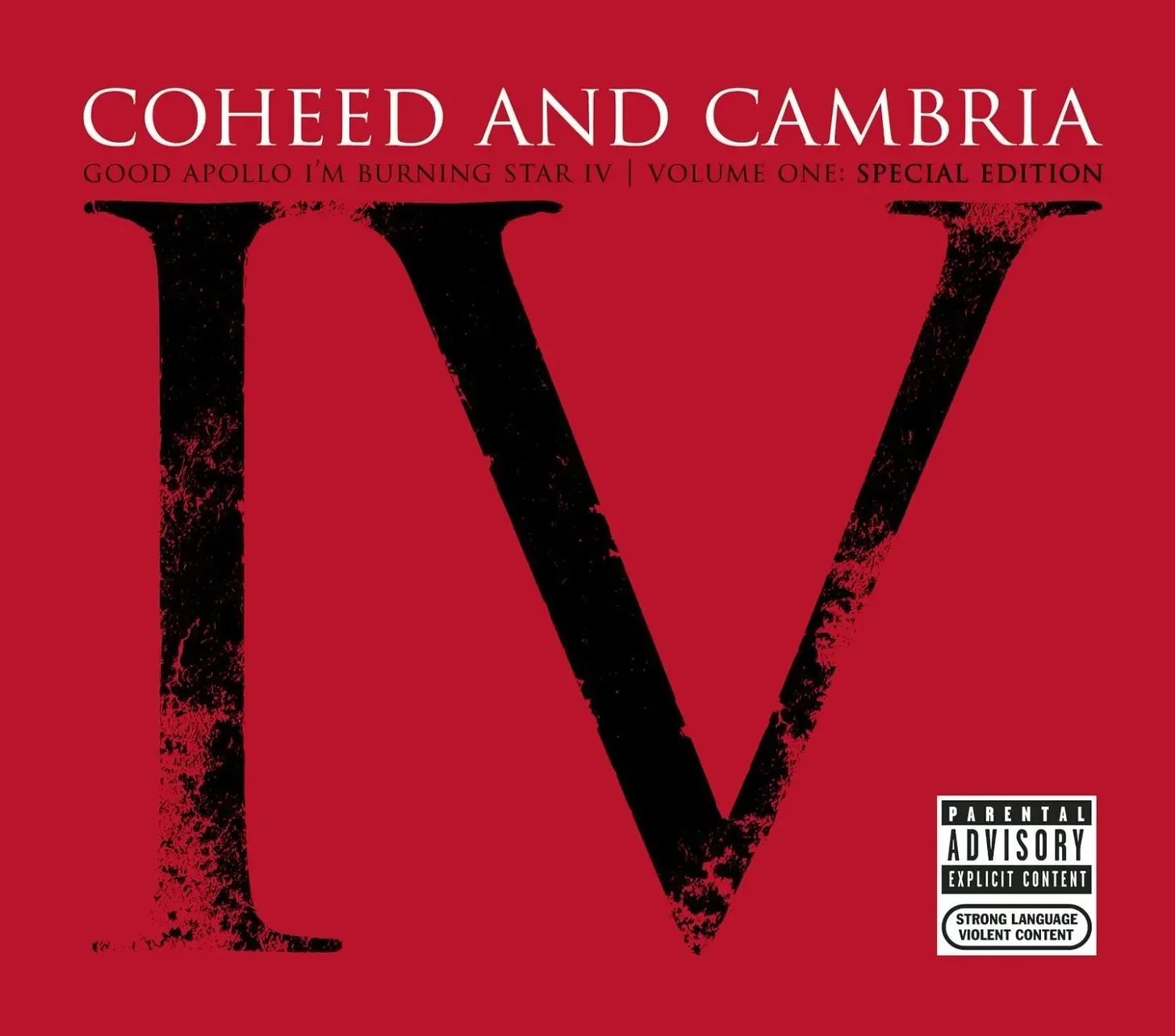
A swan dive into Coheed and Cambria’s Good Apollo, I’m Burning Star IV, Volume One: From Fear Through the Eyes of Madness - which may also be the bravest album title known to man.
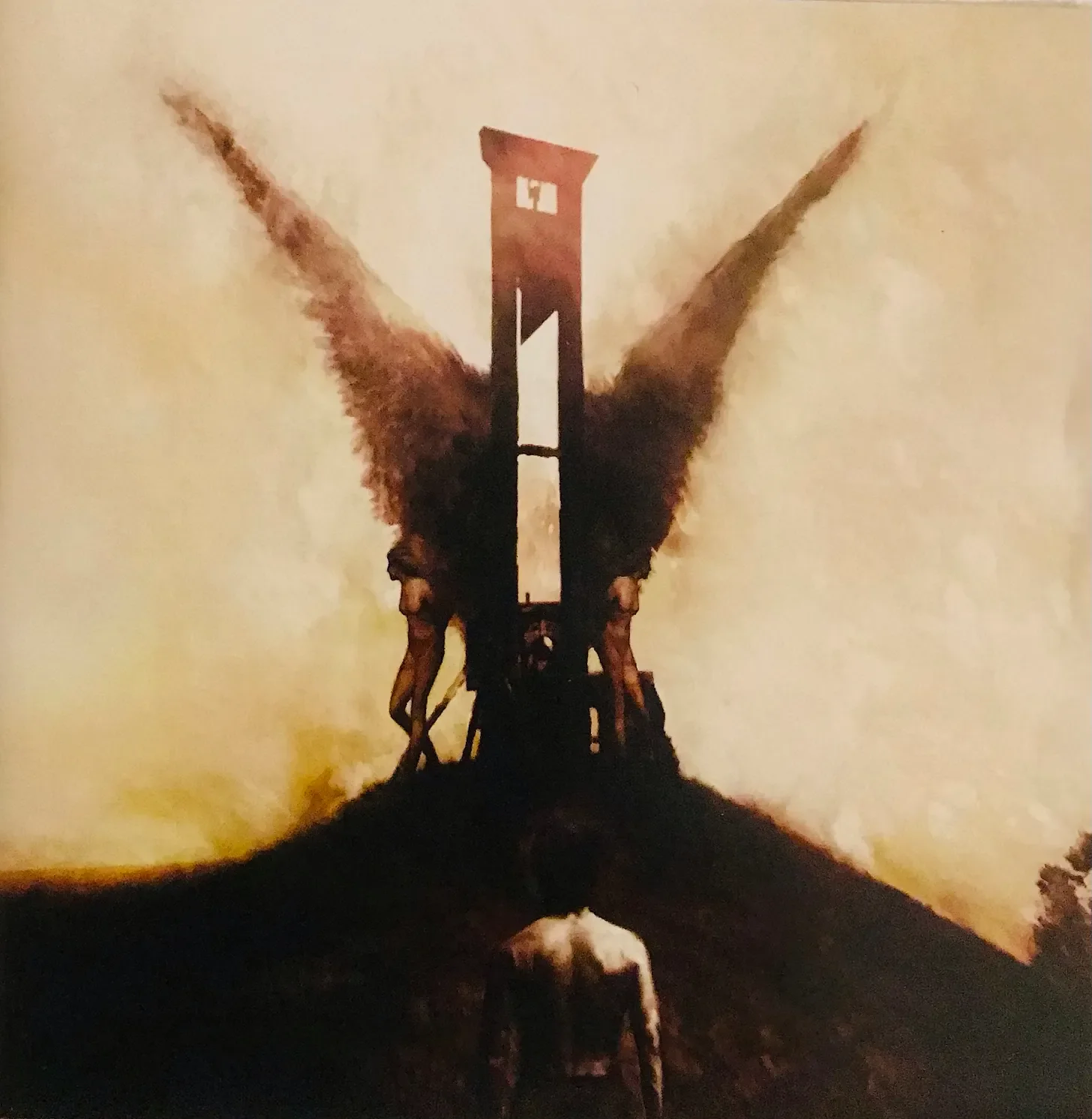
Late August, 2005: I was running ZERO magazine when Good Apollo arrived. It was not accompanied by a host of angels or blinding flashes of light and came in a padded envelope with all the others. Truth be told, back then, the postman used to bring me so many CDs for review, we agreed that I would leave my car unlocked and he would simply dump them all on the back seat. At the time, I lived opposite a nursing home, so they weren’t going anywhere with a hundred old people across the road with nothing better to do than look out of the window.
How are you supposed to know your life is about to change from the outside of a Jiffy bag when every single day brought another deluge of padded envelopes, press releases and records claiming to be the most important thing I’d hear all year?
Coheed and Cambria weren’t new to me. I’d already fallen in love with Blood Red Summer when it came out as a single from the Secrets of Silent Earth album, so the name meant something, but I wasn’t waiting on anything else given that the rest of Silent Earth kind of lost me. I knew nothing about Good Apollo before I put it on, but it went on the pile of artists I’d heard of because you have to have some kind of system.
I liked the cover though and sometimes, that’s enough.
So I put it on. Then I played it again. And again…
By the end of the day, it was like Nicole Kidman had delivered it by hand and asked me out for dinner. By the end of the week, it had taken over my life. By the end of the month, I was still trying to work out what the hell had happened.
This wasn’t another collection of songs about your poor little broken heart that passed through the office (aka: the kitchen table). There was heartbreak in there - quite a lot of it as it turns out, but it had been fed through something different until it came back wearing… armour? There were characters and recurring themes. Deaths, prophecies, far away planets, arguments with God… and a bicycle that was great at offering creative advice.
It was like somebody had handed me a book and was using guitars instead of paragraphs.
Twenty years on, it all seems kind of obvious if you’ve ever lent the band your ears. We’re used to Coheed and Cambria arriving with enough mythology to need scaffolding to hold it up but back then, hearing Good Apollo cold, the story wasn’t homework. It was in fact, something I didn’t know what to do with.
I didn’t know who everybody was or exactly what they were doing, but I knew the album went somewhere special. Songs were more like doors that opened and slammed in equal measures. Characters returned. Melodies carried information from one part of the record into another - hell, even the backing vocals had a story of their own to tell.
By the time The Willing Well arrived, it felt as though the curio I’d lifted from the day’s slush pile on the whim of a cool cover had built an entire world around me and wasn’t about to let me go home anytime soon.
Note: don’t ever let anybody tell you that cover design isn’t important.
When it was released in September 2005, Good Apollo was Coheed and Cambria’s third album, their major commercial breakthrough (I use the word commercial loosely) and also gave us the moment when the band stopped sounding like an ambitious group trying to build a universe and started sounding like they might actually own one. It hit number seven on the American album chart. Welcome Home escaped the mothership and even went off to live a separate life in video games and film trailers.
But its success is probably the least interesting thing about it.
Good Apollo is a break-up album disguised as a science-fiction opera disguised as a hard-rock record disguised as something you could easily explain if only everybody would stop interrupting and you could get your head around it.
It is angry, wounded, melodic, spiteful, funny, pompous and often, also beautiful. It has strings. It has children singing. It has a four-song closing movement called The Willing Well that lasts for the better part of half an hour. It has a dog in the title and as mentioned, a demon bicycle as part of the plot.
It should collapse under its own weight, but instead, it flies...
IN SPACE, EVERYBODY CAN HEAR YOU SCREAM
There is a version of this article that spends the next thousand words explaining the Amory Wars - which is the overriding thread of Coheed’s entire output - but nobody wants that version and I don’t want to write it either. It is currently trapped in a filing cabinet somewhere, yelling to be let out but that’s not going to happen.
Here is what we need:
Coheed and Cambria’s early records form part of a science-fiction story created by singer and guitarist Claudio Sanchez. The setting is Heaven’s Fence, a collection of planets held together by beams of energy called the Keywork. The central family is named Kilgannon. The parents are Coheed and Cambria. Their surviving son is Claudio (natch). There are wars, prophecies, viruses, murder, tyranny and enough capitalised nouns to make a fantasy novelist reach for the emergency brake, get out of their own inferior car and go home.
The first two albums, The Second Stage Turbine Blade and In Keeping Secrets of Silent Earth: 3, placed us largely inside that fiction. You didn’t need to understand what was going on to feel the songs - the music understood that you were here because your heart had been broken and the guitars sounded magnificent.
Then Good Apollo did something dangerous.
It pulled the camera backwards into a massive birds eye view.
The story now revealed a Writer (capitalised noun alert) living outside Heaven’s Fence, creating and controlling the people inside it. He had relationship problems of his own. Erica Court had rejected him, or betrayed him, or failed to behave according to the version of her he had written in his head. His anger leaked into the fiction. The characters suffered because their creator suffered. Ambellina, the woman guiding Claudio Kilgannon towards his destiny, became entangled with the Writer’s feelings about Erica. If he could not control the real woman, perhaps he could control the fictional one. If you thought that was a royal head-fuck, this is the point where a bicycle starts talking…
I had it explained to me by Claudio when we hooked up at Jurys hotel somewhere around the corner from the British Museum when they came over in support of the record… and still had to have it explained to me again later.
Writing from the Writer’s perspective allowed him to put more of himself into the lyrics. Twenty years later, he was even more direct about the emotional source: he had experienced heartbreak, did not know how to process it and funnelled it into musical anger. The Writer was not a neat autobiographical portrait, but he was no longer safely hidden behind the stars either.
Most concept albums ask us to believe in the story. Good Apollo asks whether the storyteller can be trusted. The man playing God is having a breakdown. His characters are at the mercy of somebody who cannot manage his own emotions, and he is beginning to confuse authorship with ownership which makes it a bad relationship with a notebook rather than a science fiction soap opera.
Note: I am not the world’s biggest fan of science fiction and have never termed Good Apolloas such in my own head even when the rest of the world seems to disagree with me.
It also builds an entire ‘mega-frame’ around its own songwriting process. The Writer isn’t simply another character wandering around inside the story. He is the man making it, breaking down in real time, feeding pieces of his life into the machinery and discovering that fiction is not a secure container. The album never lets us settle on whether we are hearing a fictional man’s grief or Claudio’s real one.
Is it a trick of the light? It might as well be…
WELCOME TO THE MACHINE
The album begins innocuously enough because it knows what is coming to beat you around the head.
Keeping the Blade is a short orchestral introduction built around a melody that had already appeared in the band’s work. It feels less like a new beginning than an old door opening - a bonus feature if you will and were already familiar with what had gone on before. Coheed understood the value of recurring musical ideas long before the mythology became available in expensive hardcover editions. A melody returns and, even if you cannot name it, your body knows you’ve driven past that place at some point in your life.
Then we have Always & Never, all acoustic guitar wrapped up in nursery-room menace. Children’s voices lurk behind Sanchez’ own... the song sounds intimate, almost harmless, which is pretty much how horror films persuade you to go upstairs.
And then comes the Hammer of the Writer in the shape of Welcome Home.
There are riffs and there are Riffs. The opening of Welcome Home is the announcement that should have played when the postman threw it in the back of my car. It does not enter the room; it repossesses it. The guitar curls downward with the weight of something I’d never heard before (or since), followed by drums that pound as if somebody has released the horses. Strings gather around the band and Sanchez arrives hurt and furious, then spends six minutes trying to find ever larger jars to contain the fury.
He wrote the central riff at his parents’ house, still working an ordinary job (in a pet shop, if I recall correctly), and has recalled being discovered by his mother while playing it in his underwear.
Rock history likes to pretend that enormous songs are delivered on mountaintops by lightning but sometimes your mum walks in because she needs to do the laundry.
Musically, Welcome Home is Coheed making a claim to other rock icons and it is not embarrassed by any of this.
Embarrassment is for bands who have not yet written Welcome Home.
This is not dignified heartbreak. It is accusation, humiliation and violent fantasy, followed by the admission that love remains trapped inside the anger. The Writer wants Erica punished for transforming him into this new person, as though she arrived with a toolbox and carried out the conversion herself.
When we are young, this kind of rage can feel like truth because it is loud enough to drown out every competing witness. Somebody hurt us. Therefore, they are the villain. We are bleeding. Therefore, we are innocent.
Adulthood, the irritating bastard that it is, tends to introduce paperwork.
It is now possible to hear Welcome Home as both a great rock song and a record of emotional failure. In fact, that tension may be why it survives. Sanchez has called it mean-spirited and still plays it. He and Chondra Echert, the real person standing somewhere behind Erica Court, eventually reconciled and married. The song did not become false when the relationship changed. It became fuel: here is what heartbreak sounded like before anybody involved knew the ending.
The band wanted it as the lead single. Their label preferred the more obviously accessible The Suffering. As usual, the band was right in the long run. Welcome Homebecame their signature song, eventually going platinum in the United States. It is the door through which thousands of listeners first entered Heaven’s Fence, even if many of them took one look at the map and decide they would be much safer standing in the gift shop…

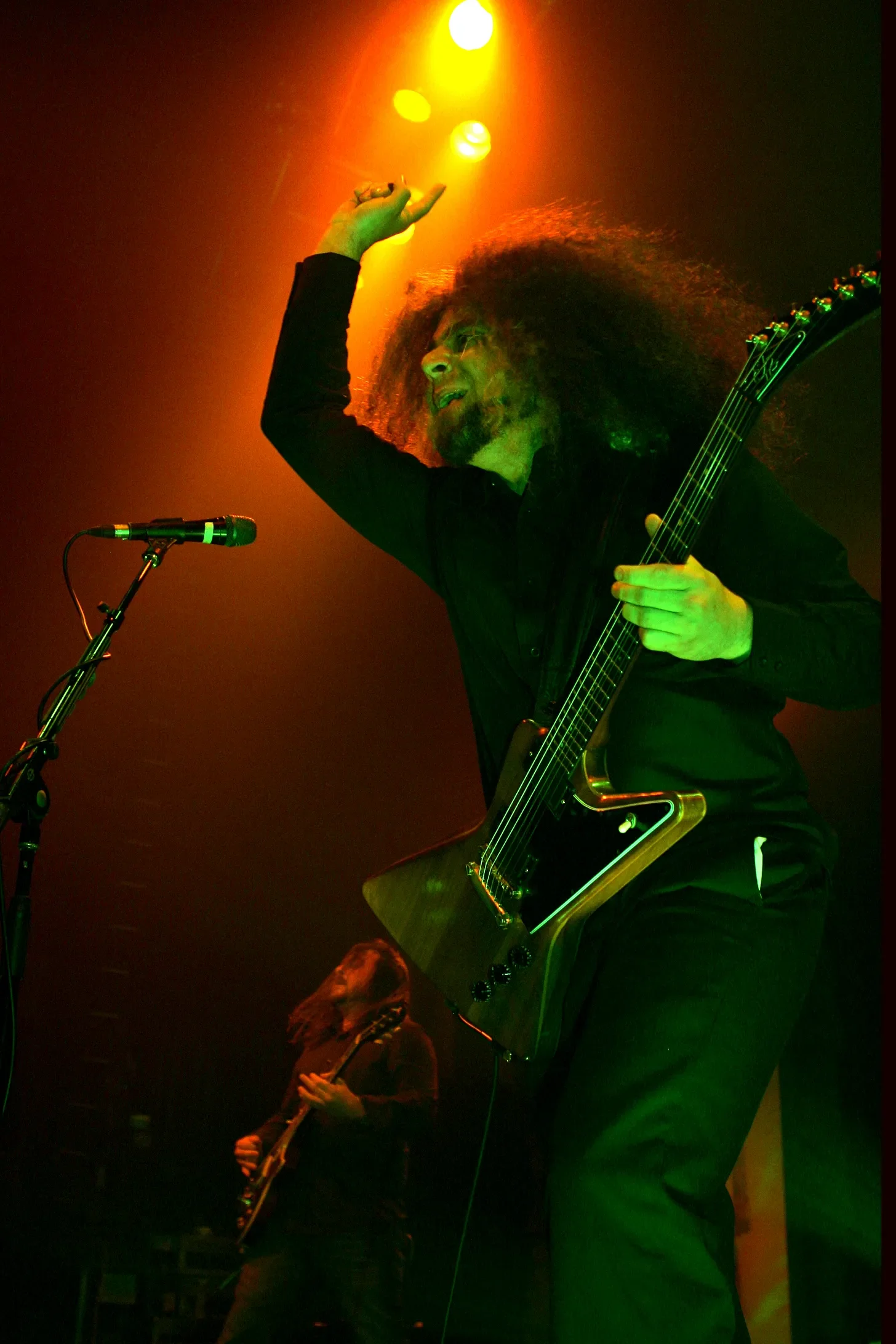
Taken from my interview at Jury’s with Claudio - pic credit: the inimitable and wonderful Chiaki Nozu. No idea what we were talking about here but from the look on Claudio’s face I was probably knee-deep in relaying what I thought of the album…
GOD RIDES A TEN-SPEED
After Welcome Home, most albums would offer you a bottle water and somewhere to sit. Perhaps even a biscuit.
Instead, Good Apollo chooses to give us The Bicycle.
Ten Speed (of God’s Blood & Burial) is where the album’s absurdity and intelligence shake hands. The song is spring-loaded like some demonic pinball machine from the first note. Drums, bass and guitar lock into a riff that feels as though it is forever leaning around the next corner. The chorus is huge (sorry: Huge) without being heavy, and has one of those Coheed melodies that makes a complicated song behave like pop music for a few glorious seconds. It owes a lot to Blood Red Summer but I can’t put my finger on why. I don’t understand how the backing vocal lines have been constructed either.
Inside the story, Ten Speed is the Writer’s demonic adviser, pushing him towards violence and control. Psychologically, it is the voice that tells him his worst impulses are not only reasonable but necessary. Artists have always blamed the muse but in this instance, Coheed simply gave the muse some handlebars, which is just about the coolest idea ever. The Writer’s madness does not appear as a dragon or a machine god. It appears as a bike he already owns. It doesn’t kick down the front door dressed as Satan/Santa/Santana but sits in the corner of the room and waits until you are tired enough to answer.
The song also proves how little the concept restricts the band - and this is the entire genius of the band. On paper, “man argues with evil bicycle about murdering his former partner through symbolic interference in a parallel science-fiction narrative” is not radio material. In practice, it is one of the tightest songs on the record and yes, easily my favourite.
All that said, put the song on and none of it matters…

LOVE SONGS FOR PEOPLE WITH EVIDENCE BAGS
The middle of Good Apollo is where the album becomes more interesting than its reputation - it’s my favourite part of the album by a long distance.
It’s easy to remember the opening assault and the closing suite in the shape of The Willing Well, but between them sits a run of songs that chipped off from the same damaged relationship.
Crossing the Frame is compact and powered by the sort of melodic bass movement that keeps Coheed’s songs from becoming unwieldy blocks of guitar. It feels like pursuit. The Writer cannot leave Erica alone because he cannot leave his idea of her alone. The title itself even suggests a boundary being crossed.
Apollo I: The Writing Writer slows the machinery down and lets the dread breathe. It’s one of the album’s central pieces, though it does not announce itself with the blunt force of Welcome Home. The Writer addresses Apollo, his dog, while trying to understand what he has become and what he intends to do. The ordinary tenderness of speaking to an animal sits beside the monstrous power he holds over his characters.
Good Apollo, good dog. Burning Star IV, bad everything else.
The title that once looked like decorative prog nonsense now becomes strangely intimate. Apollo is a witness. The dog cannot answer, judge or leave. Anybody who has ever explained the collapse of their life to an animal knows the arrangement. You provide both sides of the conversation and the animal has the decency not to point out the holes in your best laid plans.
Once Upon Your Dead Body follows with a title that could belong to a paperback found rotating beside the till at a bus station - and there’s nothing wrong with that in any world. The music, however, is almost playful. That’s another Coheed speciality: hide the knife in a melody of cake people want to eat together - and the contrast raises a question that follows the entire record. How seriously are we supposed to take the violence?
The Writer is not presented as a healthy being whose conclusions deserve our support. He is a cracked lens through which the fiction is being burned. The album does not always make that distinction comfortable, especially when its most venomous lines arrive dressed in its most triumphant music, but discomfort is not endorsement. Sometimes art puts you inside an ugly mind because the view from the pavement tells you nothing about the room upstairs.
Then Wake Up appears and complicates the prosecution.
It is the album’s naked love song: acoustic, orchestral and painfully direct. Removed from the surrounding story, it sounds like devotion. Placed where it is, devotion starts to look a lot like fixation. The Writer who has spent the album condemning Erica can still imagine escape, reunion and permanence. Of course he can - anger and longing are often make wonderful housemates. It’s beautiful, but beauty is not proof of good intentions. Every terrible relationship has at least one song it thinks belongs to it…

THE SUFFERING SELLS
If Welcome Home was the song Coheed believed would represent them, The Sufferingwas the song that demonstrated how good they had become at smuggling themselves into daylight and it is ridiculous pop-rock engineering of the highest level.
The rhythm bounces. The guitars leave space. Claudio’s vocal leaps through a melody designed to sound inevitable after you have heard it once. The chorus is immediate enough to survive outside the concept, while the arrangement keeps twitching at the edges so nobody mistakes accessibility for simplicity. Simple is the last word on anybody’s lips to describe this song.
The video placed the band in a fantasy landscape full of mythological creatures, ensuring that anybody who thought the story might be easy to grasp was punished with a kendo stick for their optimism.
Lyrically, The Suffering stages rejection and self-pity as theatre. The Writer asks what he did to deserve this and whether he might have been the right man under different circumstances. It is a more charming performance than Welcome Home, which makes it no more reliable.
Such is the trap of Good Apollo: the Writer keeps making excellent song after excellent song out of reasons we should distrust him.
The Lying Lies & Dirty Secrets of Miss Erica Court does not believe in subtle titles. It sounds buoyant while its groove carries a case for the prosecution built mainly from jealousy. The Writer’s Erica is less a person than an accumulation of charges. We do not know her. We know what he needs her to represent.
Returning to the album twenty years later with a microscope can become uncomfortable. The language of the wronged young man once arrived without much resistance. Rock music had spent decades teaching us that a woman who left was cruel, a woman who stayed was salvation, and a woman who exercised independent judgement was probably about to acquire an unpleasant nickname before the second verse.
Good Apollo does not escape that tradition. It fires it into space, but it also does something else. By making the narrator a Writer with literal power over women inside his fiction, the album exposes the machinery of grievance. He is not merely describing Erica. He is rewriting the universe to make his pain cosmically correct.
Every writer should be able to see the genius of the wizard behind the curtain here… or at least find it a little bit terrifying.
Mother May I closes the album’s (conventional?) middle section with a slinking, stop-start menace. By now, individual songs are beginning to feel less like chapters than rooms in the same house. The argument has gone on too long. Everybody is exhausted because it is exhausting.
Then the floor opens…
THE WILLING WELL
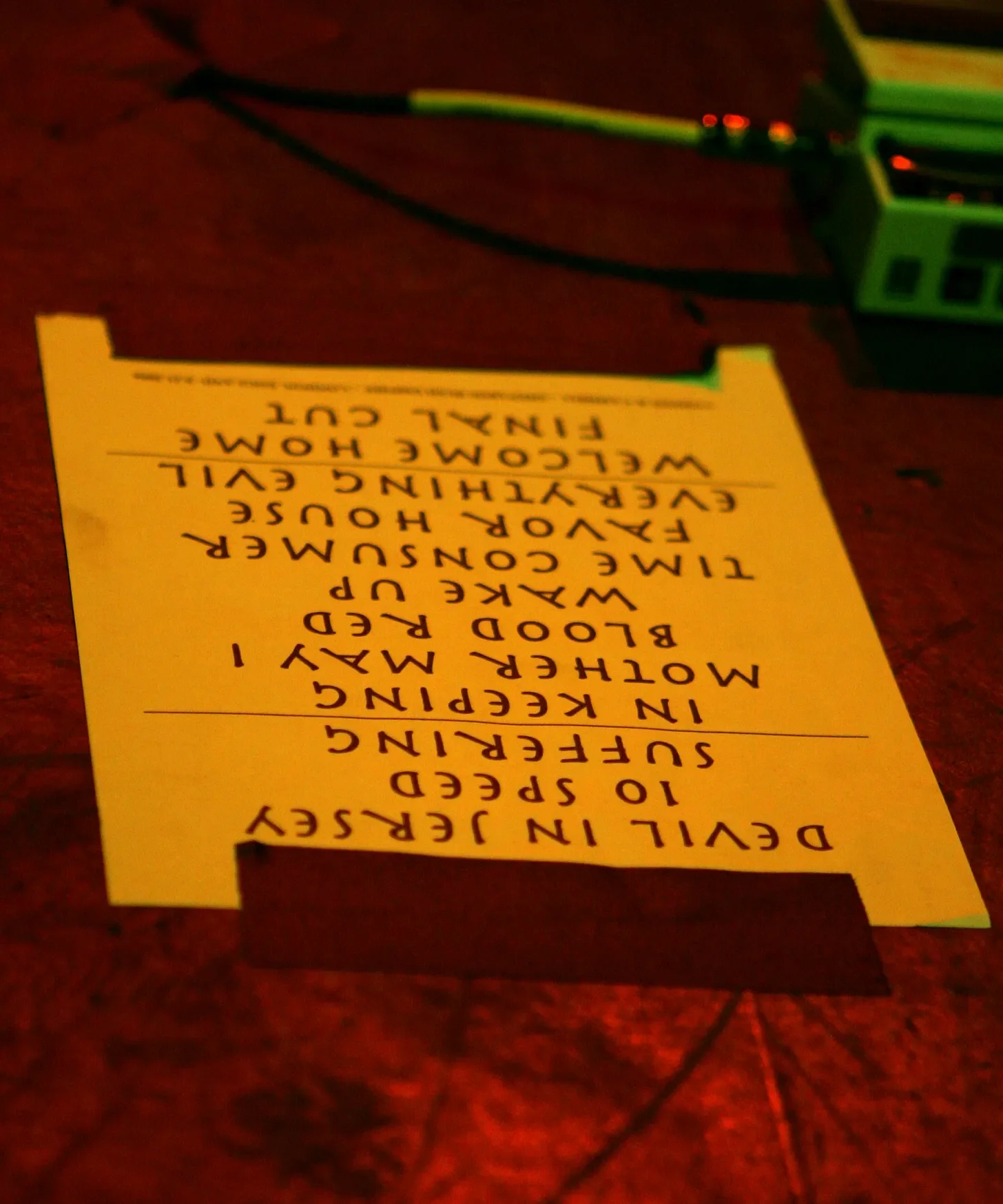
To complete the cycle, four songs lasting nearly half an hour. Recurring melodies, shifting time signatures, collapsing identities, guitar solos, screams, callbacks and enough plot to totally invalidate your home insurance.
A lot of Coheed fans think this is the best part of Good Apollo.
But I don’t.
Most of the time, I stop the album here. Not because I think The Willing Well is badly played or carelessly constructed, I’m not completely unhinged, but because this is where the record I love turns into a record I have to admire from a safe distance. After eleven songs that carry the story without buckling beneath it, the mythology finally grabs the steering wheel and drives us directly into prog country… and I don’t like prog so much.
But it would be remiss of me to spend this long digging around inside Good Apollo only to quietly slip out through the fire exit before the final act. This is where the Writer moves closer to his creation, where the division between real heartbreak and fictional catastrophe finally starts to collapse. It matters to the story even if it doesn’t do much for me as a collection of songs.
So, one more time unto the breach.
The Willing Well I: Fuel for the Feeding End begins in motion, the band playing with a kind of disciplined panic. Josh Eppard’s drums refuse to simply keep time, choosing instead to argue with it. Michael Todd’s bass moves beneath the guitars like a second narrative, while Travis Stever and Sanchez build parts that interlock rather than merely pile up.
For all the attention I’ve paid to the story here, Coheed and Cambria are a frighteningly good band. This is also as good a place as any to point out how important Travis is to the dynamic. I don’t think they would be half the band they became without him, but that’s another story altogether.
Concept is cheap. Any fool can invent twelve planets and a prophecy, but can you write a chorus that lays waste to all who look upon it?
Probably not.
The problem, for me, is that Fuel for the Feeding End keeps changing shape so often that I stop caring which shape it has become. I can hear the craft. I can hear the band pushing at the edges of what a Coheed song can contain. I know other people hear those sudden turns and shifting sections as the sound of the group taking flight but I hear a song refusing to sit still long enough for me to love it.
The story, meanwhile, is moving in the opposite direction. The characters inside Heaven’s Fence are being pulled towards the Writer as the creator moves closer to his own creation. The distance between personal grievance and cosmic catastrophe is disappearing.
The Willing Well II: From Fear Through the Eyes of Madness is darker and even more disorientating. Fear is not simply something the Writer feels; it is how he sees. Everything passing through it comes out altered and this may actually be the album’s real subject.
The Writer sees betrayal and builds a universe that confirms it. Claudio Kilgannon sees destiny and tries to resist it. The listener sees an elaborate science-fiction record and may miss the small human collapse generating the entire machine.
I understand what the song is doing but I simply don’t have the heart to hear it doing it.
That may sound unfair, but music isn’t a complicated exam in which recognising the correct answer means you have to enjoy it. Sometimes you can see every piece being moved across the board and still wish everybody would hurry up and finish the game.
The Willing Well III: Apollo II: The Telling Truth returns to the musical shape of The Writing Writer, changing the words and perspective. Earlier Coheed songs begin surfacing inside it. The band’s catalogue folds in on itself, turning familiar phrases into evidence that the fiction has always been contaminated by the life of its author.
Now that is clever. Possibly too clever for me but clever nevertheless.
All writers do this, of course. They take a person, remove the name, change the hair, put them on Mars and act surprised when they are recognised. Sanchez has simply built an entire solar system around the evidence.
The suite ends with The Willing Well IV: The Final Cut, a slow, blues-heavy piece owing more to Pink Floyd than to the nervous energy that first carried the band. Guitars wail across open space and the rhythm lumbers with intent. After an album full of words, the extended instrumental passages allow the emotion to escape the plot.
Or I guess that’s the theory behind it.
By this point, I have usually escaped the album myself.
For those who remain, The Final Cut offers aftermath rather than resolution. The Writer’s anger has burned through argument and arrived at emptiness. The grand machinery slows, voices gather and instruments peel away before the record wanders into a hidden acoustic coda—Bron-Y-Aur, a small Led Zeppelin tribute tucked behind nearly half an hour of musical warfare.
I can respect The Willing Well. I can understand why it inspires the kind of devotion normally reserved for religious apparitions and limited-edition vinyl. It is ambitious, beautifully played and structurally central to everything the album is trying to do.
I just don’t particularly like listening to it.
Perhaps that is the final trick Good Apollo plays on me. It arrived like a book written with guitars instead of paragraphs, held me captive for eleven songs and then ended with four chapters I have spent twenty years pretending I’ll finish one day.
I probably won’t.
That doesn’t mean I love the book any less.
(Nobody likes the stupid Spider ending at the end of It, but that doesn’t make it a shitty book.)
THE BAND INSIDE THE STORY
It is easy to talk about Coheed as though Claudio Sanchez invented the universe and everybody else turned up to provide weather.
This is the sound of a band becoming capable of the singer’s vision and ambition. Sanchez supplies the architecture, voice and much of the guitar language, but the record moves because four musicians understand tension differently. If I understood jazz even a little bit, I could probably even make some useful comparisons.
Josh Eppard is central to it. His drumming is busy without becoming cluttered, technical without asking for a certificate. He can make the pop songs bounce and the progressive sections feel as if they are coming apart at precisely the intended speed.
Michael Todd’s bass is not buried beneath the concept. It prowls. Listen past the vocal melodies and there is another version of the album happening underneath, less interested in Heaven’s Fence than in getting from one chord to the next by the most interesting available route.
Travis Stever’s guitar work gives the songs texture and friction. Coheed’s riffs rarely sound like one enormous instrument copied across the stereo field. The parts speak to each other, disagree and occasionally form a small committee. Like I said - Travis is a key part of this story. Claudio might not need him as such but he is better with him than without. (For reference give Travis’ Davenport Cabinet project a whirl).
Producers Michael Birnbaum and Chris Bittner let the record be large without sanding away the band (which is something of a miracle considering the amount of layers). The strings matter. The vocal layers matter. The strange transitions matter. But underneath the theatre, you can still hear four people in a room discovering that they can push further than they did last time.
There is more going on around them than you might consciously notice too. Ukulele. Lap steel. Additional percussion. A didgeridoo buried somewhere in the machinery. Sanchez’s niece, Janiris, supplies the child’s voice on Always & Never and again near the end of the record. None of this arrives waving a flag to tell you how clever the arrangements are. It adds colour at the edges, the musical equivalent of details in a novel that make a room exist even when you cannot remember every object inside it.
That was what I heard before I understood any of the story. Not a collection of tracks dressed up with a concept, but a record built to be... what? Experienced rather than listened to? It’s not like you can turn up and have a great 4/4 time cooking in the kitchen to it. Well, you can and I have but you get my drift.
This was 2005. Rock was busy splitting itself into marketable tribes. Emo over there. Metal in the corner. Post-hardcore by the fire exit. Prog was permitted back into the building provided it did not make eye contact with anybody.
Coheed took what they needed from all of it and stormed off in a direction all of their own.
Sanchez’s instantly recognisable voice made categorisation even harder. To some listeners it was the locked door. To others it was the entire house. Once accepted, it gave the band access to emotional territory a more conventionally masculine rock voice could not have reached. He could sound wounded, vicious, theatrical, childlike and absurd, sometimes all within the same line.
It was, and still is, quite magical.

TWENTY YEARS LATER
Records do not change, which is kind of inconvenient because we do.
In 2005, Good Apollo could be seen as the enormous next step from a band whose mythology seemed to expand every time somebody asked a straightforward question. It was an album to decode. Fans traded interpretations, fitted lyrics to comic-book events and argued over names that sounded like passwords for a boiler.
Now, the code is easier to find. The Amory Wars has been expanded, revised and published across comics and collected editions. Interviews have clarified what was once guesswork. You can find diagrams for God’s sake. You can find explanations. You can probably even find somebody willing to tell you the bicycle’s motivation in seventeen parts. Hell, somewhere on a hard drive around here, I have a collection of Children of the Fence tattoos I discovered. That’s how obsessive we became.
And yet the album has become less stable, not more.
The passage of time changes the human material. Claudio and Chondra reconciled, married and became creative partners. The furious document of their separation remained. Every performance of Welcome Home became a public return to a private catastrophe that no longer existed in the same form.
There is something generous in not disowning it.
Sanchez has not pretended the song came from a noble place. He has described the anger, acknowledged the meanness and continued to recognise the song’s power. That is healthier than rewriting the past until everybody behaved perfectly. Nobody did. That is why there was an album.
The record survives because its excess now feels refreshing. Good Apollo has no interest in behaving like content. It does not arrive pre-cut into fifteen-second pieces. It wants, maybe even demands, seventy minutes of your life, some familiarity with two previous albums and a willingness to accept that the final act may involve a metaphysical confrontation between an author and the people he invented. None of which you may understand for a very long time.
It is not ashamed of asking too much.
We have become suspicious of that kind of ambition because we have seen it fall on its face too many times. Double albums, concept records, rock operas: the road is littered with abandoned scenery of such projects, but failure is part of the attraction.
Nobody needs an artist to attempt this. That is precisely why it matters when they do.
Coheed could have made a cleaner album. They could have followed In Keeping Secretswith twelve efficient songs, explained nothing and watched the career proceed in a professional manner.
Instead, they put God on a bicycle, bypassed all the gate-keepers and cycled through a back door into our hearts, where they lived quite comfortably for the next twenty years…

NO EXIT
So, what exactly is Good Apollo, I'm Burning Star IV, Volume One: From Fear Through the Eyes of Madness?
It’s the album where Coheed and Cambria became themselves so completely that everybody else had to adjust around them.
It is a progressive-rock record with pop instincts, a metal record with an acoustic heart and a break-up album that deals with its pain by making fictional people suffer. It contains the band’s biggest song and some of their least penetrable music. It is juvenile in places because heartbreak is juvenile. It is sophisticated in others because transforming pain into structure requires craft, even when the pain itself is throwing plates.
Most importantly, it understands something ugly about creation.
Writers like to imagine that making art from experience is an act of rescue. Take the terrible thing, turn it into a song, a book, a painting, and now it has purpose. Maybe. But art does not automatically purify its source. Sometimes it preserves the poison.
The Writer in Good Apollo believes he controls the story. In reality, the story has become the shape of his obsession. He can kill characters, alter destinies and split the universe open, but he cannot make Erica love him. Omnipotence turns out to have its limits. This singular fact is likely the reason I love this album so much.
That is why the record’s absurdity matters. The cosmic scale does not make the heartbreak larger. It reveals how large heartbreak already feels to the person trapped inside it. Every abandoned young man thinks the stars have moved. Claudio Sanchez had the courtesy to build the stars first.
There is also a band playing at the absolute edge of what it thought it could do. There is a young writer exposing more of himself than he may have understood or could ever replicate again. There are melodies that across albums like memories nobody successfully buried. There is anger we can recognise without admiring, tenderness we cannot entirely trust and ambition pouring from every available opening.
You can’t anything away from a man with nothing left to lose.
•••
A lot of other records arrived to be looked at that day and in the days that followed.
Out of hundreds upon hundreds, I could honestly name four or five. They arrived, joined the pile on the table, took their turn and disappeared. That’s not necessarily a judgement on any of them, though sometimes it’s very much a judgement on them - and I said so whenever I got the opportunity because it’s important to be honest about what you hear.
Most music passes through your life because there is too much of it for anything else to happen.
But this one wouldn't go home.
It stayed all day. All week. All month. Then it kept going, long after the advance copy had stopped being an advance and the world had caught up with it.
All because I liked the look of the cover more than the others.
I still haven’t finished reading it.
Sion Smith | August 18, 2026