ROCK N ROLL OVER AND OVER
In 1976, when Kiss released Rock and Roll Over, I was nine years old. I’d love to say I saved up my pocket money for weeks until I had enough money to buy it because every Kiss fan wants to get as close to the golden-era as they can but that would be a lie. In 1976 I had never heard of Kiss and was floating upside down in a sea of Scandi-Pop (you know who I’m talking about). It’s not my fault they took their time taking over the world.
I didn’t come to the album until 1980, by which point Kiss had already found the big red emergency button and pressed it with both hands. Peter Criss was effectively out. Dynasty had sent “I Was Made for Lovin’ You” onto dancefloors and the cover of Unmasked had made the once ferocious gang of four look like the stars of a Saturday-morning cartoon, which was fitting because the album itself occasionally sounded as though it came with a free bowl of cereal and who knows, given the amount of merch that had been coming out, at some point maybe it did.
None of that mattered because things didn’t work in the same way back then. There wasn’t the division between “new” and “old” music that exists now, where every release arrives with a timestamp and the majority of the internet has finished discussing it by lunchtime. Records stayed alive because they stayed unavailable. Some albums you had. Some albums your friends had. Some existed only as pictures in magazines or titles printed on the inner sleeve of something else. You couldn’t press a button and hear the entire history of a band before breakfast. Hell, sometimes, you didn’t even know how many albums they had out or what they were called. In 1980, a record from four years earlier wasn’t old, it was simply one you hadn’t got yet.
But by 1980, I was more than au fait with the local record shop. I had Dynasty and a copy of Alive! Months had been wasted/spent scanning through the K rack to see what else there was and every cover looked like magic but it was Rock n Roll Over that I obsessed over for reasons we will come to…
I wanted it badly enough to make it everybody else’s problem. I hassled my parents. Then I hassled them again, presumably in case they had mistaken the first hundred requests for passing interest. Eventually, they surrendered and gave me the money to buy it for Christmas from them. Such is the embarrassment of an adult going into a public shop and buying a Kiss album I guess.
There was, naturally, a condition - why were there always conditions back then? I could go into town and buy the album myself, but when I got back home, I had to hand it over. No listening. No “just checking the record isn’t damaged.” No emergency preview of side one. It was a Christmas present and Christmas presents belonged to Christmas, even when you had personally travelled to the shop, handed over the money and carried the thing home like a hunter.
So there I was on the bus with the Holy Grail. I might not have been able to listen to it, but I could sure as hell commit every inch of its cover to memory: I read the label, the song titles and every piece of information I could find. I looked at it until the sleeve stopped being packaging and in my head became something else entirely.
Kiss had great album covers. Even a schmuck who hates the band would have to bow to that statement. The three albums that come between Alive! and Alive II are the very best of them. Destroyer placed the band leaving a flattened megalopolis and were feeling pretty good about their chances of conquering whatever city came next. Love Gun placed them inside a lurid fantasy kingdom - because this was still the age of Conan - that was populated by women who had apparently been waiting there all week just for them - again, maybe they were.
But, cool as that was, Rock and Roll Over did something else.
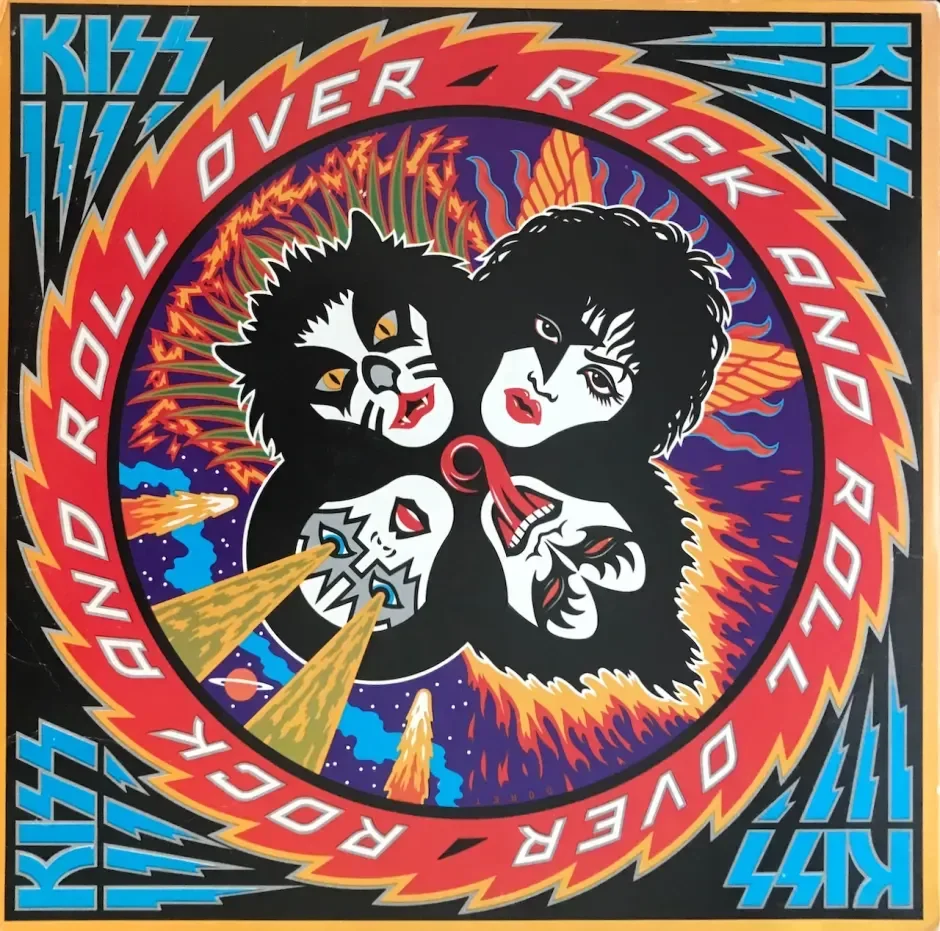
It was flat. That doesn’t sound like a compliment, but it is. There was no ruined city, no stage, no photograph and no attempt to make the four members be action heroes. Instead, their faces rotated around a perfect - and I mean Perfect - circular design: Gene, Paul, Peter and Ace transformed into flat symbols, locked together in red, yellow, blue and silver. The image had the symmetry of a seal, a badge, a patch, something you could actually draw if you were so inclined and the logic of something you might find painted on the side of a fairground ride shortly before it detached itself from the machinery and rolled down the hill.
Frankly, it looked complete.
The cover was designed by Michael Doret, although his name was not announced across the front. You would have thought they could spare one line of seven point text to give a brother a few props but album-cover artists rarely received that sort of treatment. Having said that, there’s barely anything on here beyond the bare essentials. It’s all geared up to be nothing but that wonderful circle that contains a whole world inside of it.
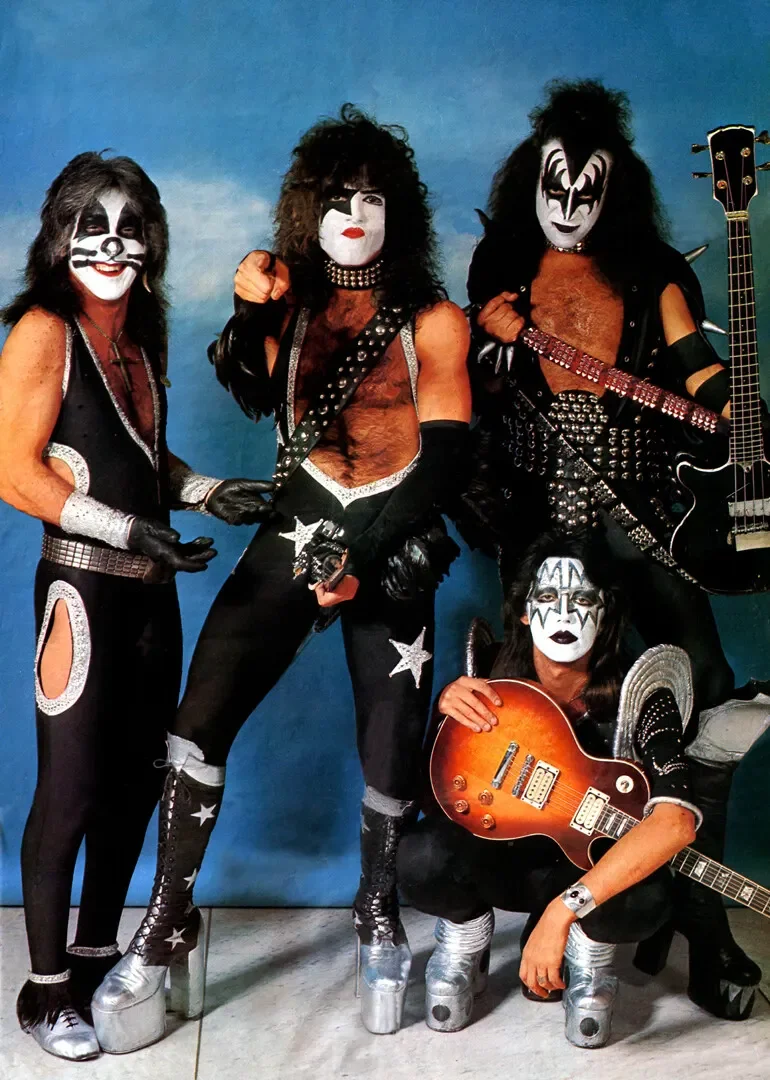
He knew very little about Kiss when he was given the job, so the band had to explain the four individual characters to him. Gene belonged to fire, Ace to outer space, Peter to the jungle and Paul to some celestial realm of stars, wings and women.
Without knowing this to be a fact, it is tempting for me to see the cover as the moment the ‘icon’ characters properly came into focus. The makeup already existed, as did the raw ingredients of each personality, but the Demon, Starchild, Catman and Spaceman had not yet been publicly nailed down in the way the world understands them now. The Marvel comic would do that the following year and Phantom of the Park would give them superpowers in 1978. Perhaps that distance helped? Instead of repeating the stage show or painting another heroic tableau, he reduced Kiss to their essential components: four faces and one logo in constant motion.
Regardless of all this, Doret later described it as a “mandala surrounded by a sawtooth blade” which is probably all anybody really needs to know. Nobody makes album covers like this anymore.
The cover is a large part of why Rock and Roll Over remains my favourite studio album by the original line-up. No long-standing Kiss fan of any worth will lay it all at the feet of the music. It’s wrong, but that’s the way it is in KissWorld.
Kiss (or maybe rather Neil Bogart at Casablanca) understood more than anybody that the experience began before the needle reached the vinyl. The logo mattered. The make-up mattered. The object in your hands mattered. You didn’t merely listen to a Kiss album. You entered into a life-long blood pact with it.
Anyway, I handed the album over when I got home, as promised and so began The Long Wait…
ROLLING BACK THE MACHINE
Rock and Roll Over was released on 11 November 1976, only eight months after Destroyer. Eight months! Some bands now spend longer than that announcing a box set.
Kiss had moved from imminent financial disaster to national obsession with barely enough time to notice the scenery changing. Alive! saved them. Destroyer turned the rescue into an empire, adding orchestras, choirs, sound effects, Bob Ezrin and enough cinematic ambition to make the first three records look as though they had been recorded in somebody’s garage because, spiritually at least, they had.
It was apparently a brilliant album (everybody too lazy to listen says so) and yet also my least favourite of the OG line-up studio albums because it was also not quite the way Kiss naturally breathed.
For this follow-up, they returned to Eddie Kramer, the man who had captured Alive!and understood that polishing Kiss until you could see your face in the mirror rather missed the point. The solution was to record in the Star Theatre, an empty venue in Nanuet, New York, and treat the studio album like a live performance without the inconvenient business of an audience throwing stuff at you.
They ran cables through the building. Peter played high above the others in a bathroom, linked by video camera, so the drums could acquire the natural echo of the space. The band played together and repaired mistakes afterwards. Kramer has always argued that this is the best way to record a group: get everybody playing, capture the performance, then fix whatever fell off. It’s also a good way to live your life but that’s another story…
The approach suited Kiss because the band was never supposed to sound as though it had been assembled with tweezers. Mutt Lange is not welcome in this building. Kiss needed movement - four people pushing the same object and occasionally disagreeing about the direction.
The guitars have room to breathe. Gene’s bass does not need permission to wander off and do its own thing. Peter’s drums sound like drums being hit by a man in a tiled room because that’s pretty much what happened. Ace’s guitar appears from whichever side is least supervised and Paul’s voice sits at the centre like a man who has already seen the stage design because he built it.
Ten songs. Thirty-three minutes. No orchestra. No choir of children asking whether anybody is lonely. No car crash. No concept beyond making Kiss sound like Kiss again.
Rock n Roll Over is indeed, a masterpiece. I’m going to take it apart because if there’s one thing I detest in rock n roll, it’s revisionist history:
I WANT YOU
The album begins by lying to you. I Want You opens with Paul’s twelve-string acoustic guitar and a voice that suggests we may be entering reflective territory. Perhaps Destroyer has changed them? Perhaps everybody has read a book and drinks Darjeeling in the evening.
Nah. Then the band kicks the door in.
It is one of the great Kiss openings because it contains the entire album’s argument inside its first few seconds: texture without fuss, drama without decoration and a sudden reminder that this is meant to be played loudly and annoy the shit out of the previous generation. The song moves through riffs and stops without ever losing the straight line running through it. Paul sings the title as though wanting something is sufficient proof of ownership. Truth be told, he sounds fucking fantastic.
It rises, drops back, pretends to finish and returns with the guitars making sounds that suggest the theatre’s wiring has become involved. The gentle opening returns at the end, but nobody believes it anymore.
TAKE ME
Take Me does not waste time with the acoustic deception. Written by Paul with Sean Delaney, it is Kiss operating in its most shameless register. The lyric contains the kind of sexual invitation that only works if delivered from a stage while wearing seven-inch heels and surrounded by explosions. Read quietly from a sheet of paper, it may constitute evidence. This is both its secret sauce and its downfall outside of the Kiss Kamp.
Paul does not sound like a man whispering into somebody’s ear. He sounds like the leader of a rally whose cause has not been fully explained. The backing vocals answer him, the guitars push everything forward and Peter gives the beat enough looseness to stop it becoming a march.
This is where Kiss’s alleged stupidity becomes extremely clever. The words are simple. The construction isn’t. Each gap, response and shift in weight is doing a job. A song can be direct without being basic, just as a man in make-up can sing about the rocket in his pocket without lacking professional discipline.
Sometimes, people analyse and think about rock n roll far too much because they have to find something to say in order to pay their rent. An easy target is an easy target but you know what, fuck those guys. Take Me is exactly what we all came for.
CALLING DR. LOVE
Gene Simmons saw the Three Stooges short Men in Black, heard its hospital announcement calling for three doctors and did what any responsible songwriter would do. He made himself one of them.
Calling Dr. Love is the Demon at his most efficient. The riff is blunt, the beat sits back and Gene hands over his medical qualifications with the confidence of a man who has never actually been asked to provide proof. His bedside manner would get a real doctor struck off before the second chorus - and probably did.
It’s also one of those Kiss songs that proves how much space matters. There is no frantic attempt to fill every second. The riff is simple, leaves a mark and gets out of the way for the story. Peter’s drums poodle along behind it. Ace throws in exactly the right amount of dirt. The backing vocals turn a private fantasy into one of the greatest backing vocal singalongs since Roxanne. Technically speaking, this came first but you know what I mean.
By 1976, the four characters seem to have established their departments of authority. Paul dealt in stars and seduction. Ace came from space (natch). Peter supplied street-corner humanity. Gene had blood, monsters, fire and a private healthcare practice.
By 1976, public opinion had also lined up with this theory and like they always promised, Kiss gave the people what they wanted. I’d love to know if this was a conversation that actually happened. I need to do a podcast episode with Gene one day…
LADIES ROOM
On the surface, Ladies Room is Gene converting a queue for the toilet into a romantic destination whilst apparently singing, “Meet, meet you in the ladies room.”
That’s not what I heard.
For far longer than I will ever admit, I thought he was singing, “I make speeches in the ladies room,” which honestly seems like an entirely reasonable thing for Gene Simmons to be doing. Where else would the Demon hold a press conference? The main room was probably too busy and the men’s toilets would already be full of guys applying Paul Stanley make-up in the mirror…
There was no internet waiting to correct all your sins back then. If an album didn’t include a lyric sheet - and Kiss albums generally had more pressing things to squeeze inside them - you listened, made your best guess and lived with the result. Eventually, the wrong words become the song and by the time somebody told you otherwise, it was too late. Your version had squatter’s rights.
I can see the video even as I write this: Gene delivering his keynote address from between the sinks while Paul checks his outfit, Peter runs the taps for atmosphere and Ace tries to work out how the hand dryer operates. Gene slams both hands onto the cubicle door, smoke pours from the cubicles and the sinks explode at the end of the chorus.
Picture it and kneel before me. ”I make speeches in the ladies room” is better. My version has production values.
This is not one of the album’s monuments. It’s better than that. The riff has an easy, rolling quality, less threatening than Calling Dr. Love but carrying the same belief that Gene’s presence will improve any woman’s evening whether she has requested assistance or not. The title is cookie-cutter Kiss: simply take something ordinary, add appetite and behave as if the transformation is doing the world a favour.
Songs like this on Rock and Roll Over do not feel like filler because the album has zero interest in changing scale. Ladies Room belongs beside the ‘better’ tracks. It contributes to the flow, the personality and the feeling of four people playing rather than pausing every few minutes to erect a landmark.
Not every song needs to be Stairway to Heaven. Sometimes a door with an easily identifiable gender sticker on it will do just fine.
BABY DRIVER
Peter Criss takes the wheel. I love it when Peter does his thing. Every band needs a break from singing about their dick.
Co-written with Stan Penridge and developed from material dating back to Peter’s pre-Kiss band Lips, Baby Driver is rougher around the edges than the Stanley and Simmons songs and that’s exactly why it matters.
Peter’s voice cannot help sounding lived in. Paul commands. Gene performs menace. Peter sounds as if he has already had the evening the others are promising and moved on long ago. His vocal gives the album grain - and dare I say - depth!
The song is not as elegant as I Want You or as inevitable as Calling Dr. Love, but Peter attacks it as though the title grants him a licence to unleash the voice inside him. The swagger of this song is pretty much perfect.
This is the original line-up functioning as advertised: not four identical musicians beneath matching make-up, but four different problems sharing a logo. Remove Peter’s personality and Kiss becomes more precise and somehow, less alive. Sad but true, Kiss fans.
Chemistry is chemistry no matter how you slice it.
The barbecue of side one ends here. Five songs, no wasted motion and not a burnt sausage among them.
LOVE ‘EM AND LEAVE ‘EM
Side two returns to Gene, who has reduced the entire romantic process to a collection-and-disposal service. This song is shit. As a fan, you have to point these things out sometimes.
It’s not subtle, kind or especially interested in what happens after breakfast. It is, however, built around a groove that works for the most part with Gene’s bass moving underneath the guitars with more agility than the Demon usually gets any credit for.
The song began life in an earlier form called Rock and Rolls-Royce (which was probably also shit), because even Gene’s discarded titles arrive wearing jewellery. By the time it reached the album, the machinery had been stripped back and the central proposition clarified.
I could live without this being on the album at all. Looks to me like they were trying to be fair about the split of writing credits more than anything. They should have resurrected the song It’s Not Smoke and kept powering on.
MR. SPEED
… and maybe the reason they didn’t is because it sounds remarkably similar to this one.
Every Kiss fan has at least one song they believe the rest of civilisation has criminally neglected and Mr. Speed has an entire support group.
Written by Paul and Sean Delaney, it is three and a half minutes of filthy confidence. The riff doesn’t need to shout. It simply rolls. Paul sings from the point of view of a man proud of the speed with which he can pick up women (natch, again), a skill that sounds less impressive the longer adulthood is allowed to inspect it but there’s that revisionist thing again. Let’s not do that because Mr Speed is interstellar. It is Paul being efficient in the extreme.
What makes the track so loved is not the lyrical boast but the ease. It asks nothing hard of you. Kiss are not trying to write another anthem - they’re playing a song that fits the four of them. Ace decorates it without taking it hostage. Gene and Peter sit inside the groove. Paul sounds as though the vocal requires no effort at all. Maybe it doesn’t.
The anniversary campaign has sensibly chosen Eddie Kramer’s 2026 mix of Mr. Speedfor a seven-inch single. Fifty years later, the neglected song has finally received a promotion.
Fast worker.
(At which point, an unanswered question in my Kiss memory banks is why, with songs like this kicking around, did they choose to make side four of Alive II, studio tracks. I mean, I dig those songs but there was no need for them to turn up at at the end of Alive II. They could have kept them kicking around and the next album would have been off to a great start.)
SEE YOU IN YOUR DREAMS
See You in Your Dreams is possibly the closest Rock and Roll Over comes to a lesser track, which is another way of saying the album is annoyingly consistent.
Gene would later record it again for his 1978 solo album, apparently either because he was unconvinced that Kiss had found the final version or because he’s lazy. The remake added polish and guests, but the original at least has the advantage of sounding like it belongs here. It is lean, slightly awkward and held together by the band sticking tape on things rather than the idea of Gene Simmons as an independent entertainment industry.
The chorus is catchy without becoming permanent. Ace’s guitar gives it some life while Peter pushes it harder than the song strictly requires. It’s the sort of track that reveals its usefulness when heard in sequence and loses some of its reason for existing when isolated.
Albums used to be full of such creatures, they really did. Should have handed the vocal to Peter on this one. It would at least have given it some grit.
HARD LUCK WOMAN
Paul Stanley wrote Hard Luck Woman with Rod Stewart in mind and you can hear why. The acoustic guitars, folk-rock movement and narrative shape all belong near Maggie May and You Wear It Well. Paul thought he might offer it to Rod, but with Beth becoming an unexpected hit and Kiss suddenly requiring another song sung by Peter that radio stations could play without frightening the neighbours, so it goes.
Paul could have sung Hard Luck Woman beautifully - maybe he did at some point but Peter makes it sound true. His rasp carries regret without needing to perform it. He sounds like somebody leaving because staying has become worse, not like a rock star demonstrating sensitivity between flash-bombs going off.
The song might have been an attempt to follow Beth, but it is not Beth II. It is better integrated than that. The acoustic instruments feel physical. Ace’s guitar belongs to the arrangement rather than arriving to remind everybody which group this is. Peter as always, remains recognisably Peter.
It also proves that stripping back after Destroyer didn’t mean abandoning ambition or texture. Rock and Roll Over is not ten versions of Deuce. The empty theatre gave the band room to be quiet as well as loud.
The song even escaped the album and lived a separate life, later returning through Garth Brooks, country radio and enough cover versions to demonstrate that a great Kiss song remains a great song after you remove the Kiss.
…and not every band survives that test.
MAKIN’ LOVE
The album ends as though somebody has noticed the venue is booked for another event and increased the voltage.
Makin’ Love is Paul Stanley at full operating temperature. The riff is urgent, Peter drives it forward and the lyric leaves no ambiguity about the evening’s intended destination. After the warmth of Hard Luck Woman, Kiss immediately puts the furniture back against the wall.
It’s exactly the right ending because Rock and Roll Over does not require resolution. There is no story to complete, no ruined city to revisit and no child asking whether the Demon is lonely. The album’s job is to sound like the band playing - so they play until they hit a brick wall.
Then you turn it back over and the circle they promised begins again.
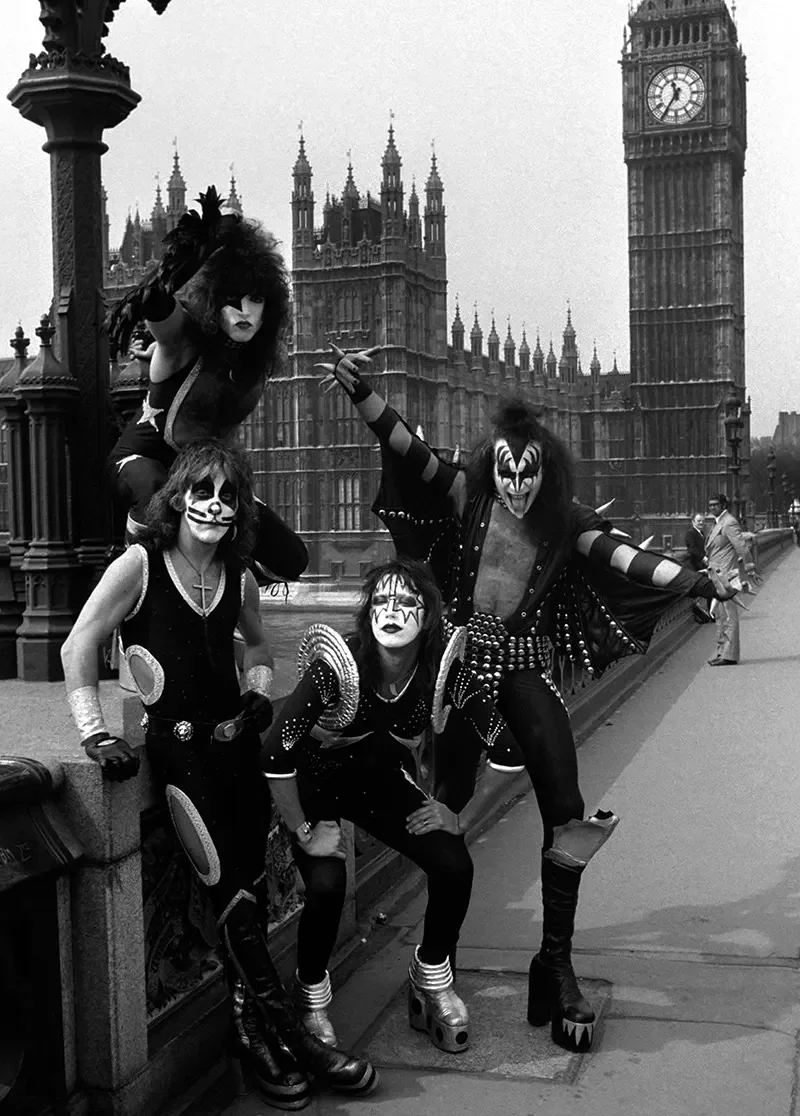
The infamous London photo shoot. May 1976.
HALF A CENTURY AGO? REALLY?
The new 50th-anniversary edition is built around an irresistible proposition: Eddie Kramer has returned to the original analogue multitrack tapes and created a completely new 2026 mix of the album he recorded half a century ago.
That is more interesting than another remaster with the volume moved slightly to the right, which is how most of them go - though I say this without actually hearing it first because I trust him.
There is also enough surrounding material to fill your garage: 22 unreleased demos, alternate mixes and outtakes; nine Gene Simmons demos (hmmm); the unfinished instrumental Queen For A Day; selections newly mixed from all four 1977 Budokan shows (yay); a 104-page book (double yay); Dolby Atmos and 5.1 mixes (my ears don’t work well enough to be excited by that and it’s all their fault); and sufficient collectible material to ensure that Kiss remain committed to the ancient principle that affection should occupy shelf space.
I’m looking forward to hearing the new mix, but part of me is a little wary because Rock and Roll Over does not need improving. I mean, Stephen King is probably a better writer now than he was in the seventies but I don’t need him to rewrite Carrie to prove it. Its sound is part of the memory: the physical drums, the space around the guitars and the grubby sense that everything is happening at once in some kind of emergency is why I love it.
Clean it too thoroughly and you risk removing the fingerprints.
Kramer, at least, understands what made it work because he put the fingerprints there. A good new mix will not make the album modern. It will let us stand somewhere else in the theatre. Not that I want to but perhaps we will hear Peter’s bathroom differently.
There’s a sentence nobody expected to read today.
The anniversary also gives the cover another turn. Doret’s design has been recoloured in gold, red and black for some editions, animated on a zoetrope disc for another and pressed onto enough formats to keep collectors awake making financial decisions and I hate them all because it messes with what I saw on my bus ride.
The original has no depth because it does not need any. It does not show Kiss performing, posing or conquering. It takes the four faces and turns them into a lethal machine that continues moving when the record stops and that’s what the album does too.
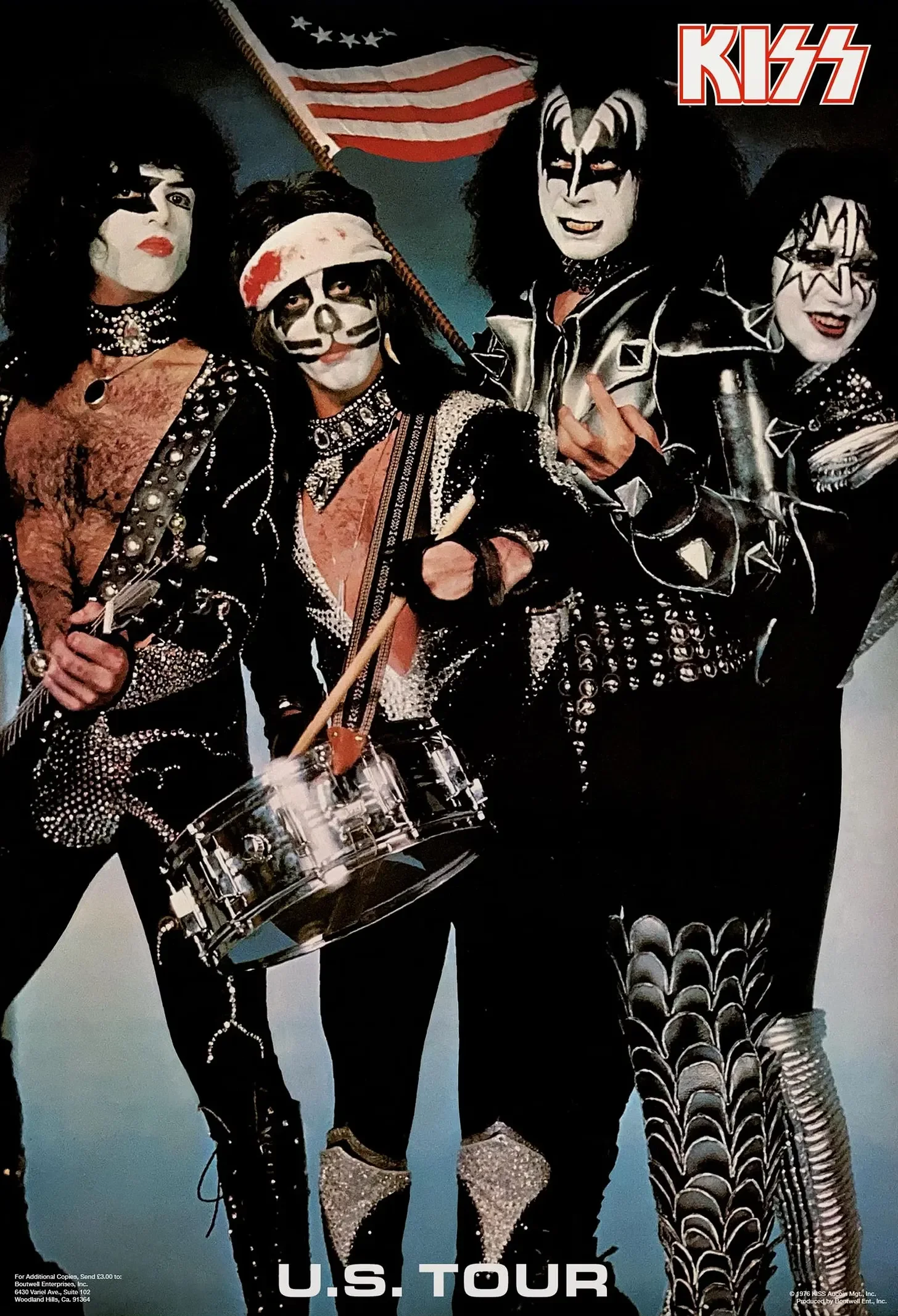
…featuring Peter and his oddly bandaged head. The pose parodies Archibald Willard’s famous patriotic painting The Spirit of ’76, showing Revolutionary musicians marching through battle beneath an American flag. In the original painting, the fife player has a bloodied bandage around his head; Peter has inherited that detail while carrying the marching drum. The other members didn't seem to get this memo….
NO CORRECT WAY UP
I can make a case for Destroyer as the grand Kiss album if I have to. I can also explain why the first record contains the blueprint, why Hotter Than Hell has the filth, why Alive! is the document that made everything possible and why Love Gun catches the original four at the precise moment victory starts developing a bit of a crack in the wall, but Rock and Roll Over is my favourite.
Favourite is not a court judgment. It is not assembled from production values, cultural importance and a weighted average of the songs. Favourite is the record you carried home on a bus and studied because you were not yet allowed to play it.
It is anticipation preserved in a very, very cool cardboard sleeve.
By Christmas morning in 1980, Kiss had already moved on. The world had moved on. Peter was leaving, the sound was changing and the four faces turning around that sleeve no longer represented a stable fact.
None of that mattered to me in the slightest. I was even largely unaware (or unwilling to see) that anything untoward was going on at all. Wrexham is a long way from New York, and when the needle finally dropped into I Want You, the album was new to me and that’s all that mattered… and should still be all that ever matters.
That distinction has almost disappeared. Now everything is available at the drop of a hat, very little has time to become an object of desire. We can hear an album the second curiosity occurs and abandon it before the bus reaches the next stop, but I had weeks to imagine what Rock and Roll Over sounded like and the miracle of Christmas is that it sounded better.
Fifty years after Kiss made it, and forty-six years after I sat guarding it on the journey home, I can still look at Doret’s cover and feel some part of that delay. The four faces turn. The title goes around and around. There is no top or bottom, no beginning or end and no indication that any of them are getting off.
There is only Rock n Roll. Over and over and over.
As for the box set? Take my money. As always, take my money. I’ll only spend it on something dumb like food or petrol.