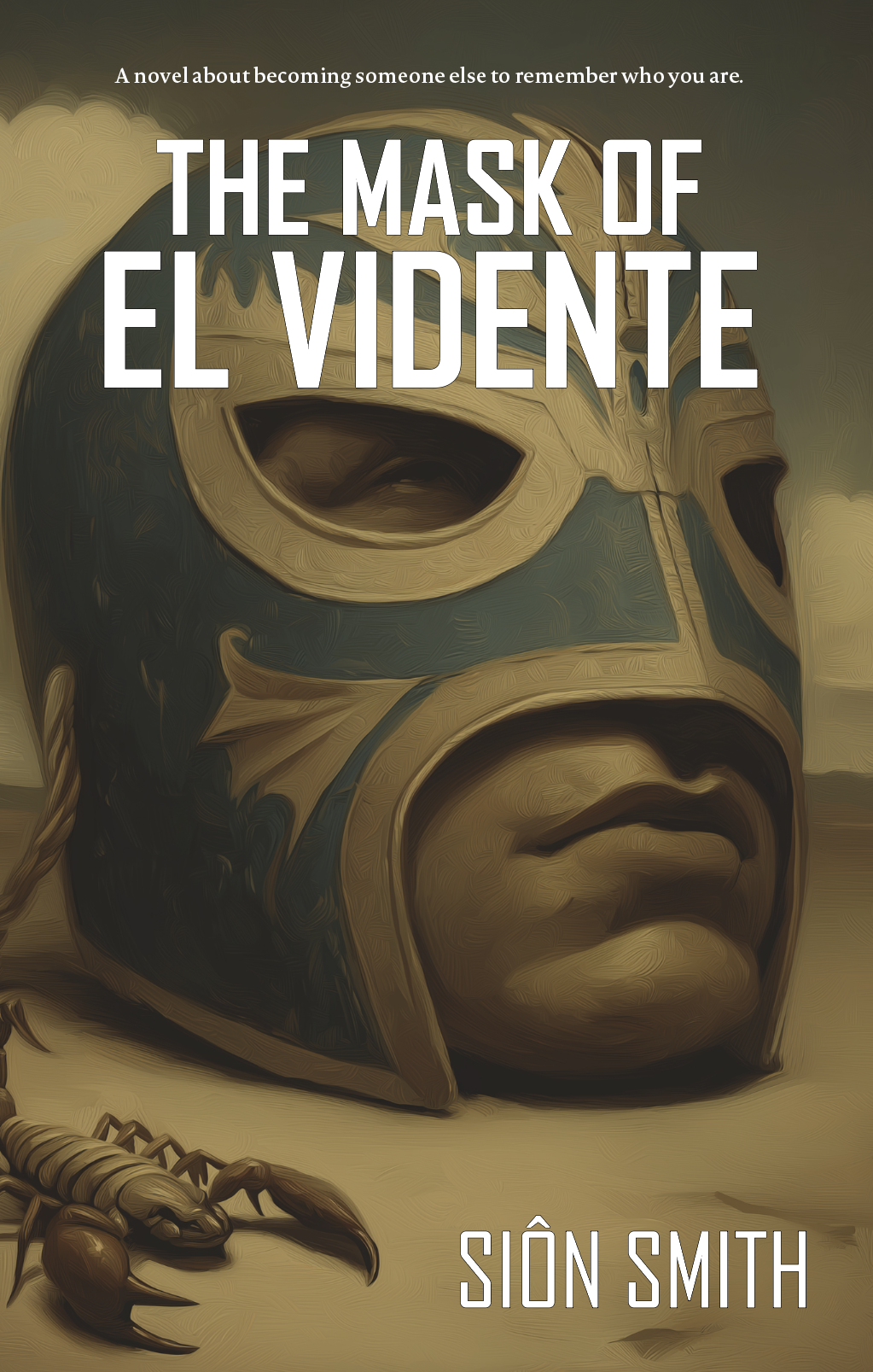
 Image 1 of 1
An extract:
Author’s Note
I wrote this book without thinking. It never occurred to me for one moment that I’d be skating on thin ice. Turns out, the legal estate of Carlos Castaneda don’t much like people dive-bombing the pool, and this could turn into a problem. But wait—double jeopardy—El Santo’s legal estate and representation aren’t too keen either.
Forty-odd thousand words in the trash? I couldn’t do it. There was a point when I changed all the names to make it “work,” but it simply didn’t. It lost its soul and being a book about souls, that was kind of important.
Thus, what you hold in your hands is genuinely one of ten copies that exist. Eleven if you include the one I’m hanging onto. It’s still technically against the law, but unless you are a) a mean-spirited lawyer, b) a descendant of anybody mentioned, or c) out to get me, I think it’ll be just fine. But wipe any ideas of an El Vidente convention from your mind. It’s not going to happen.
This book took me five years to finish. Not because it’s especially long or complicated, though at times it’s both, but because I kept having to try and write like somebody else.
Back to The Teachings of Don Juan and to A Separate Reality. To those mind-bending moments when Castaneda cracked open reality like an egg and whispered, ‘look again’ in my ear
I first discovered Castaneda as a teenager, and he blew my mind wide open. My original paperbacks still have pencil sketches in them and maps of my street marked with where I thought time portals might be. That’s how seriously I took it. I’m not the only one.
Alongside that, there was wrestling. Always wrestling.
My love of it goes all the way back to the mid-seventies: British wrestling on a Saturday afternoon, Japanese strong style, American drama, and most of all, the wild technicolour chaos of lucha libre. I’ve always been fascinated by the ritual of it. One man against another, yes, but something more than sport. Something theatrical. Mythic. Wrestlers don’t just fight. They become someone else entirely once they step into the ring.
Over the years I’ve watched thousands of wrestling matches and re-read Castaneda more times than is probably healthy. One of those things was a lot more fun than the other, but both led me to the same idea: that identity is whatever you choose to make it, masks are magic, and sometimes the most unreal things reveal the most about what’s real.
What you’re holding isn’t quite fact, and it isn’t quite fiction. It’s a ritual. A fable. A meditation on power, performance, and what happens when you surrender to transformation on purpose.
Put on the mask. Step into the ring. Let’s get it on…
Chapter 1: The Teaching Begins
I had been studying with don Juan Matus for three years when he first mentioned the warriors who fought in the squared circle of power. It was a humid evening in Sonora, and we were sitting outside his house watching the desert stars emerge from the dying light.
“There are men,” he said suddenly, breaking a silence that had lasted nearly an hour, “who understand the warrior’s way without ever walking in the desert or ingesting the sacred plants. They transform themselves nightly before crowds of thousands, and yet no one recognizes what they are witnessing.”
I assumed he was speaking metaphorically, as he often did. Don Juan’s teachings were filled with references to warriors and battles that I had learned to interpret as internal struggles for awareness and personal power.
“These warriors,” I asked, “are they sorcerers like yourself?”
Don Juan chuckled, a sound like wind through dry leaves. “They are something else entirely, Carlos. They are performers of the most ancient magic—the magic of becoming someone else completely, of inhabiting a separate reality so thoroughly that the audience becomes convinced of its truth.”
He stood and walked to the edge of his property, where the cultivated land met the endless expanse of the Sonoran Desert. “Tomorrow,” he said without turning around, “we will go to Mexico City. There is something you must see.”
The Arena México squatted in the heart of the city like some ancient temple dedicated to forgotten gods. Don Juan had somehow procured tickets to what the locals called lucha libre—freestyle wrestling—though I couldn’t understand why this spectacle was relevant to my apprenticeship in the Yaqui way of knowledge.
“Watch carefully,” don Juan instructed as we took our seats in the packed arena. “Do not watch with your ordinary vision. Watch with the eyes of a warrior who seeks to understand power.”
The first match featured a masked wrestler called El Santo—The Saint—facing an opponent known as El Demonio Negro, The Black Demon. As the two men circled each other in the ring, something extraordinary began to happen to my perception. Perhaps it was the combination of the crowd’s energy, the theatrical lighting, and the months of training in non-ordinary states of awareness, but I began to see the match not as a sporting event but as something far more profound.
“The masks,” don Juan whispered, though his voice somehow carried clearly despite the roar of the crowd, “are not costumes. They are faces of power. When a man puts on the mask, he stops being who he was and becomes what the mask represents.”
I watched El Santo execute a series of moves that seemed to defy the normal limitations of human anatomy. His body moved with a fluidity that suggested he had accessed some other understanding of physical possibility. When El Demonio Negro responded with his own impossible feats of strength and agility, I realized I was not watching two men pretending to fight, but two beings who had temporarily transcended their ordinary human limitations.
“The crowd provides the energy,” don Juan continued, his words somehow reaching me despite the chaos surrounding us. “Their belief, their emotional investment, their willingness to suspend what they think they know about what is possible—all of this creates a field of power that the warriors in the ring can use to accomplish extraordinary things.”
During the climax of the match, something happened that challenged everything I thought I knew about the nature of performance versus reality. El Santo, caught in what appeared to be an inescapable hold, seemed to literally dissolve and reform himself in a different position, escaping through what could only be described as a shift in the very fabric of space within the ring.
The crowd erupted, but I could see that only a few people had actually witnessed what had occurred. Most saw only the expected escape move, their rational minds editing the impossibility into something acceptable. But don Juan was nodding with satisfaction.
“Now you begin to understand,” he said as we left the arena. “These warriors have discovered how to use the collective dreaming of the audience to enter and manipulate what you would call non-ordinary reality. The ring becomes a space where different rules apply, where the impossible becomes not only possible but necessary.”